
If you need an aluminium part that takes real load, 7075 is the grade you reach for. With zinc as its primary alloying element, 7075-T6 delivers a strength comparable to many steels at roughly one third of the weight, which is why it dominates aircraft structure, performance automotive, and competitive sporting equipment. That strength comes with machining quirks, and 7075 aluminium machining services reward shops that respect them. This guide covers the grade, its cutting behaviour, and how to specify parts that hold tolerance.
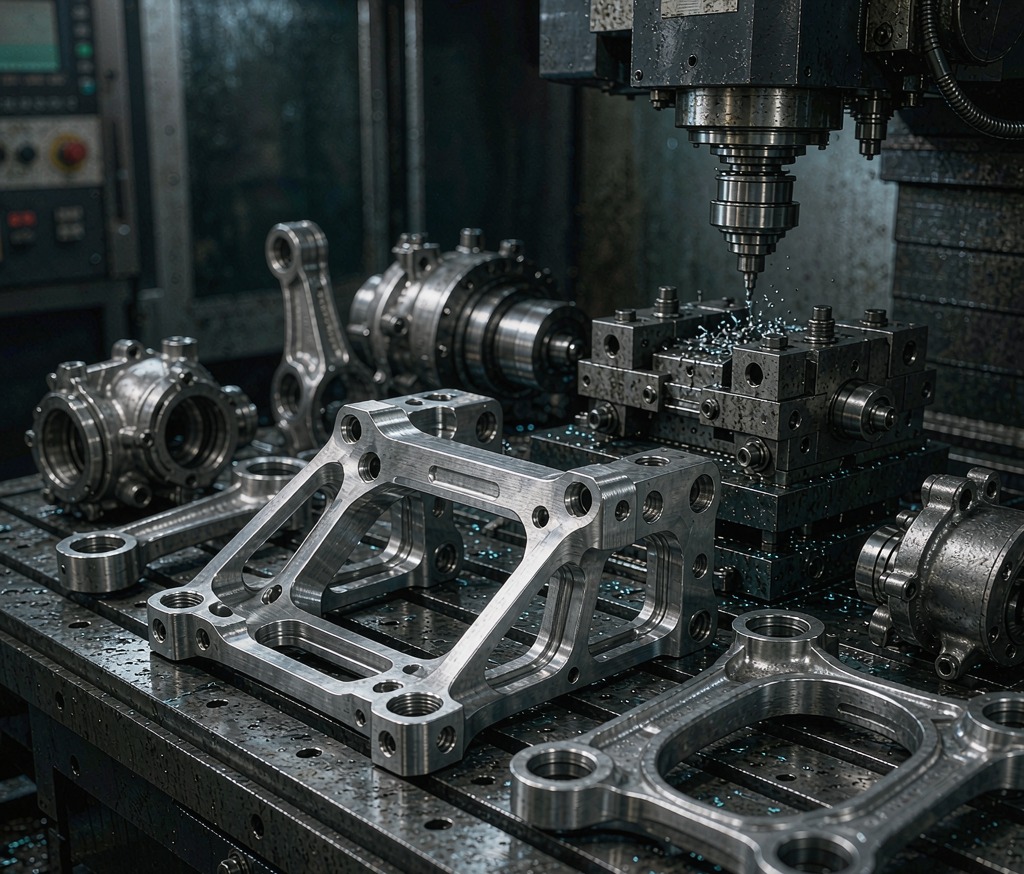
What 7075 Aluminium Is and Why It Is Used
7075 is a high-strength aluminium-zinc-magnesium-copper alloy. In the T6 temper it reaches roughly 570 MPa tensile strength, the highest of the common aerospace aluminiums. That strength-to-weight ratio is the entire reason it exists; where a 6061 part would be too weak or too thick, 7075 lets a designer shed mass without sacrificing load capacity. You will find it in wing spars, bracket arms, gearbox housings, and bicycle frames.
The trade-off is that 7075 sacrifices some corrosion resistance and weldability to buy that strength, and it is less formable than 6061. For machined parts those weaknesses matter little, because the part is cut from solid rather than welded or formed. Our aluminium CNC machining guide compares 7075 with 6061 and 2024 for different applications.
How 7075 Machines Compared With 6061
7075 cuts cleanly and at high speed like most aluminium, but it is gummier and more prone to built-up edge than the free-machining 6061, and it work-hardens slightly under light passes. The practical implication is to keep speeds high, feeds positive, and tooling sharp, exactly as you would for aluminium generally, but with a little more attention to edge condition. Chip evacuation matters because the gummy chips can reweld to the tool.
We rough and finish 7075 on rigid CNC milling and CNC turning centres, and on 5-axis CNC machining cells for the complex bracket and housing geometry that defines aerospace work. Deep features and precision holes go to CNC drilling with peck cycles, and thin-wall structures are roughed, stress-relieved where needed, then finish-cut with light passes to avoid spring-back.
Strength, Tolerances, and Thin Walls
7075 holds tight tolerances well because it is dimensionally stable in the T6 temper. The recurring problem is thin-wall deflection: a 1.5 mm rib will move under clamping and under the tool, then relax after release. The fix is rough machining, a stress-relief where the geometry warrants, and finish passes at low clamping force. For the most demanding airframe features we cut on 5-axis to hold interrelated datums in one setup.
Surface finish off a finish pass is typically Ra 0.8 micrometres or better, and bearing or sealing faces can be improved by surface grinding where flatness must be held to microns. Our machined aluminium parts guide covers the design rules that keep thin features stable through machining.
Surface Treatment and Corrosion Care
Because 7075 is less corrosion resistant than 6061, especially in the cut edges and near fasteners, a surface treatment is common on finished parts. Anodizing builds a hard, insulating oxide that also takes dye for identification, and a sealed Type II or Type III coating markedly slows corrosion. For structural aerospace parts, chromate conversion coating under primer remains common, and for appearance parts a powder coating over a pretreatment gives durable colour.
Where 7075 meets a dissimilar metal such as steel, galvanic corrosion can attack the aluminium, so isolation or coatings are designed in. Our 6061 aluminium machining page discusses the corrosion and coating choices when a design uses both grades, and our aluminium welding guide covers the limited cases where 7075 is joined rather than machined.
Heat Treatment and Temper Selection
7075 is usually supplied in T6 (peak aged) or T73 (overaged for better corrosion resistance at slightly lower strength). T6 is the default for maximum strength; T73 is chosen where stress-corrosion cracking resistance matters more than absolute strength, such as thick sections in corrosive service. The temper should appear on the drawing so the supplier machines the correct stock.
Our heat treatment capability supports ageing and stress-relief cycles, and we report hardness to confirm temper. For parts that will be finish-machined after heat treatment, ordering the correct pre-tempered stock avoids a distortion surprise at the final cut.
How to Specify 7075 Machined Parts
State the alloy and temper (7075-T6 or T73), the specification (AMS 4045 or equivalent), dimensional tolerances with notes on thin walls and datums, surface finish on sealing faces, and the required finish or coating. Request material certification where the part is flight or safety critical, and call out any penetrant inspection. Providing the temper up front lets the shop select stock and sequence heat treatment correctly, which protects both lead time and final tolerance.
Frequently Asked Questions
Is 7075 harder to machine than 6061?
Slightly. It is gummier with more built-up-edge tendency, so keep speeds high, feeds positive, and tooling sharp.
Which temper should I choose?
T6 for maximum strength; T73 where stress-corrosion cracking resistance matters more than peak strength.
Does 7075 need a coating?
Often yes, because it is less corrosion resistant than 6061; anodizing or conversion coating is common.
Can thin walls be held to tolerance?
Yes, with rough, stress-relief, and light finish passes plus low clamping force to prevent spring-back.
Do you provide material certification?
Yes, with hardness verification to confirm temper on flight-critical parts.
Should I worry about galvanic corrosion?
Only where 7075 bolts to steel; design in isolation or coating at the joint.
Ready to Start Your Project?
Get a build-ready quote on your custom metal parts within 24 hours. Share your drawing and our engineers will respond with process, lead time, and pricing.

