
Many steel and cast-iron parts fail at the surface—through wear, scuffing, or fatigue—long before the core is stressed. Selective surface hardening fixes exactly that, and laser hardening services do it with minimal distortion and no whole-part heat cycle. This guide explains when laser hardening beats the older methods and how to apply it to gears, ways, and tooling.
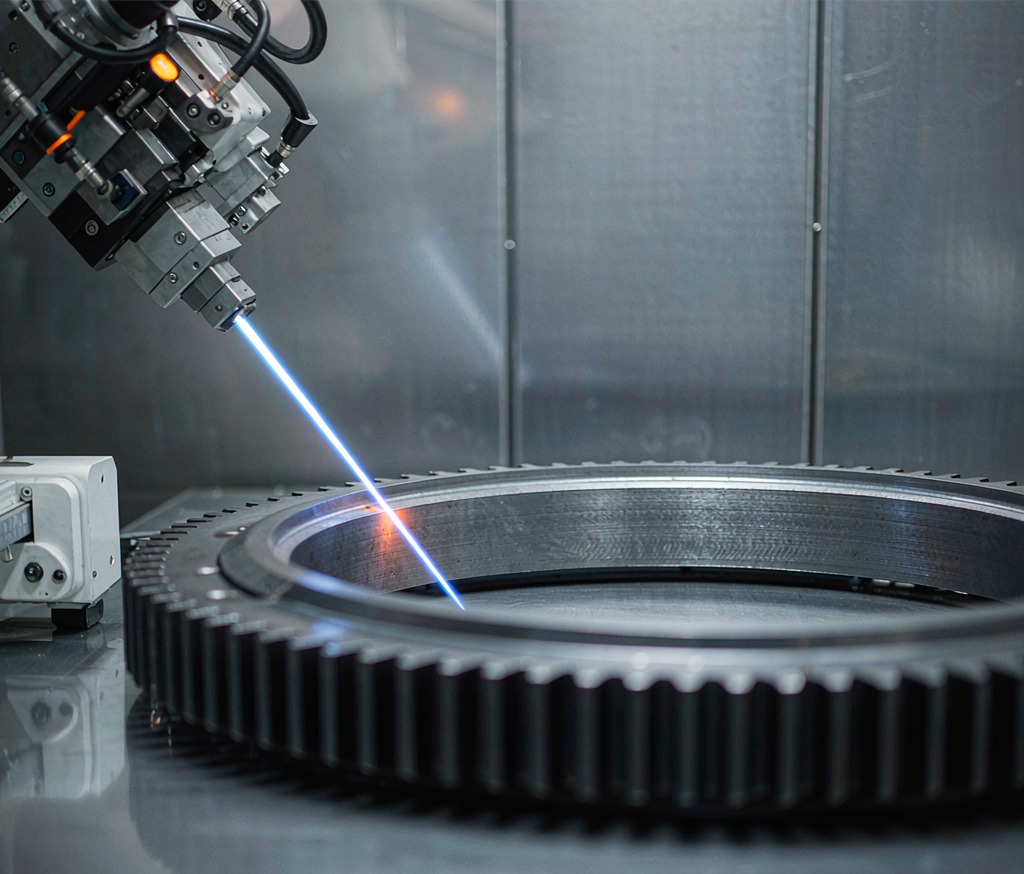
How Laser Hardening Works
A focused laser rapidly heats a thin surface layer above the transformation temperature while the mass of the part self-quenches it, forming martensite. Because only the skin is heated, distortion is tiny and post-machining is usually unnecessary. It is ideal for localized wear tracks on gears, ways, guides, and cutting edges where you want a hard face and a tough, ductile core behind it.
Laser vs Induction & Flame Hardening
Induction hardening is fast and economical but needs coil tooling sized to the part and can be hard on complex geometries. Flame hardening is flexible but less precise and hotter overall. Laser hardening targets exact zones without contact or masks, making it the best choice for selective, low-volume, or intricate patterns that would be impossible to coil or flame consistently.
Our induction hardening and flame hardening pages help you pick the right method when laser is not ideal, because the best process depends on volume, geometry, and available tooling.
Best Parts for Laser Hardening
Gear teeth, cam lobes, valve seats, slideways, and tool edges benefit most. The process also suits cast iron, where uniform through-hardening would crack it. After hardening, surfaces may be finished by surface grinding or CNC grinding only where the hardened band must be precise, since the as-hardened surface is often good enough for non-critical wear faces.
Process Control & QA
Key variables are power, scan speed, and beam shape, which set case depth and hardness profile. We verify with hardness mapping and, where needed, microsection. For parts needing both hardness and corrosion resistance, we can follow with chrome plating, black oxide, or DLC coating, layering the treatments to cover both wear and environment in one program.
Related Heat Treatments
Laser hardening is one tool in a broader heat treatment toolkit that includes carburizing, nitriding, and case hardening. We choose the route by required depth, distortion tolerance, and material. Laser is the right call when distortion is the enemy and only a portion of the part needs hardening.
When Not to Use Laser Hardening
If the entire part must be uniformly hard, furnace treatments are simpler. If the case must be very deep (several millimeters), induction or carburizing is faster. Laser shines for selective, thin, distortion-sensitive bands—think bearing races, spline tips, and mold cavities—where a furnace cycle would warp the whole component and force costly straightening.
Designing the Hardened Band
Because distortion is minimal, you can often harden a finish-machined part rather than hardening then grinding. We work from your print to define the hardened zone, its depth, and the hardness target, then validate on a sample before running the lot. For parts with multiple wear surfaces, we can scan distinct bands in a single setup, hardening a gear’s tooth flanks and root in one pass. When the hardened face must also resist corrosion, we follow with nickel plating or PVD coating on the same component, layering the treatments so the part survives both wear and environment in service.
Energy, Speed & Throughput
A common misconception is that laser hardening is slow. For selective bands it is often faster end-to-end than furnace heat treatment because there is no whole-part heat cycle, no quench tank, and no straightening step. The laser head traverses only the surfaces that need hardening, and the part stays cool enough to handle almost immediately. Throughput scales by adding laser stations or by indexing multiple parts under one head, so the process suits both low-volume tooling and higher-rate production of small wear components. Induction hardening still wins on pure cycle speed for simple, high-volume round parts, but laser is unmatched for geometry-specific, low-distortion work.
Typical Case Depth by Application
Case depth is matched to the duty rather than maximized. Light-wear guides and ways need only 0.3–0.5 mm; gear teeth and cam lobes that see rolling or sliding contact benefit from 0.6–1.0 mm; severe-duty tool edges may run to 1.2 mm or more where the core can support it. Going deeper does not always help—an overly deep case can spall under impact, so we balance depth against the load type. Hardness in the band typically reaches 55–65 HRC on medium-carbon steels, and we confirm with microhardness traverses. Where the application is corrosive as well as abrasive, we coordinate with surface treatment planning so the whole stack is specified together.
Getting Started With a Laser Hardening Program
The fastest path is to send us the print with the wear zones marked and the required hardness noted. We run a sample, measure the case, and report depth and hardness so you can validate before committing the lot. For existing parts that are wearing prematurely, we can often add a hardened band without redesigning the component, which is a low-risk way to extend field life. If you are weighing laser against nitriding or carburizing, we will lay out the distortion, depth, and cost trade-offs plainly so the decision is technical, not habitual.
Frequently Asked Questions
How deep can laser hardening go?
Typical case depths are 0.3–1.5 mm, controlled by laser parameters and scan strategy.
Does it distort the part?
Minimally—self-quenching and localized heating keep distortion far below furnace methods.
Which materials respond?
Medium-carbon and alloy steels and many cast irons. We confirm hardenability from your grade.
Is post-machining needed?
Usually no. Only surfaces that must be ground to a tolerance get finished afterward.
How does cost compare to induction?
Laser avoids coil tooling, so it wins for low volumes and complex patterns despite slower single-part cycles.
Ready to Start Your Project?
Get a build-ready quote on your custom metal parts within 24 hours. Share your drawing and our engineers will respond with process, lead time, and pricing.

