
H13 is the workhorse hot-work tool steel behind die-casting dies, forging tools, extrusion mandrels and plastic molds. It is also one of the more demanding steels to cut. Its vanadium-rich carbides wear tools fast, it work-hardens if you let the cutter rub, and it conducts heat poorly so the cutting zone runs hot. The good news: with the right sequence — rough in the annealed state, finish after hardening — H13 is very manageable. This guide covers the tools, parameters and habits our shop uses to machine H13 cleanly.
Why H13 Is Tricky to Machine
In the annealed condition (about 192–229 HB) H13 mills and turns like a tough alloy steel, but the hard chromium-vanadium carbides still abrade edges. After heat treatment it reaches 45–55 HRC, where only coated carbide, ceramics, PCBN or EDM make economic sense. The biggest beginner mistake is treating H13 like 4140 and pushing aggressive speeds — tool life collapses. Our broader CNC machining services cover the full range of steels we run, but H13 earns its own playbook.
Machine in the Annealed Condition First
Do the heavy stock removal while the block is soft. Leave a controlled allowance (often 0.3–0.5 mm) for distortion and final sizing after heat treatment. This single habit protects your tooling budget more than any speed tweak. When the part is near net shape, send it for heat treatment and finish only the features that matter. For general background, our steel fabrication team handles the surrounding build.
Cutting Tools That Survive
Use coated carbide with AlTiN or TiSiN for milling and turning. For hardened H13, switch to ceramics or PCBN on stable setups, or plan for EDM on sharp internal corners where milling cannot reach. Keep tool overhang short, avoid interrupted cuts where possible, and respect rigidity — H13 punishes chatter with rapid edge breakdown.
Speeds and Feeds by Hardness
For annealed H13, carbide end milling runs roughly 50–90 m/min with light chip loads; turning sits around 120–180 m/min in roughing. Once hardened to 48–52 HRC, drop milling to 140–200 m/min only with premium coated carbide and small depths of cut (0.2–0.6 mm), or move to hard turning with PCBN at 110–180 m/min. The principle from our CNC grinding work applies here too: finish passes want low feed and high speed.
Controlling Heat and Work Hardening
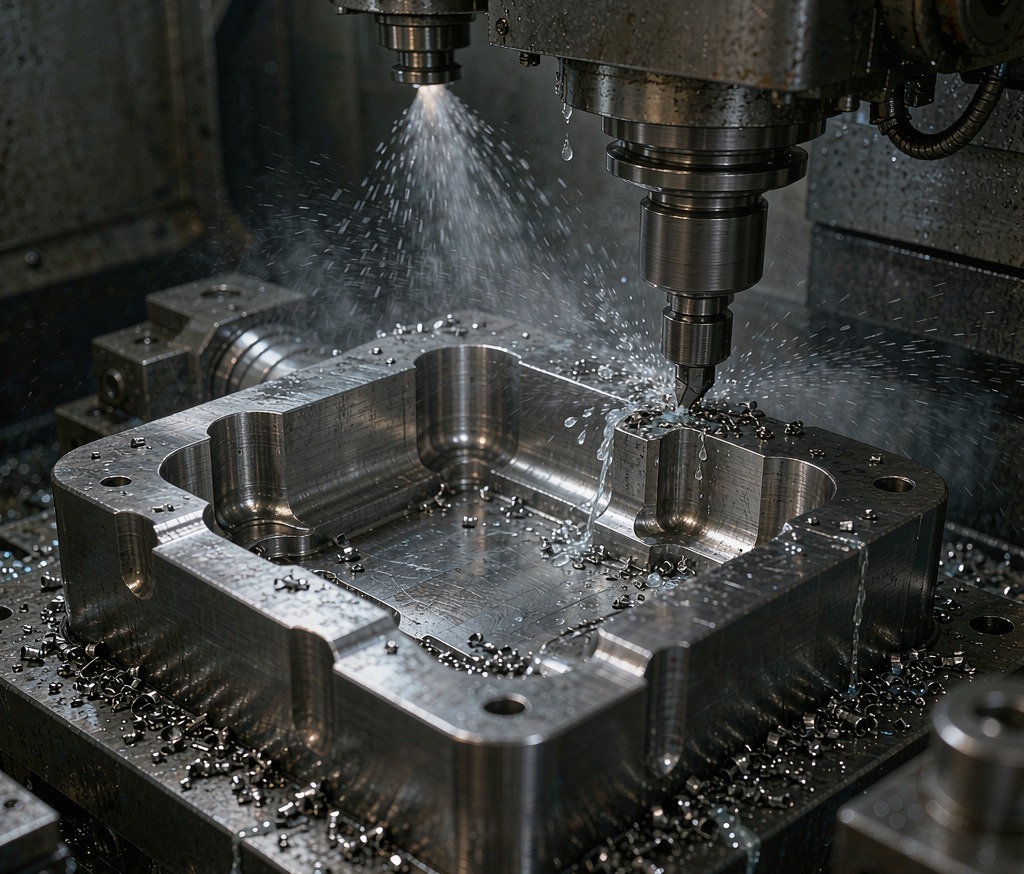
H13’s low thermal conductivity means heat piles up at the edge. Use high-pressure flood coolant (100–150 bar is ideal) or at least generous emulsion, and never let the tool rub — climb milling reduces work hardening by keeping the cutter engaged in fresh material. If you hear squeal or see a hardened skin, you have already lost ground; back off speed and confirm rigidity before continuing.
Hardened H13: Mill, Grind or EDM?
After hardening, choose by feature. Hard milling and PCBN turning handle most profiles. Grinding delivers the finest surface (Ra 0.4–0.8 µm) on flat and round references. EDM cleans up sharp corners and deep cavities in fully hardened steel without mechanical stress. Many dies combine all three. Our CNC turning cells finish cylindrical die details, while milling and grinding close the rest.
Frequently Asked Questions
Can H13 be machined after hardening? Yes, but only with hard-capable tools (coated carbide, ceramic, PCBN) or EDM/grinding. Heavy stock removal should happen before heat treatment.
What coolant works best? High-pressure flood emulsion; avoid oil-based coolant near the high cutting temperatures of H13. Dry or MQL suits hard milling with premium coatings.
Why does my tool wear out so fast? Usually work hardening from rubbing, insufficient coolant, or treating H13 like a free-cutting steel. Rough in the annealed state and keep the cutter cutting.
Is EDM needed for H13 dies? Not always, but EDM is the cleanest way to form sharp internal corners in hardened steel that milling cannot reach.
Ready to Start Your Project?
Get a build-ready quote on your custom metal parts within 24 hours. Share your drawing and our engineers will respond with process, lead time, and pricing.

