
D2 is the cold-work tool steel you reach for when a part has to resist abrasion: blanking dies, forming tools, shear blades, roll punches and wear plates. Its high carbon and roughly 12% chromium build a matrix full of hard carbides that give D2 outstanding wear resistance — and make it one of the more unpleasant steels to machine. With a machinability rating near 45–50% of a free-cutting steel, D2 demands conservative speeds, rigid setups and the right sequence. Here is how our tool room gets repeatable results.
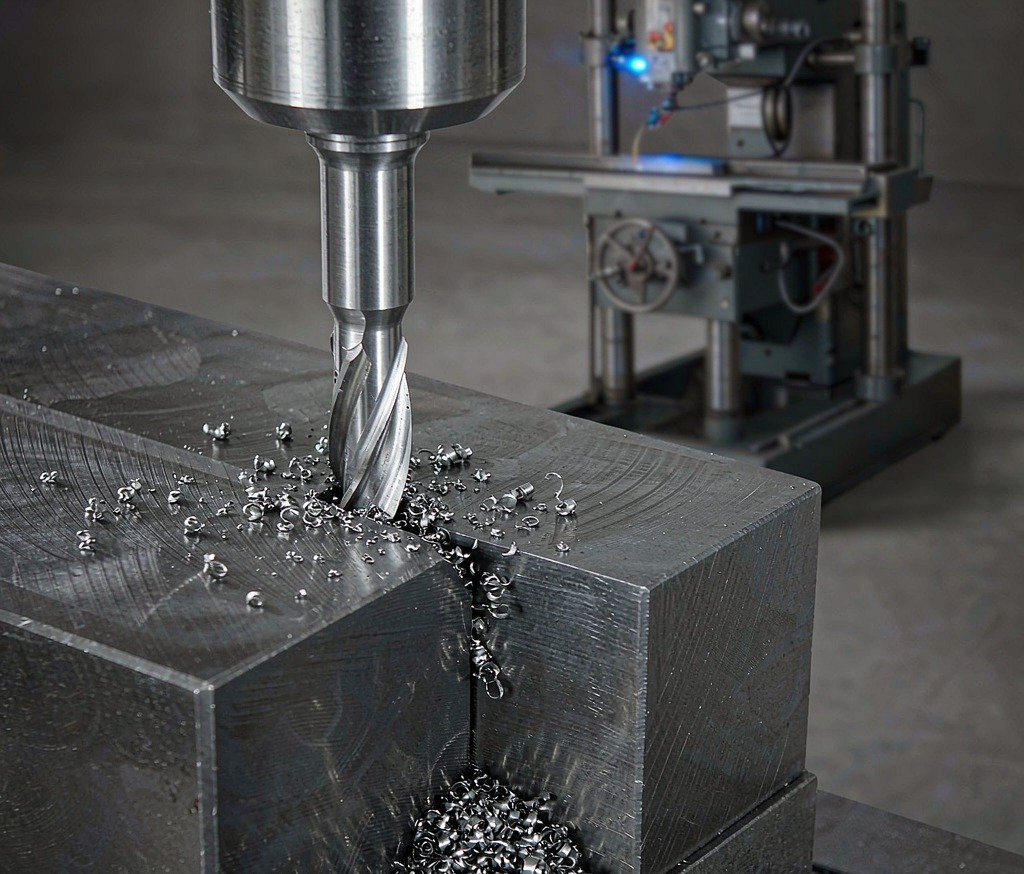
What Makes D2 Difficult
The chromium carbides that make D2 wear-resistant act like abrasive grit against the cutting edge. In the annealed state (about 200–250 HB) D2 can be turned, milled and drilled with coated carbide, but tool wear is faster than with ordinary alloy steel. After hardening to 58–60 HRC, conventional turning and milling are off the table; finishing moves to grinding, EDM or PCBN hard turning. This is the same family of challenge we see with heat-treated wear steels across the shop.
Rough Machine Before Heat Treatment
The single most important rule: remove the bulk of the stock while D2 is annealed. Leave only a small finish allowance for post-hardening correction. Hardening D2 first and then trying to machine it is slow, expensive and risks cracking. Most of our steel fabrication jobs that use D2 follow exactly this soft-rough-then-harden-then-finish order.
Tool and Coating Choices
Coated carbide (TiAlN or AlTiN) is the practical workhorse for annealed D2. Cermet can run faster than carbide in stable finishing, but it is fragile under interruption. For hardened D2, use PCBN or ceramic for finishing only — never for heavy stock removal. Keep tool overhang short and the setup rigid; D2 punishes chatter with edge chipping. Where geometry is too fine for milling, EDM finishes the feature in the hardened state.
Turning and Milling Parameters
For annealed D2 with coated carbide, rough turning runs around 200 sfm (≈60–65 m/min) climbing to 275–575 sfm for finishing as stability allows; feeds stay moderate (0.005–0.015 ipr). Milling prefers conservative speeds with low chip loads and short tool overhang. The governing idea parallels our CNC grinding discipline: control heat, avoid work hardening, and finish with light passes. If you are new to tight-tolerance cutting, our CNC machining services can advise on the right allowance.
Finishing Hardened D2
Post-hardening, grinding is the default for flats and rounds, delivering the fine surface a shear blade edge needs. EDM handles intricate cavities and sharp corners without mechanical stress. PCBN hard turning can replace light grinding on cylindrical features. Whichever route, watch for grinding burn and microcracks — control wheel choice, coolant and infeed.
Frequently Asked Questions
Can D2 be machined after hardening? Only by grinding, EDM or PCBN/ceramic hard turning. Conventional milling and drilling are impractical at 58–60 HRC.
Why does my tool wear out so fast on D2? The chromium carbides abrade the edge. Keep D2 annealed for roughing, use coated carbide or cermet, and avoid chatter.
Is D2 the same as 4140? No. D2 is a high-carbon, high-chromium cold-work steel built for wear; 4140 is a lower-alloy steel that machines far more freely.
How do I avoid cracks when finishing D2? Use plenty of coolant, control grinding parameters, and limit interrupted cuts on the hardened part.
Ready to Start Your Project?
Get a build-ready quote on your custom metal parts within 24 hours. Share your drawing and our engineers will respond with process, lead time, and pricing.

