
Every fabricated metal part eventually faces the same finishing question: powder coat it or paint it? Both protect the surface and add color, but they behave nothing alike in service. Powder coating bakes a dry polymer film into a thick, cross-linked barrier that shrugs off chips and corrosion for 15–25 years outdoors. Wet paint is thinner, cheaper up front, and far more flexible for custom colors and heat-sensitive parts. This comparison helps procurement and design teams pick the finish that actually fits the part’s life cycle.
How the Two Finishes Are Applied
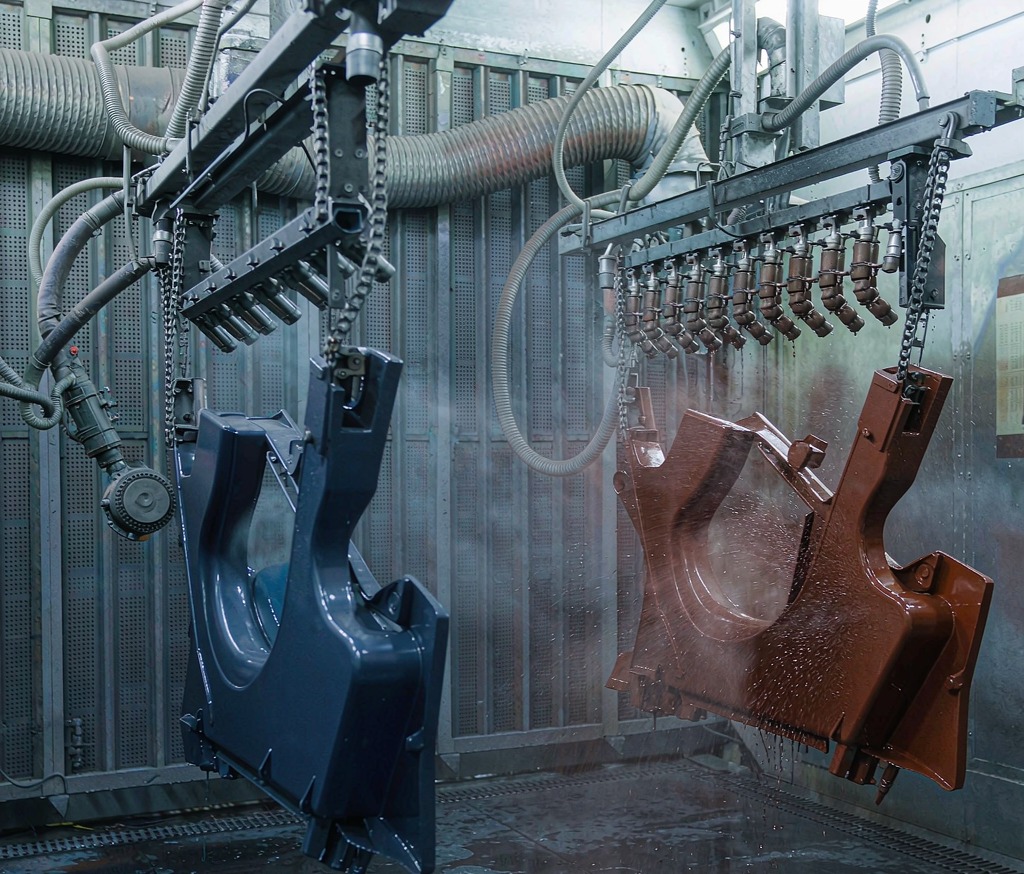
Powder coating electrostatically sprays a dry powder onto a grounded part, then cures it in an oven at 160–200 °C where the particles melt and chemically cross-link into one continuous film. Wet painting applies a liquid that dries or cures by evaporation, often in multiple coats with flash-off time between. The cross-linking is what gives powder its durability edge; paint mostly sits on the surface by adhesion.
Durability and Film Thickness
Powder lays down 60–120 microns (often 50–150 µm) in a single coat; wet paint is 25–50 microns per coat. That thicker, sealed barrier resists chipping, scratching and corrosion far better — polyester powder typically retains 90%+ gloss after 2,000 hours of salt spray, while painted systems retain 60–70%. For exterior structurals, enclosures and brackets, powder is the conservative choice. Our galvanizing and surface grinding prep steps often precede the final coat.
Cost and Lifecycle
Wet paint looks cheaper on the quote because there is no oven and little capital. But powder’s near-zero VOC, recyclable overspray (under 5% waste) and rare recoats usually win on whole-life cost, often 20–30% lower over the product’s life. For high-volume or repeat runs, powder is the efficient route; for one-offs and oversized items, wet paint stays competitive. The decision mirrors the one in our metal finishing overview.
Environmental and VOC Impact
Powder coating emits almost no VOCs and reclaims overspray, which simplifies compliance and lowers material cost. Solvent-based wet paint can emit 300–500 g/l of VOCs, requiring ventilation and controls. Waterborne paints close the gap but still trail powder on waste. Teams comparing finishes also read our sandblasting prep note — preparation quality drives final life more than the topcoat alone.
When Wet Paint Wins
Choose wet paint for heat-sensitive assemblies that cannot take a 200 °C cure, for exact custom color matching and specialty effects, for on-site field touch-ups, or for very fine, thin films. It is also the pragmatic answer for plastics and composites. Our surface treatment guidance covers when each finish is appropriate.
Frequently Asked Questions
Which lasts longer outdoors? Powder coating, commonly 15–25 years versus 2–5 years for standard paint, thanks to its thicker cross-linked film.
Is powder coating more expensive? Upfront yes; over the lifecycle usually no, because recoats are rare and material waste is low.
Can powder coat any color? A wide RAL and custom range, but exact match and special effects are easier with wet paint.
Can heat-sensitive parts be powder coated? Generally no — the 160–200 °C cure rules out many assemblies; use wet paint or a low-temp process.
Ready to Start Your Project?
Get a build-ready quote on your custom metal parts within 24 hours. Share your drawing and our engineers will respond with process, lead time, and pricing.

