
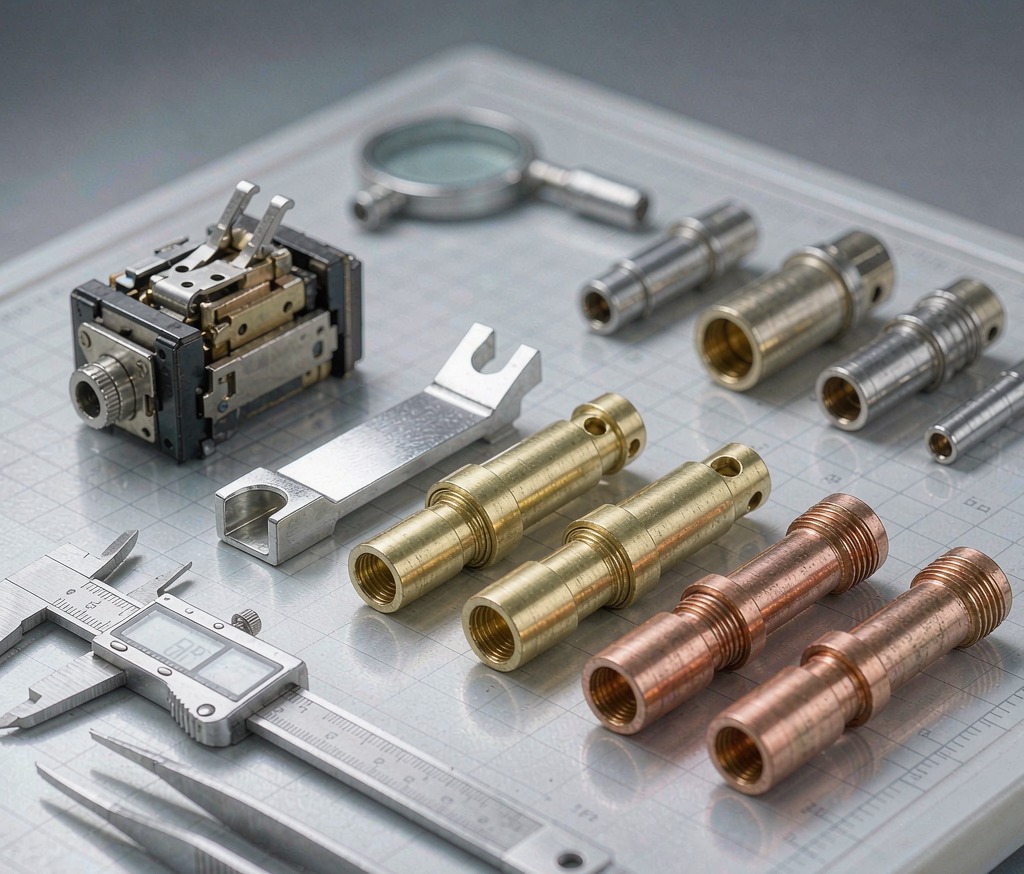
Electrical contacts look simple — a small shaped piece of conductive metal — but they are among the most performance-critical parts in a device. A contact that arcs, overheats or loses spring tension can fail an entire switch, relay or connector. Specifying the right base material, manufacturing route and plating is what separates a contact that lasts from one that nuisance-trips. This buyer’s guide covers the materials and methods our custom parts team uses for contacts and terminals.
Why Contacts Are Specialized Parts
A contact must carry current with low resistance, resist welding and erosion, and keep stable mechanical force over millions of cycles. That combination of electrical, thermal and mechanical demands is why contacts get their own alloys and processes rather than being treated as generic stamped bits. Our OEM services regularly build contacts into larger assemblies.
Choosing the Base Material
Copper and its alloys (CuCrZr, CuW, beryllium copper) dominate for conductivity and spring properties. Silver and silver-faced materials win for low contact resistance and arc resistance in switching duties. For cost-sensitive signals, tin-plated copper is common. Selection depends on current load, environment and cycle life — the same material discipline our wire EDM and machining cells apply to conductive parts. Compare with our copper machining notes for pure copper work.
Manufacturing: CNC and EDM
Precision contacts are produced by CNC milling and turning for larger or lower-volume shapes, and by EDM for fine, burr-free features and tight corners that stamping or milling cannot achieve cleanly. Progressive stamping handles high-volume thin contacts. The route tracks volume exactly as described in our electronics metal parts guide.
Plating and Surface Finish
Plating decides contact resistance and wear. Silver, gold and tin are common; gold for low-force signal contacts, silver for power, tin for cost-sensitive mating. A sound underplate (nickel) improves adhesion and corrosion resistance. Finish also affects insertion force and fretting corrosion, so plating is a spec item, not an afterthought. Our precision machined parts work often pairs a tight-tolerance base with a specified plate.
Specifying Contacts for Your Device
Give your supplier the current rating, voltage, duty cycle, mating force, environment and expected life. From that we select alloy, process and plating, then hold the critical dimensions by CNC or EDM. A clear spec prevents over-engineering and the field failures that come from guessing. Our custom fabrication team can fold contacts into a complete subassembly.
Frequently Asked Questions
Which material is best? It depends on load and environment — copper alloys for conductivity/spring, silver-faced for switching, gold plate for low-force signals.
How are fine contacts made? CNC and EDM for precision low-volume; progressive stamping for high-volume thin contacts.
Why plate the contact? Plating sets contact resistance, wear and corrosion behavior; the base metal alone is rarely enough.
What should I specify? Current, voltage, cycle life, force and environment — that drives alloy, process and plating choices.
Ready to Start Your Project?
Get a build-ready quote on your custom metal parts within 24 hours. Share your drawing and our engineers will respond with process, lead time, and pricing.

