
When a component must move electricity or heat, custom copper parts are often the only sensible choice. Copper combines the best electrical conductivity of any common engineering metal with excellent thermal performance and good corrosion resistance, which is why it shows up in busbars, connectors, heat sinks, and RF hardware. In this guide we cover the grades, the machining strategy that keeps copper burr-free, and the finishing steps that protect conductive surfaces in service. Start with our copper CNC machining services for the process overview.
Why Designers Specify Custom Copper Parts
Copper’s standout property is conductivity: C110 carries roughly 101% IACS, meaning almost no resistive loss in power paths. That makes it the default for busbars, terminal blocks, and grounding hardware. Its thermal conductivity is nearly as impressive, so CNC milling of copper heat sinks and cold plates is routine in power electronics. Where a part must be both a structural member and a current path, copper is hard to beat. Designers also value copper’s formability and its ability to be joined by brazing, soldering, or mechanical crimp, which keeps assembly flexible across product generations.
Common Copper Grades We Machine
The two workhorses are C101 (oxygen-free, high-purity) and C110 (electrolytic tough pitch). C101 is chosen for semiconductor and RF work where purity matters; C110 is the cost-effective general grade for connectors and busbars. Tellurium copper (C145) machines faster and is used for screw-machine parts, while beryllium copper (C17200) adds spring properties for contacts and springs. CNC turning produces pins, sleeves, and rings in all of these grades to tight tolerances. We help you pick the grade only after seeing the current, environment, and mechanical load the part must carry, because the wrong grade costs conductivity or machinability.
Machining Copper Without Burrs
Copper is gummy and tends to build up edge on the tool, so sharp carbide, positive rake, and generous coolant are the rule. The bigger quality risk is the micro-burr left inside holes and fluid channels, which can short a connector or block a cooling path. We deburr every copper part and can ultrasonically clean conductive hardware before shipment. For profiles that are hard to mill, EDM machining cuts complex copper electrodes and details without mechanical stress. Tight workholding and shallow climbs keep thin copper sections from tearing during the cut, preserving both dimension and surface.
Typical Custom Copper Parts We Make
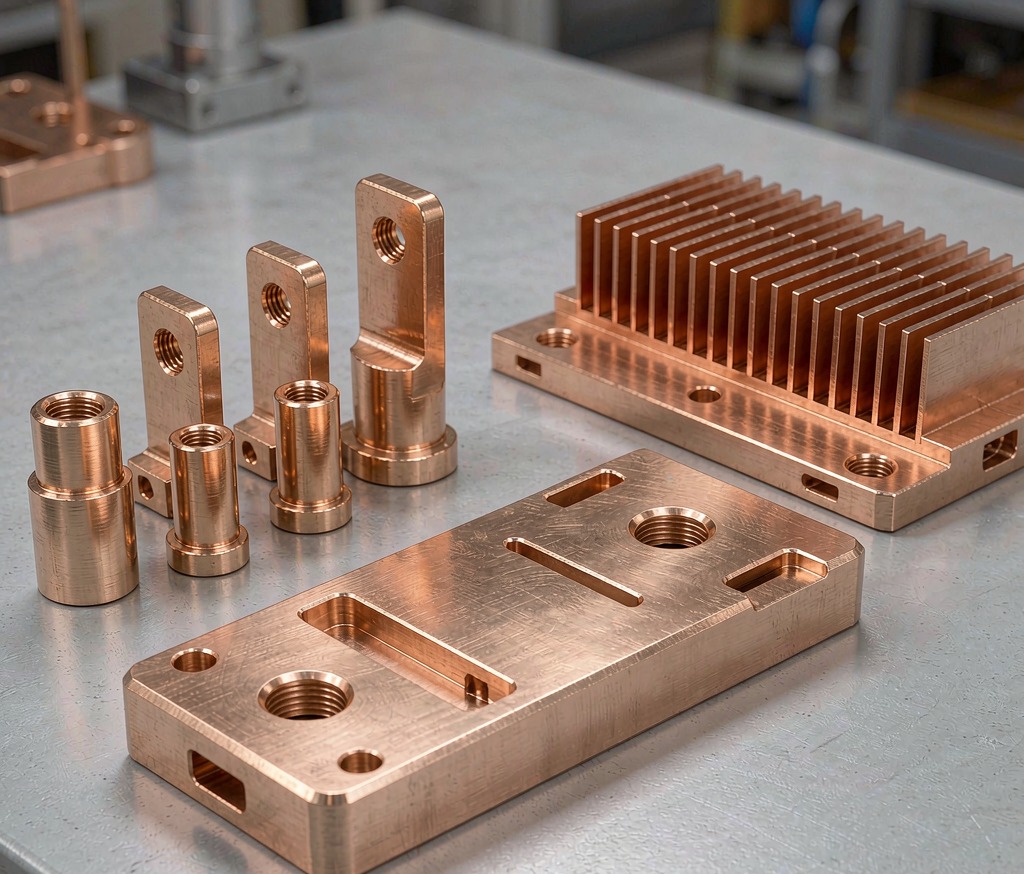
Busbars and power-distribution bars, electrical connectors and terminals, RF and waveguide components, heat sinks and cold plates, welding shanks, and contact pins are all common. Many of these start as bar or plate and are finished by milling, turning, drilling, and tapping. Where a longer or hollow section is needed, copper and brass extrusion supplies near-net shapes that we then machine to final feature. For high-volume conductive parts, extrusion plus machining is often the lowest-cost route to a clean, repeatable component with consistent grain and finish.
Surface Finishes for Copper
As-machined copper tarnishes, so functional parts usually get a finish. Nickel plating protects conductivity paths and adds wear resistance, tin plating improves solderability, and anodizing is uncommon on copper but possible on copper alloys for appearance. Electroless nickel is a frequent choice where uniform coverage on internal features matters. Our custom metal connectors guide covers mating and plating detail. A clean, documented finish avoids field failures that start as a tiny corrosion pit on a current path and grow under load.
Industries and Quality Control
Copper parts serve electrical distribution, electronics, telecom, semiconductor equipment, and new-energy systems such as EV charging. Because even a small burr can affect electrical performance, we inspect critical dimensions, verify material certs, and supply dimensional reports on request. Our custom metal terminals page explains the tolerance and certification expectations for conductive hardware. Traceability from bar stock to finished part is standard on programs that require it, which protects both performance and audit readiness.
Prototyping and Volume Production
Copper parts move smoothly from prototype to production because the process is tool-free. We machine evaluation samples from bar stock in days, then scale to repeat batches with the same setup and inspection plan. Sharing forecast volume helps us plan plating capacity and avoid a bottleneck at the finishing step. Our copper machining guide walks through the prototype-to-production path so your program stays on schedule from first article to full run without re-qualifying the process.
Drawing Tips for Copper Parts
State the exact copper grade, the required conductivity if applicable, and the plating specification (thickness, standard) on the drawing. Flag any internal channels or threaded holes that must be burr-free, and note whether the part is a current path or just structural. Sharing the assembly context helps us pick the right grade and finish the first time, avoiding a rework loop on conductive hardware. Include the mating connector or busbar interface so fit is verified before shipment and the part is accepted on first incoming inspection.
Frequently Asked Questions
Which copper grade should I choose?
Use C110 for general connectors and busbars, C101 where purity and RF performance matter, C145 for free-machining screw parts, and beryllium copper where spring properties are required.
Can copper parts be plated?
Yes. Nickel and tin plating are standard for corrosion resistance and solderability; electroless nickel gives uniform coverage on complex internal features.
How tight can copper tolerances get?
Critical features are routinely held to +/-0.01 mm depending on geometry and grade, with full dimensional inspection available on request.
Custom copper parts reward early engineering input: the right grade and finish decide whether a connector performs for years or fails in the field. Send us your drawing and we will machine and plate it to spec.
Ready to Start Your Project?
Get a build-ready quote on your custom metal parts within 24 hours. Share your drawing and our engineers will respond with process, lead time, and pricing.

