
Two processes dominate custom metal part production: powder metallurgy (PM) and CNC machining. Both make precise, repeatable parts, but they sit at opposite ends of the volume-and-cost curve. This guide compares them head to head so you can choose the route that fits your quantities, tolerances, and budget—and avoid paying for capability you do not need while still hitting the numbers your assembly demands.
How Powder Metallurgy Works
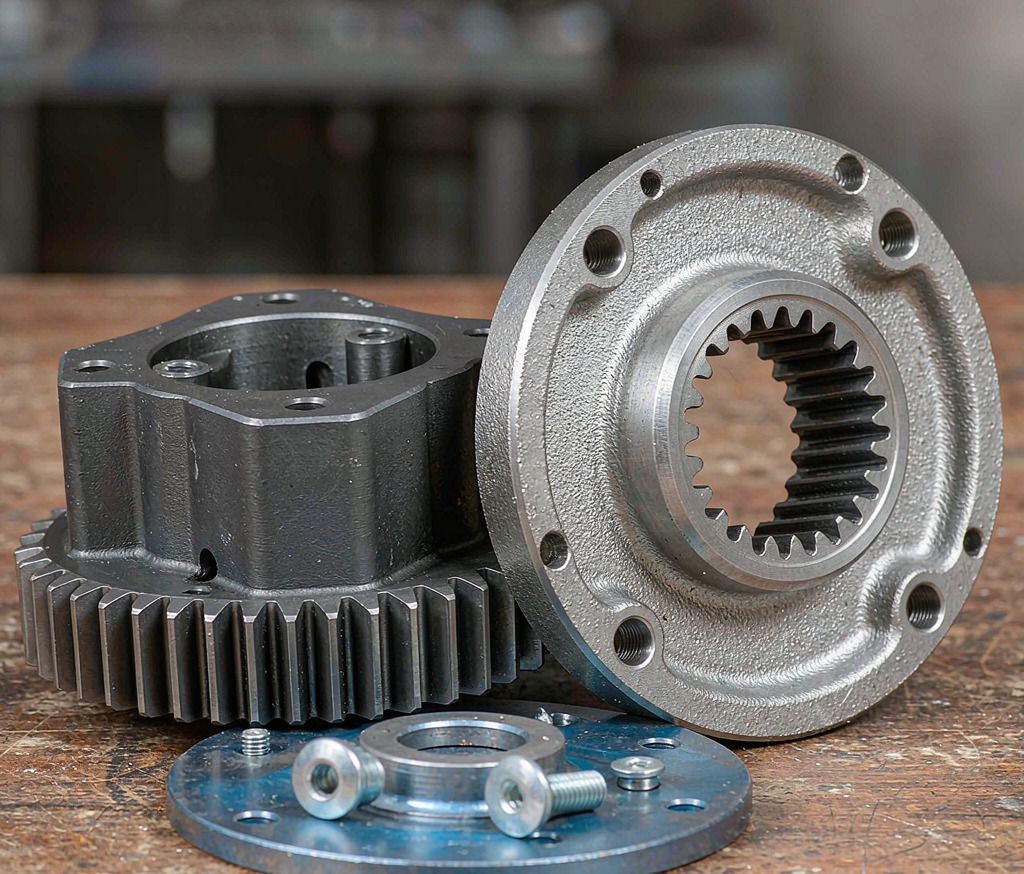
PM blends metal powder, compresses it in a die, then sinters it in a furnace to bond the particles. The result is a near-net-shape part with minimal scrap, because you add material where you want it rather than cutting it away. It excels at high volumes of small, complex pieces like sintered gears and bushings, and it can even build porosity for self-lubricating bearings that wick oil through the part body. Secondary sizing, coining, or machining cleans up critical features after sintering. Our powder metallurgy services page outlines the full capability set, from tooling to infiltration.
How CNC Machining Works
CNC machining removes material from a solid blank with cutters, holding very tight tolerances and any 3D shape without a die. CNC turning handles round parts on a lathe, and mill-turn centers combine both. It shines for prototypes, low volumes, and features PM cannot form—deep pockets, undercuts, very tight bores—but every chip is paid-for scrap, so material utilization is poor on large parts. Our CNC machining cost guide breaks down where the money goes so you can see setup versus cycle cost clearly.
Cost at Different Volumes
PM carries a die and setup cost up front, then runs parts cheaply—typically worth it above roughly 5,000–10,000 pieces depending on complexity. CNC has near-zero setup but higher per-part cost, so it wins below that band and for one-offs. This mirrors the broader PM vs casting discussion for even larger shapes, where the tooling threshold moves but the logic stays the same: spread fixed cost over enough units and the near-net process wins.
Tolerance and Density
CNC holds ±0.01 mm or better routinely on a good machine. PM lands around ±0.1 mm as-sintered, improvable with sizing, but density stays below wrought metal (typically 85–95%), which lowers fatigue strength and elongation. For sintered gears in low-stress drives that is fine; for structural links or safety parts it may not be, and you would specify a higher-density grade or add a machining pass on the critical surface.
Sustainability is an underrated tie-breaker. PM near-net shape wastes little powder—most overspray is reclaimed—while CNC can send the majority of a billet to scrap, which matters when material is expensive or supply is tight. For high-volume programs, that scrap difference shows up in both cost and carbon footprint. Pair PM with a sensible secondary plan and the process is hard to beat on total resource use, which is why sintered gears and similar parts dominate automotive and appliance runs.
Material and Geometry Limits
PM struggles with very thick sections, undercuts, and threads (those need secondary ops), and alloys are limited to what sinters cleanly—iron-copper, steel, stainless, and some bronzes. CNC has almost no geometry limit but wastes material on large parts and cannot easily build internal porosity. PM also blends materials—e.g., iron-copper or iron-nickel—that are hard to achieve any other way, and it can infuse oil or polymer after sintering for self-lubrication or bearing life.
Best Applications for Each
Choose PM for high-volume small parts: gears, bushings, sprockets, magnetic cores, and structural brackets where near-net shape pays. Choose CNC for low-volume prototypes, large or low-run parts, and anything needing tight tolerance or a non-PM alloy. When the part is a candidate for casting instead, our contract manufacturing overview helps frame the build and the quality system behind it.
Decision Checklist
Ask: what is my annual volume, required tolerance, alloy, and wall thickness? If volume is high and shape is PM-friendly, compact and sinter. If volume is low or features are complex, machine it. Hybrid programs often machine the first articles to prove the design, then tool PM for production once the geometry is frozen—getting the best of both without betting the launch on unproven tooling.
Secondary Operations and Hybrid Builds
Most PM parts are not sintered and done. Sizing, coining, and a light CNC pass clean up the features that matter, and heat treatment or steam treatment improves hardness and corrosion resistance. Resin or oil infiltration seals porosity for pressure-tight parts. A hybrid build—PM blank plus machined seat—captures PM’s material savings on the body while keeping a precision surface where it counts. Our powder metallurgy services and CNC cost guide show how these steps affect the per-part price so you can budget the whole process, not just the pressing.
When the part is too large or too low-volume for PM, CNC stays the fallback, and many programs keep a machined sibling in production for spares. The decision is rarely permanent: as volume climbs, a part born as a machined prototype is a strong candidate to migrate to compact-and-sinter, and the design should be reviewed for PM-friendliness before that move so the tooling investment pays off.
Frequently Asked Questions
Is PM stronger than machined steel? Typically no—lower density means lower fatigue strength, though it is plenty for many duties.
What volume makes PM worthwhile? Usually 5,000+ parts, where die cost amortizes across the run.
Can PM hold tight tolerances? About ±0.1 mm as-sintered; secondary sizing tightens it.
Which is faster to prototype? CNC—no tooling, parts in days.
Can PM make porous parts? Yes, controlled porosity is a signature PM advantage for bearings.
Ready to Start Your Project?
Get a build-ready quote on your custom metal parts within 24 hours. Share your drawing and our engineers will respond with process, lead time, and pricing.

