
Brake systems are safety-critical, and their metal components, including caliper brackets, rotors, pistons, and backing plates, must meet exacting standards for strength, dimensional accuracy, and consistency. Whether for automotive, motorsport, or industrial equipment, sourcing these parts demands a supplier who understands both metallurgy and tight-tolerance machining. This guide covers the key brake metal components and how they are made to be trusted.
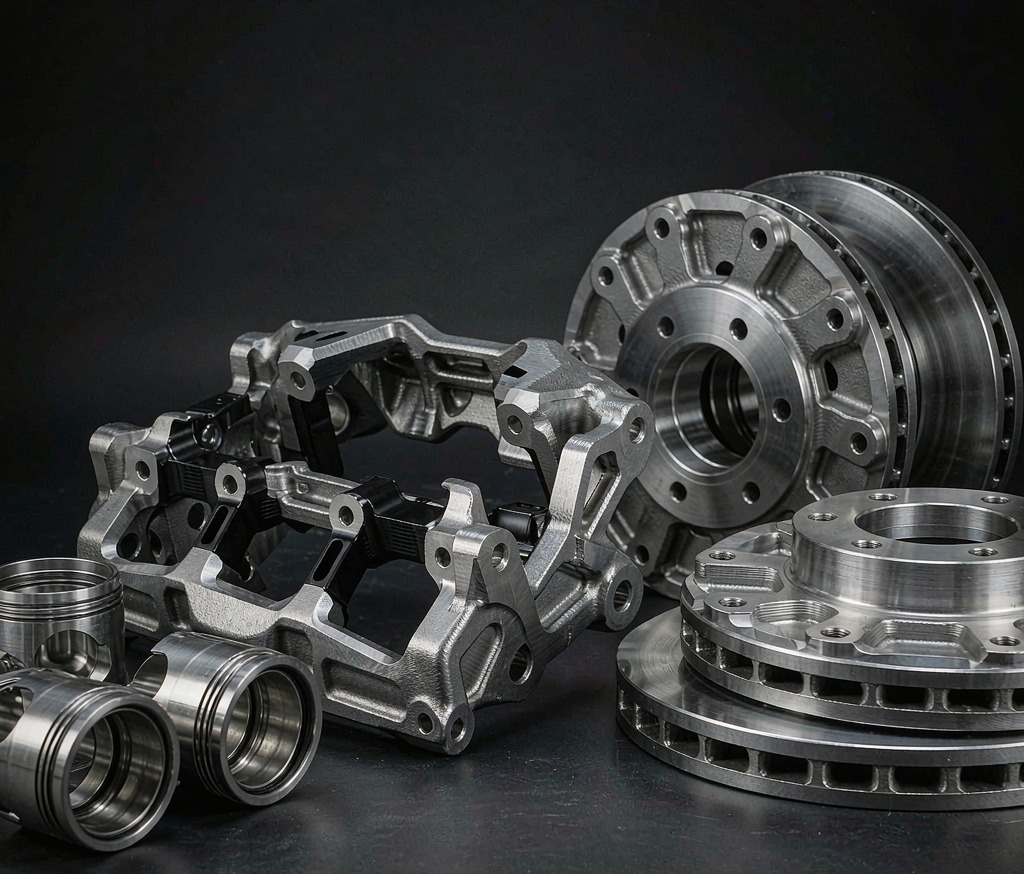
Caliper Brackets
Caliper brackets locate the caliper relative to the rotor and must resist high, repeating loads without deflection that would ruin pedal feel. They are typically machined from forged or cast blanks. Our CNC milling finishes the mounting faces and bores; heat treatment ensures the required strength and fatigue life. Context for vehicle programs is in our automotive metal parts guide, which frames the broader sourcing decision.
Rotors & Discs
Brake rotors need flat, balanced friction faces and precise hat dimensions so the wheel spins true. Turning and CNC grinding deliver the surface finish and runout control that prevents pulsation felt through the pedal. Our custom metal chassis article discusses related suspension and brake mounting structures that share the load path.
Pistons & Housings
Brake pistons require smooth, hard surfaces and tight diameters to seal fluid without weeping. Turning plus finishing, sometimes with anodizing or plating, meets wear and corrosion needs across the service life. Cast housings are supported by our die casting services, which produce the complex shapes caliper bodies often require at production volume.
Backing Plates & Hardware
Backing plates and shims locate friction material and damp noise that would otherwise annoy the driver. Stamped or machined steel with consistent thickness is key to quiet operation. Shaft and linkage elements nearby are covered in our precision shaft manufacturing guide, which shares the same discipline of tight tolerance and verified runout.
Materials & Process Chain
Cast iron and carbon steel dominate rotors and brackets; aluminum appears in caliper bodies for weight savings where temperature permits. The process chain, from casting or forging through machining, heat treatment, and finish, must be controlled end to end for the consistency that safety-critical parts demand. A single out-of-spec step can compromise the whole assembly’s performance under hard braking.
Noise, Vibration & Harshness
Brake noise is a leading warranty complaint, and metal backing plates plus shims are where much of the damping happens. Consistent plate thickness and clean interfaces reduce the squeal that frustrates drivers. Specifying these parts with the same rigor as the rotor itself pays off in customer satisfaction, because the perception of quality is often set by the absence of annoying sound.
Validation & Field Reliability
Before a brake component goes into production, validate it through rig and vehicle testing that mirrors real duty cycles, including heat and corrosion exposure. A supplier who can provide first-article data and supports your validation with sample parts shortens the path to release. Treat the component set as one system so that bracket, rotor, and piston perform together under hard, repeated stops.
Working With Your Supplier Early
Brake parts reward early collaboration because the components must perform as a system under hard, repeated stops. Bring the manufacturer in while the bracket, rotor, and piston are still being defined so interfaces, tolerances, and heat paths are optimized together. A supplier who develops the set can validate fit and balance before production, removing the risk that individually acceptable parts combine into a noisy or underperforming brake.
Documentation & Traceability
For safety-critical braking hardware, batch-level material certificates, hardness records, and first-article data are non-negotiable. Keep them with the component file so any field concern can be traced to its source immediately. A supplier who delivers this discipline as standard, rather than as a special request, is the partner you want on a part where failure is not an option and warranty cost is brutal.
Getting Started on Your Brake Parts
Start by sharing the duty cycle, the required rating, and the interfaces between bracket, rotor, and piston so the supplier can engineer the set as one. Request first-article data on bore, flatness, and hardness, and keep those records with the component file. With a partner who holds casting, machining, and heat-treat under one roof, you get brake hardware that is quiet, safe, and repeatable across every batch and every vehicle that depends on it.
Quality & Traceability
Brake parts call for full material traceability, first-article inspection, and documented process control at every stage. Specify the standard, such as an OEM or aftermarket specification, and the required testing up front so the supplier quotes to the right rigor. Insist on batch-level records that let a suspect lot be traced and isolated quickly if a field issue ever arises.
Choosing a Brake Parts Supplier
Prioritize a shop with casting or forging, machining, and heat-treat under one roof, because handoffs between vendors are where consistency leaks away. Review their inspection capability and ask for sample first-article data on the features that matter most, such as bore, flatness, and hardness after treatment, before releasing production volume.
Frequently Asked Questions
Which material for performance rotors?
Cast iron for cost and bite; carbon-ceramic or drilled and slotted designs for heat management in sport and track use where temperatures soar.
Why heat-treat caliper brackets?
To reach the yield and fatigue strength needed under repeated braking loads without permanent deflection that would alter caliper position.
How are pistons finished?
Hard anodizing or plating provides the wear and corrosion resistance required on the sealing surface exposed to brake fluid.
Can a supplier do brackets and rotors together?
Yes. A shop with casting, machining, and heat-treat capabilities can supply matched brake component sets that assemble correctly the first time.
Ready to Start Your Project?
Get a build-ready quote on your custom metal parts within 24 hours. Share your drawing and our engineers will respond with process, lead time, and pricing.

