
A custom metal chassis is the skeleton a product is built on. It locates the electronics, carries the loads, sheds the heat, and protects the internals, so its stiffness, grounding, and fit decide whether assembly is smooth or a fight. This article explains how a chassis moves from flat sheet and tube to a rigid, finished frame, and which choices keep cost and weight down. We link the work to robotic welding and laser cutting that build it.
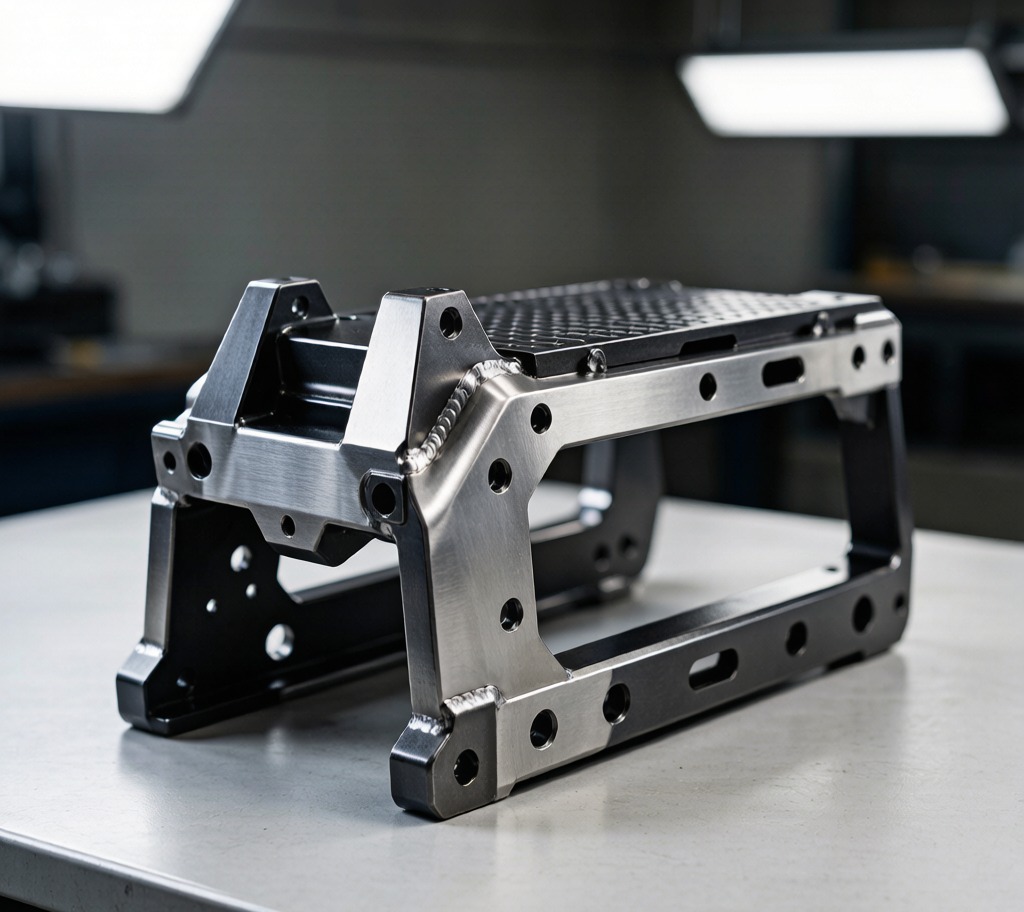
From Flat Sheet to Rigid Frame
Most chassis start as laser-cut panels and bent flanges that interlock into a box, then are welded or riveted at the corners. Laser cutting the joints precisely means the corners close without gaps, which makes welding clean and fast.
CNC bending forms the returns that give the side walls their height; get the bend order right and the panel nests into the next one without forcing.
Welding the Corners
For a sealed, strong frame we weld with TIG for thin aluminum and robotic MIG for repeatable steel seams. Robotic welding keeps the bead consistent across a run, which matters when dozens of chassis must measure the same.
Our welded assemblies guide covers weld symbol reading and how we control distortion with tack sequences and fixtures.
Stiffness Without Mass
Stiffness comes from geometry more than thickness. Beads, flanges, and a top cover turn a flexible tray into a rigid chassis. Add a rib where the heaviest component sits rather than thickening the whole wall.
Where the chassis must also be a heat path, use aluminum and plan the thermal interface before the shape is frozen; a steel fabrication review can suggest a hybrid steel-and-aluminum build.
Mounting Rails and Inserts
Internal rails locate boards and drives. Capture them with welds or rivets and add threaded inserts so service screws bite into metal, not sheet. Plan the rail spacing from the standard you are mounting, like DIN or rack units.
Tapped holes in thin material strip easily; specify inserts wherever a screw will be removed more than once.
Finish, Grounding, and EMI
A conductive powder coat with grounding tabs keeps the chassis as an EMI shield; a non-conductive coat needs a separate ground strap. Decide EMI needs before finishing, because the choice changes the coating and the hardware.
For enclosures that must stay sealed and labeled, fold the work into a custom metal enclosure program so the lid, gasket, and markings are coordinated.
Tolerances and Flatness
Hold panel cut to +/-0.1 mm and welded frame squareness to about 0.5 mm per 300 mm. Warp from welding is controlled by fixture and sequence, not by over-specifying the cut. Define the datum from the surface the boards mount to.
Confirm the assembled flatness with a first-article check so the lid seats without a gap on the first unit built.
Quality Control and Inspection
Every custom metal chassis order begins with a first-article inspection. We measure the critical dimensions on a CMM or dedicated gauge and compare them to your drawing before any volume runs start. Only after you approve the report do we release production, so the first batch is already at spec rather than a learning curve.
For functional features we add targeted checks, from thread gauging on fasteners to flatness, squareness, and runout on frames and shafts, and we keep a traveller with the lot so a later question can be traced to the exact machine setup. That discipline is what keeps reject rates low across repeat orders.
We also confirm the finish and any marking against the approved sample, because a good dimension on a badly finished part still fails on the line. Surface, color, and legend are inspected alongside the numbers so what ships matches what you signed off.
Lead Time and How to Request a Quote
Quoting custom metal chassis is fast when you send a drawing, a sample, or even a marked sketch with the key dimensions called out. We return a price with DFM feedback, a recommended material, and a realistic lead time, usually within one business day, so you can plan the build without waiting on a vendor.
Prototype quantities run in days; production batches scale with material and finish, and we can hold your drawing on file for fixed-schedule replenishment so you keep stock without tying up cash in inventory you do not need yet. Tell us annual volume and we set the cadence.
If you are unsure of the best process, ask. A short call before release often saves a costly rework, and we would rather steer you to the cheaper capable route than quote the one you assumed. The goal is a part that assembles first time at the right cost.
Common Specification Mistakes to Avoid
The most expensive mistake on custom metal chassis is over-tightening tolerances the assembly never needed. Every step past process capability adds cost per feature, so call out only the dimensions that locate or seal another part and leave the rest to standard commercial limits. Tight where it counts, loose where it does not.
The second mistake is forgetting the datum and the environment. State which surface everything is measured from, and name the service condition, indoor, outdoor, washdown, or vacuum, so the material and finish are chosen once and not reworked after a field failure.
The third is treating finish as an afterthought. Plating, anodize, or coating change dimensions and must be in the tolerance stack from the start. Tell us the final coated size you need and we will machine to suit, instead of discovering the coat pushed you out of spec at the end.
Frequently Asked Questions
Welded or riveted chassis?
Welded for sealed rigid frames; riveted for serviceable or mixed-material builds.
Aluminum or steel chassis?
Aluminum for weight and EMI; steel for stiffness per dollar and weld simplicity.
Can you add EMI shielding?
Yes, conductive coat plus grounding tabs, or a separate shield can, planned before finishing.
Do you mount internal rails?
We add welded or riveted rails with threaded inserts to your spacing.
How is flatness controlled?
By weld fixture and sequence; we first-article check assembled squareness.
Ready to Start Your Custom Part?
Send us your drawing or sample and get a competitive quote with DFM feedback, lead time, and material recommendation within one business day.

