
Custom metal stamping turns flat sheet and strip into finished parts at the lowest per-piece cost of any metal process — once the tooling exists. From brackets and terminals to clips, washers, and shields, stamping powers automotive, electronics, and appliance supply chains. This guide explains progressive dies, realistic tolerances, and exactly when stamping beats CNC machining so you can choose the right route and avoid paying for tooling you do not need.
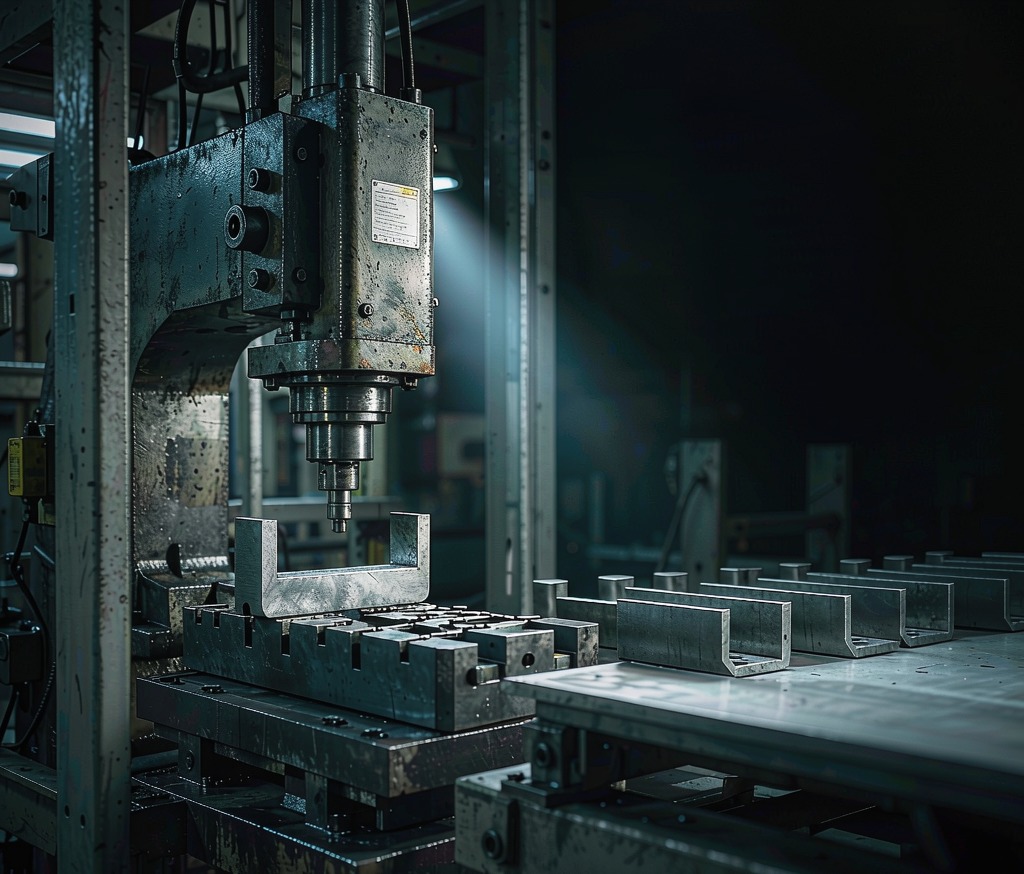
How Custom Metal Stamping Works
Stamping uses a press and a shaped steel die to cut, punch, bend, draw, or emboss sheet metal in a single stroke. Once the die exists, the press repeats that stroke millions of times, which is why it is the cheapest way to make parts in volume. We run CNC punching for lower volumes and fiber laser cutting for complex profiles, then form and finish in one workflow. For structural parts, welded assemblies combine stamped elements into rigid sub-assemblies.
Progressive, Compound, and Four-Slide Dies
A progressive die feeds a coil strip through stations that cut, pierce, and form in sequence; a finished part drops out the end at hundreds of strokes per minute. A compound die blanks the outline and pierces holes in one stroke for exceptional flatness — ideal for terminals, washers, and shims. Four-slide machines form multiple bends from four directions in a single pass, eliminating secondary assembly. Tooling is a one-time capital cost amortized across the program, not a per-order charge.
When Stamping Beats Machining
Stamping’s economics are dominated by tooling cost and annual volume. Below roughly 1,000 pieces per year, soft tooling or laser-cut blanks with forming are usually cheaper. Above 50,000 pieces per year, a hardened progressive die delivers the lowest total cost. A CNC bending service can replace tooling entirely for low-volume brackets. Our precision metal stamping overview breaks down tolerance bands and die types by part shape.
Tolerances and Design Rules
Standard stamping holds flat features to about ±0.05 mm (DIN 6930-2 fine); critical features on qualified programs reach ±0.01 mm. Follow simple rules: hole-to-edge and hole-to-hole spacing ≥ 1.5× material thickness, internal radii ≥ 0.5× thickness, and specify burr direction. Avoid sharp internal corners that crack punches. Progressive die stamping design guidance covers strip layout and die protection sensors that keep dimensions stable over long runs.
Frequently Asked Questions
How much does stamping tooling cost?
Simple four-slide tooling starts around $10,000; complex 10+ station progressive dies with in-die tapping and sensors reach $75,000. The die is amortized across the program.
What materials can be stamped?
Aluminum, carbon and stainless steel, brass, bronze, and copper, up to about 6 mm thick. We stock certified coil and sheet with EN 10204 3.1 certificates.
Can you add threads and finish?
Yes. Tapping, riveting, plating, coating, and assembly are available in one workflow, with PPAP documentation for automotive programs.
Is stamping right for prototypes?
For under ~1,000 parts/year, soft tooling or laser-cut-and-formed blanks are usually more economical than hard dies.
Cost, Lead Time, and Tooling
Stamping economics turn on two numbers: tooling cost and annual volume. A simple four-slide tool may run $10,000–$25,000 and build in 4–6 weeks; a 10+ station progressive die with in-die tapping and sensors can reach $75,000 and 10–16 weeks. That die is a one-time capital cost amortized across the program, not a per-order charge. Below about 1,000 pieces per year, soft tooling or laser-cut-and-formed blanks are usually cheaper; above 50,000 pieces per year, a hardened progressive die wins. Lead time also depends on secondary operations — tapping, plating, and assembly add steps. Our CNC punching and fiber laser cutting bridges let you start production in days while hard tooling is built, so a volume ramp never stalls. Ask for a break-even analysis that shows the cost crossover point for each option before you commit, and confirm die maintenance and storage are included so dimensions stay stable across the whole production run.
Request a Stamping Quote
Send a 2D drawing plus 3D model, material grade and thickness, annual volume, tolerances, and any finish or secondary operations. We will recommend soft, bridge, or hard tooling and provide a break-even analysis so you see the cost crossover point.
Ready to Start Your Project?
Get a build-ready quote on your custom metal parts within 24 hours. Share your drawing and our engineers will respond with process, lead time, and pricing.

