
Brass casting services deliver the warm finish, machinability, and corrosion resistance that plumbing, electrical, and decorative hardware buyers depend on. Brass flows beautifully into detail-rich molds, which is why it remains the default for valves, fittings, gears, and instrument bodies. Huaxiao casts brass by sand, investment, and die methods and finishes it with in-house turning so you get a pressure-tight, good-looking component in one shipment. Here is how to pick the process and alloy for your part, and what to specify so the foundry delivers a finished component rather than a rough blank.
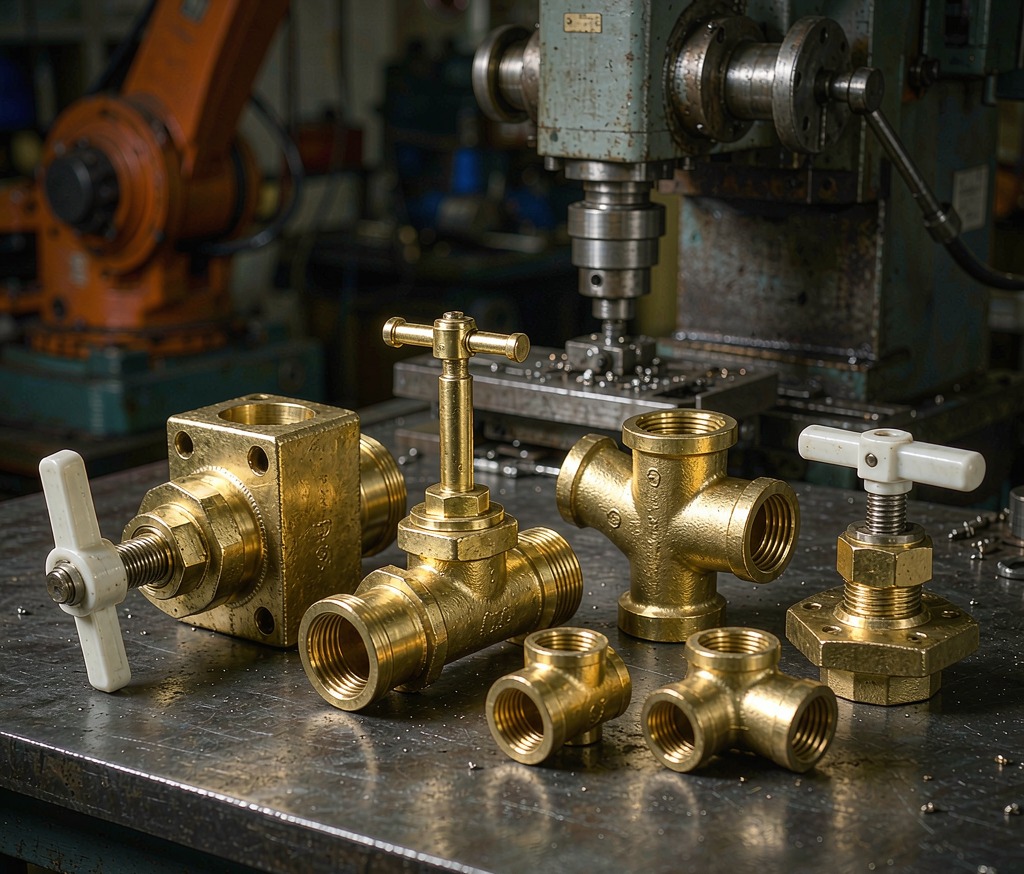
Brass Casting Processes Compared
Sand casting is the flexible, low-tooling choice for brass: ideal for valves and one-off fittings. Investment casting (lost-wax) captures fine detail and thin sections with a smooth as-cast surface, perfect for decorative and instrument parts. Die casting suits high-volume, repeatable brass components where cycle time and tolerance dominate.
Process choice tracks volume and detail. A short prototype run belongs in sand; a production run of thousands of identical inserts belongs in die casting. Investment casting bridges detail and volume.
Lead time follows the same logic: sand can pour within days of a pattern, while die casting waits on a hardened steel die that may take weeks. We help customers phase the program, prototyping in sand and migrating to die casting only once the design is frozen and volume justifies the tool.
Best Alloys for Brass Castings (C360, C385, C844)
Free-cutting alloys like C360 and C385 machine superbly and are common for threaded fittings and connectors. C844 (a red brass) offers higher corrosion resistance for buried or marine service. Lead-free grades (C69300, C87850) meet potable-water regulations in many markets.
We help specify an alloy that satisfies both your machining plan and your compliance needs, since some regions ban leaded brass in drinking-water contact.
Color is also alloy-dependent: high-zinc yellow brasses look different from the reddish tone of low-zinc or silicon brasses. If the part is decorative and visible, we match the alloy to the intended finish and confirm it on a sample before the full run.
Applications: Valves, Fittings, Hardware
Brass castings dominate valve bodies, unions, hose fittings, musical hardware, and gears. Its natural antimicrobial and low-friction surface makes it a favorite where hands or fluids touch metal. For turned follow-up work we run CNC turning to hold thread and seat geometry.
Related background on copper-family work appears in our copper casting guide and the brass CNC machining article.
Because brass seals well against itself and against softer metals, it is the instinctive choice for compression and flare fittings. When a joint must hold pressure and be disassembled repeatedly, a cast brass body with a machined seat outperforms most alternatives.
Dimensional Tolerance and Surface Finish
Investment casting holds the finest detail and thinnest walls; sand casting needs more draft and heavier sections but costs little to set up. As-cast surfaces are usually good enough for decorative parts, while sealing faces are CNC milled flat after casting.
Specify the finish you need up front: a chrome-look valve and a buried fitting have very different surface requirements, and that changes the process.
Pressure-bearing features deserve special attention: we machine the seat and verify it with a test mandrel rather than trusting the as-cast surface. That small step prevents the slow weep that ruins a valve reputation in the field.
Machining Brass After Casting
Brass is one of the easiest metals to machine, so secondary operations are cheap and fast. We turn threads, bore seats, and drill ports, then deburr and polish. When a part is better made by removal than by pouring, our sand casting services and die casting services pages explain the boundary.
Because brass chips cleanly, tight tolerances on threads and tapers are routine even on cast blanks.
Thread class matters: a decorative knob can live with a loose 6g, but a pressure fitting needs a controlled class and a clean root radius. We cut threads to the callout and gauge them, so the fitting seats the first time instead of galling on assembly.
Choosing a Brass Casting Supplier
Ask for alloy certification, pressure-test capability, and in-house machining. A supplier that only pours will hand you a rough blank; one that finishes parts closes the loop and owns the tolerance. Confirm RoHS or lead-free compliance if the part touches potable water.
Lead time, minimum order, and tooling cost should be quoted together so you can compare true landed cost, not just piece price.
Finally, ask who owns the datum. When casting and machining happen in different buildings, the tolerance chain fractures; when they share one quality system, the part that arrives is the part you approved. That integration is the quiet advantage of a full-service brass caster.
Frequently Asked Questions
Is brass casting lead-free compliant?
Yes, using alloys such as C69300 or C87850 for potable-water and compliant markets; leaded grades are available for non-contact use.
Which process is best for fine detail?
Investment (lost-wax) casting captures the sharpest detail and thinnest sections of the three methods.
Can brass castings be pressure tested?
Yes, we hydro-test valve and fitting bodies to customer-spec pressures and report results.
What finish can I get on brass?
As-cast, polished, nickel or chrome plated, or lacquered for tarnish protection on decorative parts.
What is the typical lead time?
Sand casting prototypes in days to weeks; die casting tooling adds several weeks before production.
Do you machine threads in-house?
Yes, CNC turning holds thread class and seat geometry directly on the cast blank.
Ready to Start Your Project?
Get a build-ready quote on your custom metal parts within 24 hours. Share your drawing and our engineers will respond with process, lead time, and pricing.

