
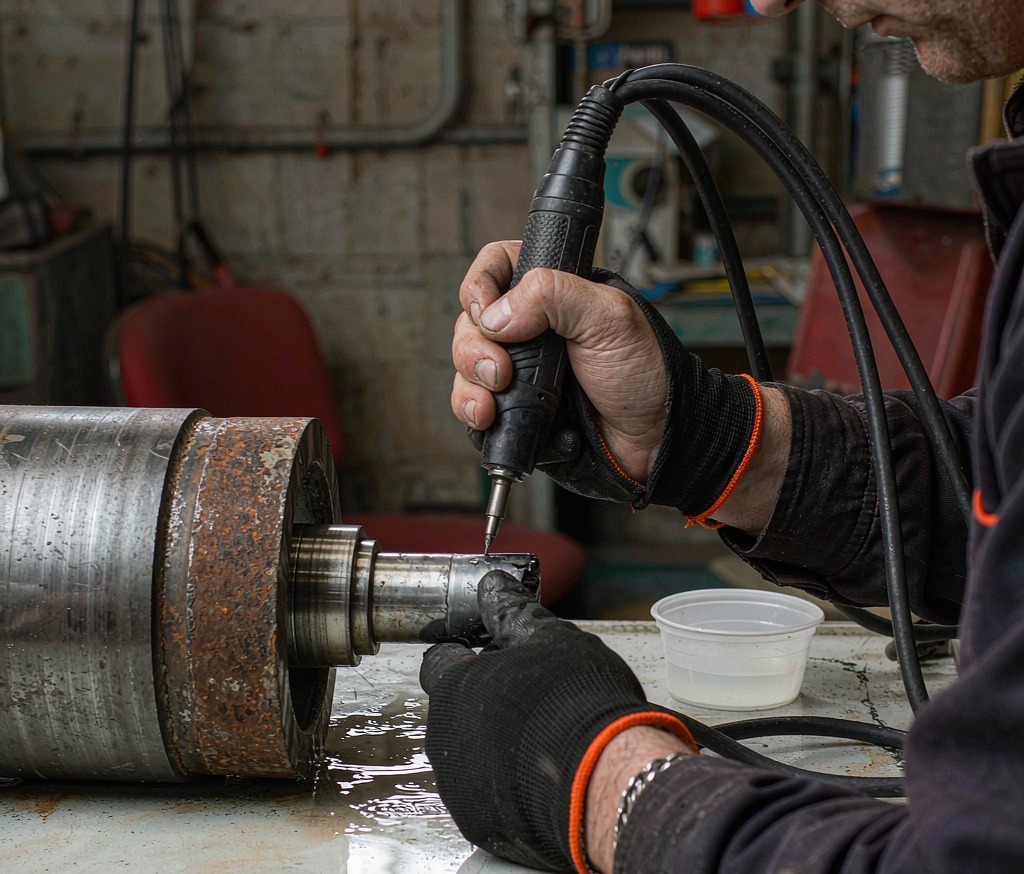
Brush plating services, also called selective or tactile plating, deposit metal onto a precise local area using a handheld anode wrapped in an absorbent pad that is saturated with plating solution and touched to the part while current flows. There is no tank, no immersion of the whole component, and no masking of everything except a tiny spot. That makes brush plating the go-to method for repairing worn diameters, building up undersized features, and applying engineered coatings in the field or on very large parts that will not fit a bath. When only a narrow band needs nickel plating, dragging the whole shaft through a line makes no sense.
What Is Brush Plating
Brush plating is an electroplating process where the anode is the stylus and the cathode is the part. The operator dips or floods the pad with the appropriate solution, presses it against the cleaned area, and a direct current drives metal ions from the solution onto the surface. Moving the stylus builds thickness progressively, and layers can be switched, strike, build, or topcoat, in the same session. Because there is no tank, the part stays cool and the surrounding area stays dry, so heat-sensitive or already-assembled components can be plated locally.
How Selective Plating Works
The work begins with surface prep: clean, degrease, and often abrade or etch the exact spot so the deposit bonds. A strike layer, a thin adherent undercoat, goes down first, then the build layer adds thickness, and a final layer can tune hardness, color, or corrosion behavior. The operator controls thickness by time, current, and pad speed, and verifies it with a micrometer or eddy-current gauge. For corrosion resistance on aluminum structures, local anodizing is a different process, but brush plating fills the niche where only a small zone needs a dense metal skin.
Common Deposit Metals
Nickel is the workhorse for wear and corrosion resistance and for building up diameters. Hard chrome, applied selectively, restores sliding surfaces, though tank chrome plating remains common for full parts. Copper is used for build-up and as a strike, silver and gold for conductivity and contact surfaces, and cadmium historically for aerospace, now often replaced by zinc plating or other alternatives. Electroless nickel is a related tank process for uniform, phosphorus-containing deposits; brush plating wins when only a local zone is involved.
Repair and Buildup Uses
The most common brush plating job is saving a costly component: a bearing journal worn 0.05 mm undersize, a seal land scored in service, a hydraulic rod with a pit. Rather than scrap the part or strip and replate the whole thing, the operator plates just the damaged band and machines it back to size. It is also used in manufacturing to add a local hard or conductive layer on an otherwise finished part, avoiding a separate tank cycle for the whole component.
Advantages Over Tank Plating
Portability is the headline benefit: the equipment is small enough to take to a job site, a ship, or a power plant. There is minimal masking because you only treat the area you touch. The part stays dimensionally stable since it is never immersed or heated in a bath, which matters for assemblies with seals, bearings, or polymers already fitted. For a broader view of immersed processes, our metal plating guide compares tank and line methods.
Design and Prep Notes
Brush plating demands a clean, active surface, so design for access: the operator must reach the zone with the stylus and keep the surrounding area dry. Sharp transitions are fine, but heavily contaminated or porous substrates need extra prep. Specify the target thickness and tolerance clearly, and note any area that must stay uncoated. Because deposits are localized, plan the final machining allowance so the built-up area can be ground or turned back to the drawing.
Typical Applications
Aircraft landing-gear journals, turbine shafts, hydraulic rods, and mold cavities are routine brush plating work, as are electrical contact surfaces and antique restoration. It is the repair technician’s tool for returning a precision diameter to spec without a full strip. Pairing it with other finishes, such as PVD coating for thin functional topcoats elsewhere on the part, lets one supplier handle both local and full-surface needs.
Frequently Asked Questions
What is brush plating used for?
Mainly local repair and buildup of worn diameters, plus applying conductive or corrosion-resistant layers to a specific zone without tank immersion.
Is brush plating as good as tank plating?
For localized work it is better because it avoids masking and heating the whole part; for full coverage, tank plating is more practical.
Which metals can be brush plated?
Nickel, chrome, copper, silver, gold, cadmium alternatives, and more, chosen by the function of the local area.
Can brush plating be done on site?
Yes. The equipment is portable, which is why it is widely used for field repair of shafts and journals.
How is thickness controlled?
By current, time, and stylus speed, then checked with a micrometer or eddy-current gauge on the spot.
Does the part need machining after?
Often yes: the built-up area is machined back to the drawing once the target thickness is reached.
Brush plating is one of several ways to put a functional metal layer where you need it. Our electroless nickel plating and nickel plating guides explain the immersed equivalents and when each fits.
Ready to Start Your Project?
Get a build-ready quote on your custom metal parts within 24 hours. Share your drawing and our engineers will respond with process, lead time, and pricing.

