
Custom metal cranks turn rotation into linear or offset motion in everything from hand pumps and actuators to exercise gear and small engines. A crank must be strong, balanced, and dimensionally true or it wobbles, wears, and fails. Huaxiao machines cranks from billet on 5-axis centers and can forge high-load versions, then heat-treats and finishes them to print. This guide covers how to get a crank that runs true, from the first prototype to a hardened production part.
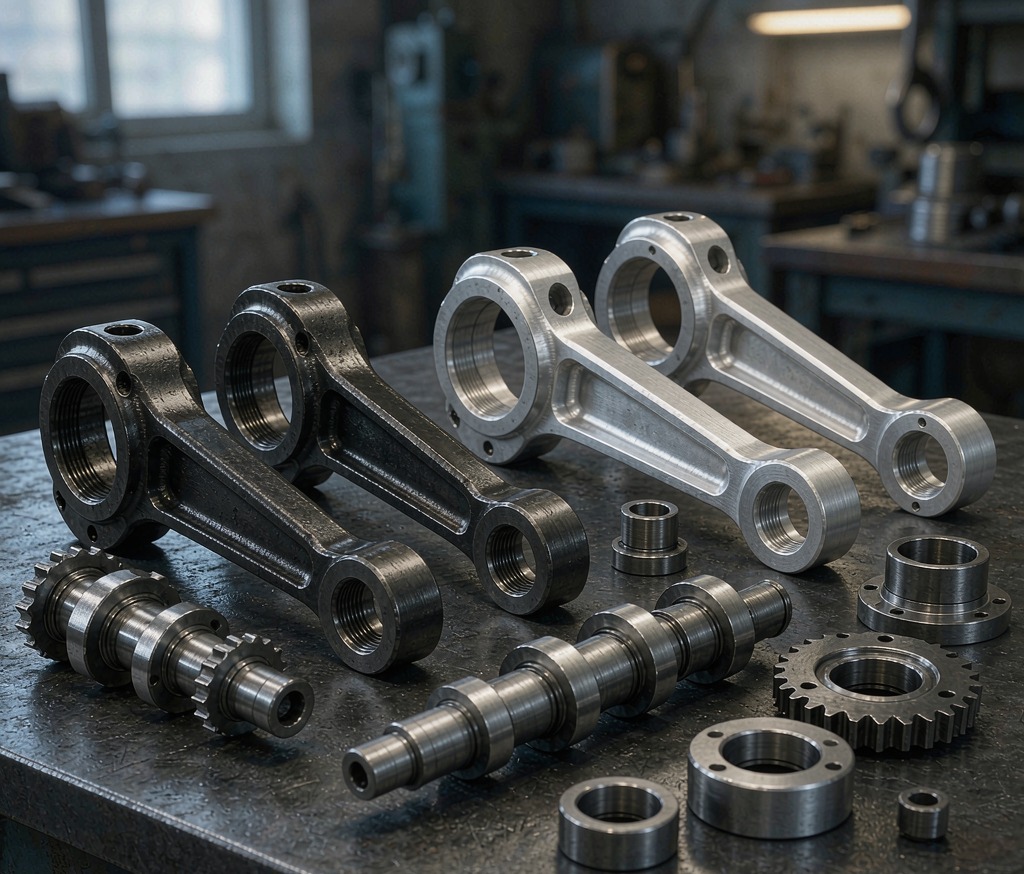
Uses of Custom Metal Cranks
Cranks appear in pumps, linkages, throttle controls, fitness equipment, and custom drive systems. The offset arm converts input rotation to stroke, so arm length and bore position define the motion. Our custom metal brackets guide covers the mating plates these often bolt to.
They sit alongside general CNC machining services for full linkage builds.
In a hand pump the crank is the human interface: if it is balanced and smooth, the tool feels effortless; if it is out of true, it buzzes in the hand and the seal wears early. The crank is therefore a feel and a function part at once.
Machining vs Forging Cranks
Low- to mid-volume cranks are machined from plate or bar on CNC mills and lathes, which is flexible and fast to prototype. High-load cranks are forged then machined for a continuous grain flow that resists fatigue.
For a deeper process comparison see our forging versus casting and machining notes across the blog.
Forging also removes the internal voids a billet can hide, which matters when the crank sees reversing load. We recommend forging once the duty cycle or safety factor demands it, and we will say so plainly rather than machining a part that will not survive the field.
5-Axis CNC for Complex Geometry
Crank arms have offset, angled, and contoured features that 3-axis machining struggles with. 5-axis CNC machining cuts the arm, bores, and keyways in fewer setups, keeping datum and balance true. Our 5-axis CNC article explains the tolerance gains.
Fewer setups means less stack-up error across the crank.
The counterweight profile on a crank is a 5-axis win: a curved pocket that would need multiple repositions on a 3-axis machine is cut in one go, holding the mass distribution that keeps the assembly balanced. That is exactly where the extra axis pays for itself.
Balancing and Tolerances
Bore position, arm length, and perpendicularity decide whether the crank runs smooth. We hold these to print and can lighten or balance arms for high-speed use. CNC boring keeps the pivot true to the arm.
Tighter tolerance here prevents vibration that would otherwise wreck bearings.
Balance is not just about speed: even a slow crank that is heavy on one side loads the shaft bearing unevenly and shortens its life. We check runout on a mandrel and, when requested, add or remove mass to hit a balance grade so the customer never sees a wobble.
Lubrication and clearance at the pivot also depend on the crank geometry: a tight bore with no relief can seize under load, while too much clearance lets the arm rattle. We size the bore and add a relief or keyway per the motion spec so the crank spins free yet stays located through its full travel.
Heat Treatment and Finishing
Load-bearing cranks are heat treated for hardness and fatigue life, then plated or coated against corrosion. Because heat treat can move dimensions, we finish-grind after treatment so the final part meets print.
Finish choice tracks the environment: zinc for outdoors, black oxide for indoor mechanisms.
We sequence heat treat before the final precision bore so the bore is cut into stable material; grinding a hardened crank after treatment is what lets us hold both hardness and fit. Skipping that order is the usual cause of a crank that measures wrong after it leaves the oven.
Prototyping to Production
Start with a machined prototype to prove the motion, then move to forged blanks if volume and load justify it. We carry the part from first article through production with consistent inspection.
Pair cranks with pins and linkages from the same build to keep the assembly coherent.
When the program scales, we preserve the prototype datum in the production fixture so the forged part behaves like the part you validated. That continuity is why a crank that worked in the lab keeps working on the line.
We also keep the production geometry in our system against your part number, so a repeat order a year later pulls the same fixture and the same datum without re-quoting the motion from scratch.
Frequently Asked Questions
Machined or forged crank?
Machined for prototypes and low volume; forged for high-load, fatigue-critical production cranks.
Can you hold true bore-to-arm geometry?
Yes, 5-axis machining and CNC boring keep bore position and arm true to datum.
Do cranks need heat treatment?
Recommended for load-bearing cranks to gain hardness and fatigue resistance; finish-ground after.
Can you balance a crank?
Yes, we can lighten or balance arms for smooth high-speed rotation.
What materials are common?
Steel and stainless for strength; aluminum where weight matters and load allows.
How do I start a crank project?
Send the motion drawing; we machine a prototype, then scale to forged production if needed.
Ready to Start Your Project?
Get a build-ready quote on your custom metal parts within 24 hours. Share your drawing and our engineers will respond with process, lead time, and pricing.

