
Custom metal lugs are the connection points that make electrical and structural assemblies work: battery terminals, cable lugs, mounting ears, and hinge tabs. A lug that cracks or corrodes at the joint fails the whole product, so material, hole size, and crimp geometry all matter. Huaxiao makes lugs by stamping, CNC milling, bending, and welding, then plates them for conductivity and life. This guide helps you spec a lug that performs, and explains how process choice changes both cost and reliability at volume.
What Custom Metal Lugs Do
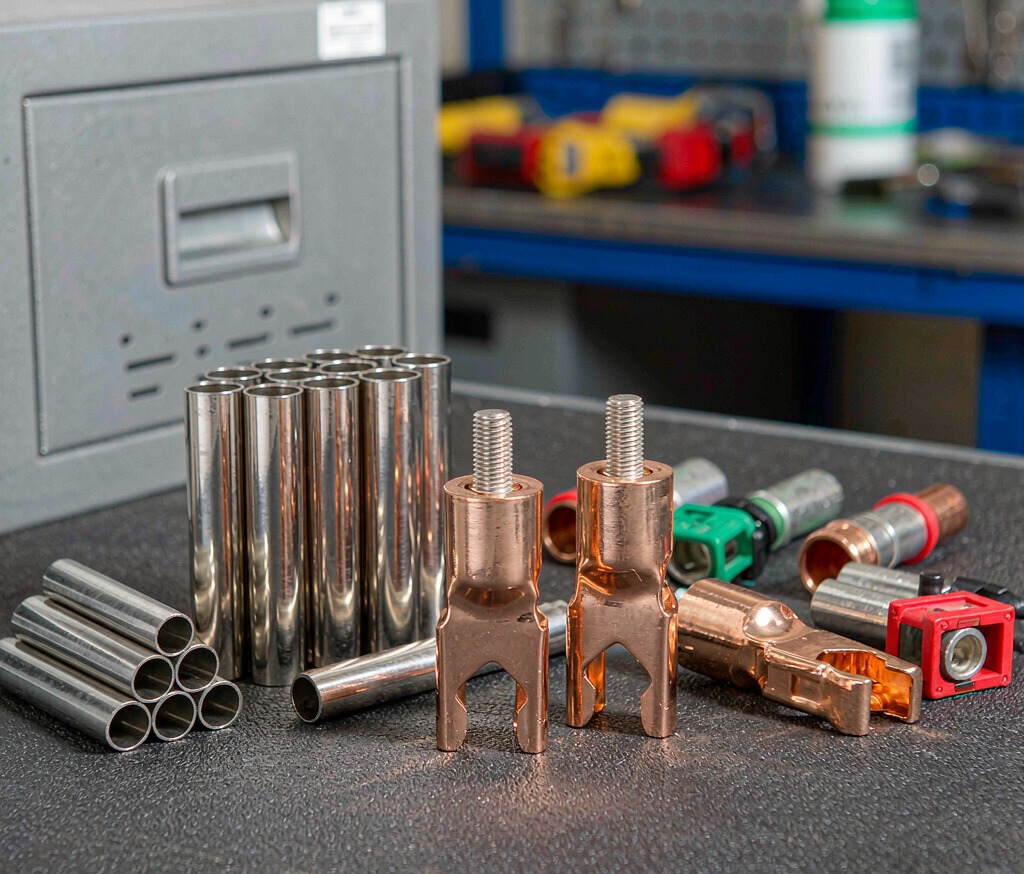
Lugs transfer current, anchor a panel, or locate a sub-assembly. Electrical lugs need high conductivity and a reliable crimp; structural lugs need strength and a clean hole. The same part family appears in our custom metal brackets guide as locating features.
They are often paired with precision metal stamping for volume terminals.
In a battery pack the lug is the single point where all the current enters and leaves, so its crimp and plating are safety-critical. We treat electrical lugs as primary characteristics and verify them by pull and resistance testing rather than by appearance alone.
Stamping vs Machining vs Bending
High-volume flat lugs come from CNC punching or progressive die metal stamping for cents per piece. Complex or low-volume lugs are CNC milled from plate. Forms and ears are made by CNC bending to hold angle and springback.
We choose the route by quantity and geometry, not by habit.
Bending deserves its own attention: the same lug bent on a hand brake versus a CNC press brake will differ in repeatability. For production we lock the tooling and back-gauge so every lug comes off the line at the same angle within tenths.
A final trim or pierce station can also coin a flat or slot in the same hit, folding another operation into the press and trimming the part count on your bill of materials.
Materials: Copper, Steel, Aluminum
Copper and its alloys dominate electrical lugs for conductivity and solderability; tin or silver plate improves corrosion and crimp life. Steel lugs are structural; aluminum lugs save weight but need compatible interfaces to avoid galvanic corrosion.
Our copper and brass extrusion line feeds bar stock for milled lugs.
When a copper lug meets an aluminum busbar, the galvanic pair can corrode quickly, so we either plate the interface or specify a bimetal transition. That material compatibility step is where many field failures are prevented at the design stage.
Crimp, Hole, and Plating Specs
Specify hole diameter and class, crimp barrel size, and stud size so the lug fits the cable and fastener. Plating (tin, silver, zinc) sets conductivity and environment rating. We hold hole and barrel to print and verify crimp pull on samples.
See metal stamping services for tolerance detail on stamped terminals.
Barrel length and wall drive the crimp: too short and the strand pack is loose, too long and the tool bottoms out. We confirm the barrel against your cable and crimp tool so the joint passes pull and the resistance stays low over temperature cycling.
Marking and polarity matter on multi-lug harnesses, so we add stamped identifiers or color cues when the drawing calls for them. A lug that is electrically perfect but installed backward still fails the build, and a small marking step prevents that field error.
Welding and Assembly Integration
Some lugs are welded to a busbar or frame. We offer stamp-weld and welded assemblies so the lug ships as part of a sub-component, not a loose piece. Riveting is an alternative where welding would distort thin stock.
Integration reduces your incoming parts count and assembly error.
Welding a plated lug needs care: heat can burn off plating near the weld, so we either weld before final plate or mask the zone. That sequence keeps the crimp end bright while the weld stays sound.
Sourcing Custom Lugs
Send the drawing with material, plating, and crimp spec; we quote stamping or machining based on volume. Prototype lugs from plate can ship fast, then scale to a die once the design is proven.
Consolidate terminals with related turned and stamped hardware to simplify receiving.
If you are unsure whether to stamp or machine, tell us the annual quantity and we will recommend the breakpoint; above a few thousand pieces a progressive die usually pays for itself, and we will show the crossover in the quote so the decision is transparent.
Drawings are welcome, but a clear sketch and a target annual quantity are often enough to start: we return a recommended route, a sample lead time, and the volume at which a hard tool becomes cheaper than plate stock.
Frequently Asked Questions
Which material for electrical lugs?
Copper for conductivity, often tin or silver plated; aluminum for weight with compatible interfaces.
Stamped or machined lug?
Stamped for high volume and low cost; machined for low volume or complex geometry.
Can lugs be welded to a busbar?
Yes, we supply welded assemblies so the lug ships integrated with the sub-component.
What plating improves crimp life?
Tin or silver plating protects copper and preserves low-contact-resistance crimps.
Do you verify crimp pull strength?
Yes, we sample crimp pull to spec on production lots.
Can you hold tight hole tolerances?
Yes, punched and milled holes are held to print and checked on first article.
Ready to Start Your Project?
Get a build-ready quote on your custom metal parts within 24 hours. Share your drawing and our engineers will respond with process, lead time, and pricing.

