
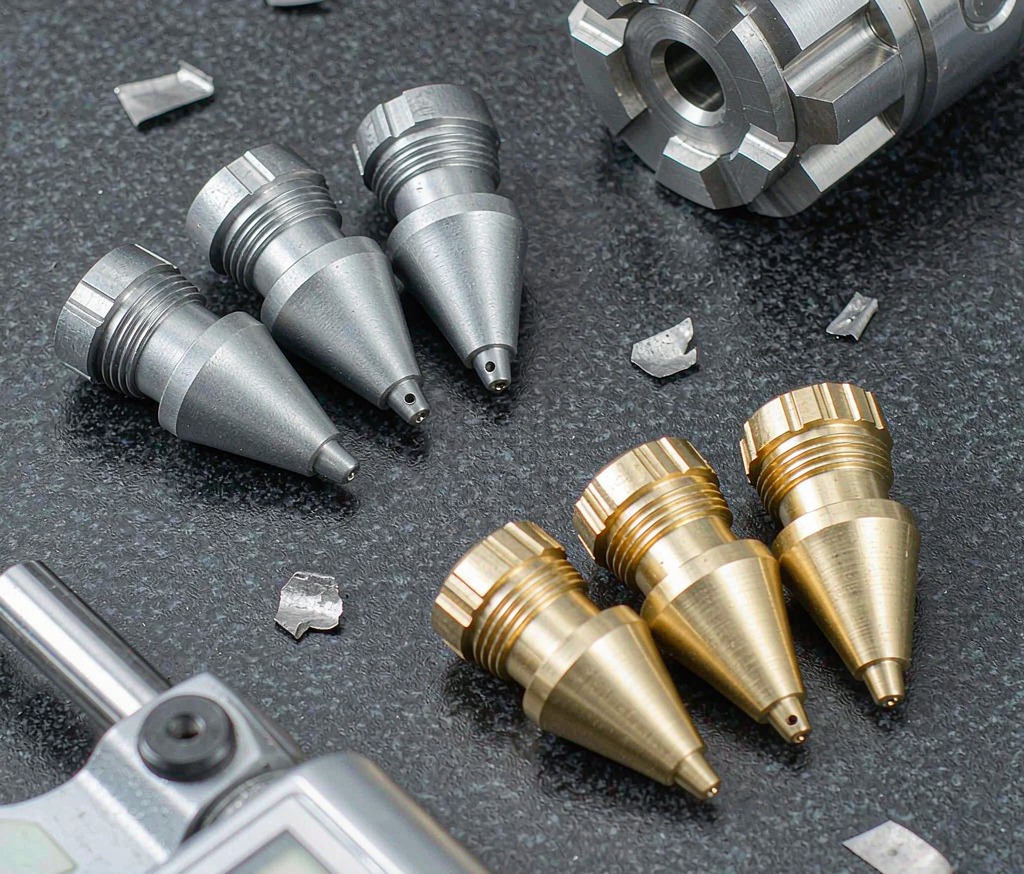
A nozzle is a flow-control device disguised as a small turned part. The outside diameter can be sloppy and nobody notices; let the orifice drift by fifteen microns or leave a burr on the exit edge and the spray pattern collapses, the flow coefficient shifts, and a whole machine goes out of calibration. That is why custom metal nozzles are quoted on internal geometry and finish, not on envelope size.
This guide explains how buyers specify custom metal nozzles that meter accurately and survive service: how to choose between turning, drilling, and EDM for the orifice, which materials resist erosion and chemical attack, how surface finish changes discharge coefficient, and what inspection data you should insist on before a lot ships.
Why Nozzles Are Harder Than They Look
Three features carry almost all of a nozzle’s function: the orifice diameter, the entry and exit edge condition, and the internal surface finish. Flow through a sharp-edged orifice is highly sensitive to edge radius, so a deburring step that is uncontrolled will produce parts that pass a dimensional check and fail a flow check. Concentricity between the orifice and the seat matters just as much, because an off-centre bore skews the jet even at the correct diameter.
Add heat, pressure, and abrasive media and the problem grows. Fuel, paint, coolant, cleaning chemicals, and abrasive slurries all erode the orifice over time, which shifts flow upward and ruins process repeatability. Selecting a wear-resistant material and a hardened finish extends the calibration interval far more than tightening the initial tolerance does.
Nozzle Families and Their Critical Features
Spray and atomising nozzles need a controlled orifice plus a swirl or fan geometry, and the pattern is verified by test, not by print. Injector and metering nozzles hold flow within a percentage band and usually get individually flow-matched. Air and blow-off nozzles are geometry-driven and tolerate looser bores. Welding and cutting nozzles are consumables optimised for thermal fatigue and easy replacement. Process and cleaning nozzles prioritise chemical compatibility and full drainage.
Small-diameter nozzle bodies with long slender profiles are almost always produced on sliding-headstock lathes. Our Swiss turning cell handles diameters from about 3 mm to 32 mm in one operation, which keeps concentricity between the seat, the thread, and the orifice inside a single chucking. Larger or heavier bodies run on CNC turning centres with a live-tooling turret.
Material Selection for Erosion and Corrosion
303 and 304 stainless cover general-purpose spray and process duty. 316L is the choice for chlorides, food contact, and pharmaceutical washdown. Brass and bronze are used for cost-sensitive air and water nozzles where erosion is mild. Hardened tool steels and 440C serve abrasive media, and tungsten carbide or ceramic inserts are pressed into a steel carrier when the abrasive load is severe. Inconel and Hastelloy appear in high-temperature and acid service.
Where the nozzle must resist both erosion and heat, a hardened core with a corrosion-resistant surface treatment usually beats a single-material compromise. Cast nozzle bodies produced by investment casting reduce machining time on complex external shapes, then get their critical bores finished afterwards. If you are comparing nozzle bodies against similar flow hardware, the trade-offs in custom metal valve bodies are directly relevant.
Machining the Orifice
Down to roughly 0.5 mm, CNC drilling with a carbide micro-drill and through-spindle coolant is fast and repeatable. Below that, or where the length-to-diameter ratio exceeds about ten, EDM becomes the reliable route: it produces a burr-free bore with no tool deflection and no work-hardened rim, at the cost of cycle time. Laser drilling is an option for very small holes in thin walls when volume is high.
Reaming or honing a drilled orifice to a controlled size and finish is standard on metering nozzles. Techniques used on sub-millimetre features are covered in more depth in our micro machining guide. Where the orifice geometry includes a conical entry and a sharp exit, the sequence matters — machine the entry first, then finish the exit last so no downstream operation rounds the edge you just controlled.
Internal Surface Finish and Flow Coefficient
Discharge coefficient is a function of edge geometry and wall roughness, so finish is a functional specification. A drilled bore at Ra 1.6 and the same bore honed to Ra 0.4 will not flow the same volume at the same pressure. Fixing the finish on the drawing, and holding it in production, is what makes nozzles interchangeable in the field.
For visible or hygienic parts, external polishing is added to reduce product build-up and make cleaning validation easier. Stainless nozzles are then passivation to restore the passive layer stripped by machining, which is the single cheapest step for extending corrosion life.
Sealing Threads and Mating Interfaces
Most nozzle failures reported as leaks are thread or seat problems, not orifice problems. NPT, BSPT, and metric parallel threads each need a different seal strategy, and mixing a tapered thread with a flat-face seal invites weeping. Specify the thread standard, the sealing method, and the wrench flat or hex size explicitly, and state whether the nozzle is installed with sealant or with an O-ring.
Seat geometry deserves a tolerance and a finish callout of its own. A 60-degree or spherical seat that is turned in the same operation as the orifice will stay concentric; a seat added in a second setup will not, unless the fixture references the same datum. Where a threaded insert or captive fitting is required, it is cleaner to machine the feature than to add a secondary assembly step.
Flow Testing and Inspection
Dimensional inspection alone is not sufficient for metering nozzles. We measure orifice diameter with pin gauges or optical comparators, check concentricity on a runout fixture, verify surface finish with a profilometer, and — where the drawing calls for it — flow-test at a stated pressure and record actual volume per unit time. Parts can be sorted into flow bands and marked so your assembly line pairs matched sets.
First-article reports include material certification, dimensional results against every controlled feature, finish readings, and flow data where applicable. Techniques for turned-part inspection generally are described in our precision turned parts guide, and the same datum discipline applies here.
Cost, Volume, and Lead Time
Cost is driven by orifice size, bore depth-to-diameter ratio, finish requirement, and whether flow testing is specified. An EDM orifice can double the unit cost of an otherwise simple turned body, and 100 percent flow testing adds a real per-piece charge — so apply both only where the function needs them. Selecting a free-machining grade where corrosion allows will cut cycle time noticeably.
Plan 7–12 days for prototype nozzles, 2–3 weeks for production lots up to a few thousand pieces, and 3–4 weeks where EDM plus flow matching is involved. Send a drawing showing orifice diameter and tolerance, internal finish, seat and thread details, media, operating pressure and temperature, and annual volume, and the quotation will include the process route we recommend and the reason for it. The same CNC turning process notes apply if your part is a turned body with cross-drilled features.
Frequently Asked Questions
How small an orifice can you machine?
Micro-drilling covers roughly 0.3 mm and above depending on depth. Below that, or at high depth-to-diameter ratios, we use EDM, which reliably produces holes down to about 0.1 mm with a burr-free edge.
Do you flow-test nozzles?
Yes. We flow-test at a specified pressure and can sort parts into flow bands, mark them, and report actual values in the inspection package when the drawing requires it.
Which stainless grade is best for chemical spray nozzles?
316L is the usual answer for chlorides and most process chemicals. For strong acids or high-temperature service, Hastelloy or a ceramic-insert design is more durable.
Can you machine hardened nozzle bodies?
Yes. Bodies are rough-machined soft, heat treated, then finished in the hard state by grinding or EDM so the final bore and seat are not distorted by the heat treatment.
Are carbide or ceramic inserts available for abrasive media?
We press or braze carbide and ceramic orifice inserts into steel or stainless carriers for abrasive blasting and slurry duty, which extends service life several times over solid steel.
What is the minimum order quantity?
Prototypes start at 10–25 pieces. Production nozzles are typically quoted from 250 pieces, with better pricing above 1,000.
Ready to Start Your Project?
Get a build-ready quote on your custom metal parts within 24 hours. Share your drawing and our engineers will respond with process, lead time, and pricing.

