
A piston converts pressure into motion, and every micron of its diameter, roundness, and groove geometry shows up as either efficiency or leakage. Custom metal pistons are ordered when a catalog piston cannot fit the bore, take the pressure, tolerate the fluid, or hold the seal arrangement a design needs — and once you are ordering custom, the specification has to be complete, because a piston that is right on diameter and wrong on groove width still leaks.
This guide walks through how custom metal pistons are engineered and produced: choosing between aluminium, steel, and iron, controlling roundness and clearance through the machining sequence, getting seal grooves and ring lands right, and which coatings actually extend life in hydraulic, pneumatic, and pump service.
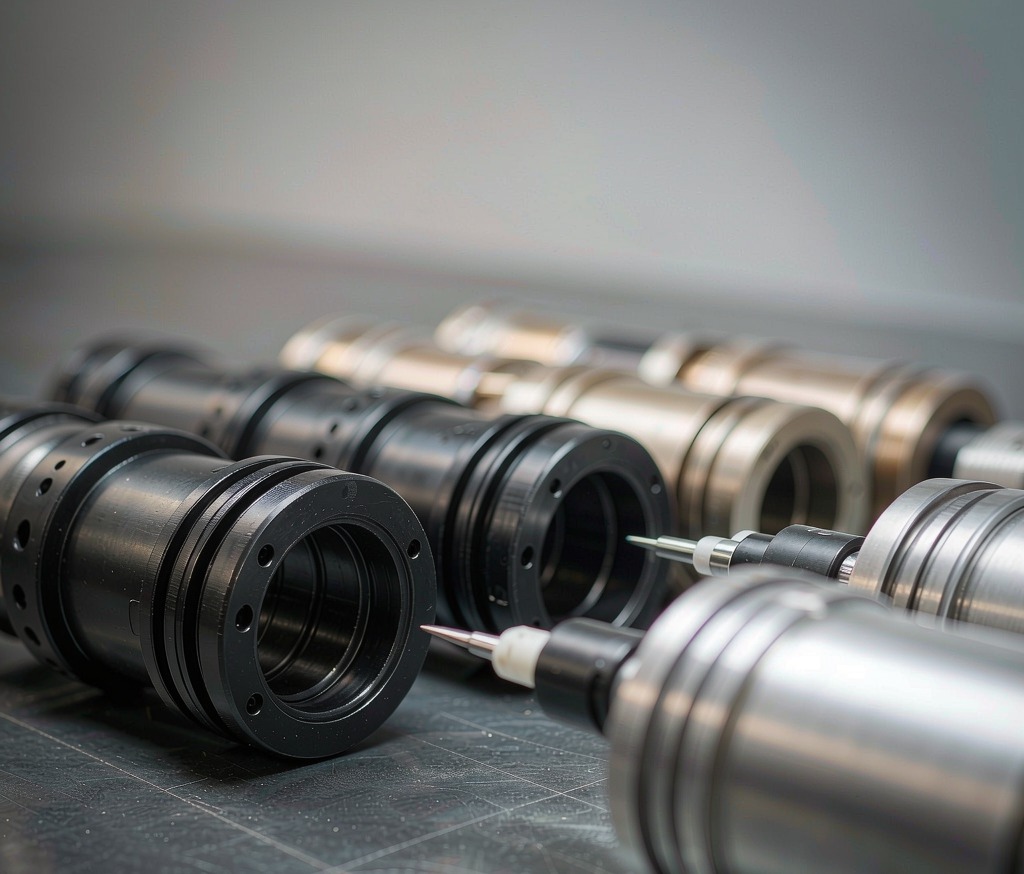
What Makes a Piston a Precision Part
Three characteristics govern piston performance: diametral clearance to the bore, roundness and cylindricity along the working length, and the geometry and finish of the seal grooves. Clearance that is too tight causes scuffing on thermal growth; too loose and the seal extrudes or the piston cocks and wears one side. Roundness errors that are invisible on a two-point measurement will still cause blow-by, which is why cylindricity is measured, not inferred.
Groove finish is the third factor. A seal running against a groove with chatter marks or a sharp corner will nick and fail early, so groove corner radii and surface roughness belong on the drawing. Buyers building complete actuators usually specify the piston together with the cylinder and rod — the systems view in hydraulic components manufacturing covers how those tolerances stack.
Piston Types and Duty Cycles
Hydraulic pistons run at high pressure with low speed and depend on elastomer or PTFE seals; the priority is groove accuracy and surface hardness. Pneumatic pistons run fast at low pressure and are usually aluminium with a lip seal, where weight and friction dominate. Pump pistons and plungers see reversing loads and abrasive media, and often use hardened steel or ceramic-coated surfaces. Free pistons and accumulator pistons need very low friction and tight roundness.
Duty cycle changes the material and process answer more than pressure does. A piston cycling a few hundred times a day can be soft-anodised aluminium; the same part at millions of cycles needs a hard-anodised or nitrided surface. State the expected cycles, stroke, fluid, and temperature range on the enquiry — those four numbers determine most of the specification.
Material Selection: Aluminium, Steel, and Cast Iron
6061-T6 and 2024 aluminium give the best weight-to-cost ratio and machine cleanly, which suits pneumatic and light hydraulic duty. 4140 and 4340 alloy steel take heat treatment to a hard, tough condition and handle high pressure and side load. Stainless 17-4 PH and 431 are used where the fluid is corrosive. Grey and ductile cast iron remain excellent for compressor and engine pistons because graphite provides inherent lubricity and damping.
Blank form matters as much as alloy. Bar stock is right for low and medium volume. Hot forging produces a grain-flow-aligned blank that is stronger and saves material on larger pistons at volume. For high-volume aluminium pistons with complex crowns, die casting or gravity casting reduces machining allowance substantially before finishing.
Machining Sequence and Roundness Control
The sequence exists to remove stress before final size. Rough turn, stress relieve or heat treat, semi-finish, then finish grind or hard turn. Skipping the intermediate relief is the most common cause of pistons that measure round in the machine and go oval in the crate. Long pistons are supported between centres or in a steady rest to keep cylindricity within a few microns.
Final size is set by cylindrical grinding for hardened surfaces or by fine CNC turning where the material and tolerance allow. Bores and internal seal surfaces are brought to size and finish by honing, which also produces the crosshatch pattern that retains lubricant. Where a piston carries a wear sleeve or bushing, the interference fit is set from the mating part — see custom metal bushings for how those fits are calculated.
Seal Grooves, Ring Lands, and Clearances
Seal groove width, depth, and corner radius must match the seal manufacturer’s published dimensions, not a nominal value. A groove 0.05 mm too wide lets the seal roll; too narrow and it is pinched during assembly. Lead-in chamfers protect the seal during installation and should be specified with an angle and a finish, since a rough chamfer cuts the seal exactly where it needs to be intact.
Ring lands on compressor and engine pistons need square, parallel faces and controlled axial clearance so the ring seals without sticking. On multi-groove pistons we machine all grooves in one setup wherever the geometry allows, which keeps spacing consistent and avoids cumulative error. Cross-drilled ports and relief holes are added after grooving so no burr enters a sealing surface, and internal surfaces are finished as described in our honing services guide.
Surface Treatment and Wear Life
Hard anodising on aluminium pistons builds a 25–50 micron ceramic layer at 60–70 HRC equivalent, dramatically improving scuff resistance in pneumatic service. Steel pistons are commonly nitrided or induction hardened on the working diameter and left tough in the core. Chrome plating and thermal-spray coatings are used on pump plungers exposed to abrasive fluid.
Coating changes size, so it must be in the tolerance stack from the start. We machine to a pre-plate dimension, apply the treatment, then finish grind or lap to final size where the tolerance demands it. Choose the treatment for the fluid as well as the wear: some coatings that excel in oil perform poorly in water-glycol or in phosphate ester.
Inspection and Functional Testing
Piston inspection uses air gauges or bore-matched comparators for diameter, a roundness tester for cylindricity, and pin or optical measurement for groove width and depth. Surface finish is recorded on the working diameter and inside the grooves. Where matched clearance is specified, pistons are measured and paired to their cylinders and marked as a set.
Functional checks add real value on sealing parts. A low-pressure leak test with the intended seal fitted catches groove and finish problems before assembly. For safety-relevant hydraulic parts we supply material certificates, hardness and case-depth results, full dimensional data, and a signed first-article report with the initial shipment.
Cost Drivers and Lead Time
The main cost drivers are the number of ground or honed surfaces, the tightness of the roundness callout, the number of seal grooves, heat treatment, and coating. Relaxing a non-functional diameter from a ground tolerance to a turned tolerance often saves ten to twenty percent with no performance loss. Choosing a forged or cast blank at volume cuts both material and cycle time.
Typical schedules: 10–15 days for prototype pistons from bar stock, 3–4 weeks for production lots that include heat treatment and grinding, and 4–6 weeks where forged blanks or hard anodising are involved. Provide the bore diameter and its tolerance, seal part numbers, operating pressure, fluid, temperature range, stroke, cycle count, and annual volume for a firm quotation.
Frequently Asked Questions
What diameter tolerance can you hold on pistons?
Ground and honed working diameters are routinely held to ±0.005 mm with cylindricity under 0.003 mm. Non-critical diameters are turned to ±0.02 mm, which is cheaper and usually adequate.
Should I choose aluminium or steel?
Aluminium for pneumatic and light hydraulic duty where weight and friction matter; alloy steel for high pressure, side load, or high cycle counts. Stainless when the fluid is corrosive.
Do you machine the seal grooves to seal-maker dimensions?
Yes. Provide the seal part number or the manufacturer’s groove table and we machine to those exact dimensions, including corner radii and surface finish.
Can you supply matched piston and cylinder sets?
Yes. Parts are measured, paired to achieve the specified clearance, marked as a set, and packaged together with the measured values recorded.
Which coating is best for high-cycle pneumatic pistons?
Hard anodising on aluminium is the usual choice — it adds a hard ceramic surface with low friction. Nitriding suits steel pistons in the same duty.
What information do you need to quote?
Bore size and tolerance, seal specification, pressure, fluid, temperature, stroke, expected cycles, and annual volume. A 2D drawing with datums plus a 3D model is ideal.
Ready to Start Your Project?
Get a build-ready quote on your custom metal parts within 24 hours. Share your drawing and our engineers will respond with process, lead time, and pricing.

