
Custom metal plates look like the simplest thing a fabricator makes, yet they are where most tolerance and cost surprises hide. Flatness, hole position, edge quality, thickness tolerance and finish all have to be right, and the process you cut them with decides which of those you can actually hold.
This guide covers the cutting and machining routes for plate work, realistic tolerances by process, material selection from mild steel to aluminium and stainless, the finishing options, and how to write a plate drawing that produces a firm, comparable quote instead of a pile of questions.
Cutting Routes and What Each One Gives You
Laser cutting is the default for plate up to roughly 25 mm in steel and 20 mm in aluminium. It gives clean, square edges, tight hole position and excellent nesting economy. We run it as sheet metal laser cutting with fibre sources, and the process detail is covered in our laser cutting services guide.
Plasma cutting takes over on thick carbon steel where laser becomes slow and expensive; plasma cutting handles heavy structural plate economically with a wider heat-affected zone and a small bevel. Punching is the cheapest route for high-volume plates with repeating hole patterns, so CNC punching wins where the tooling exists.
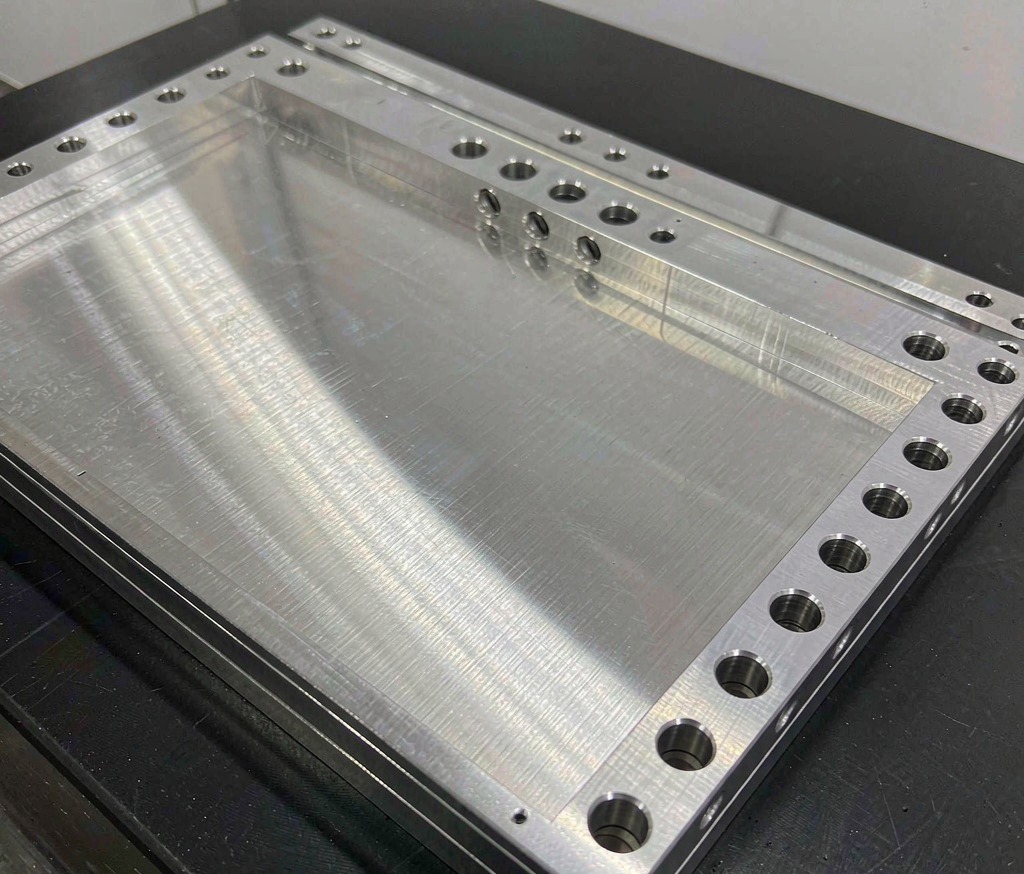
Milling from solid is the answer when thickness tolerance, flatness or a machined pocket matters more than cutting speed. Many real plates use two processes: laser or plasma for the profile, then CNC milling for critical bores, counterbores and sealing faces.
Materials, Thickness Tolerance and Flatness
Mild steel S235 and S355 cover structural plate. Stainless 304 and 316 handle corrosion and hygiene work. Aluminium 5052 and 6061 are the standard for lightweight brackets and mounting plates, with 6061-T651 plate the choice when flatness after machining matters. Tool steels and wear plate serve abrasion applications.
Buyers often assume plate arrives flat. Hot-rolled plate carries mill tolerance on both thickness and flatness, and cutting releases residual stress, so a 10 mm laser-cut plate can bow noticeably. If you need flatness better than about 1 mm per metre, plan on stress relieving or a finish machining pass and say so on the drawing.
Thickness tolerance follows the mill standard unless you specify machining. Precision ground flat stock or a skim cut on both faces is the honest way to get plus or minus 0.05 mm, and it costs more than most first-time buyers expect. Our custom metal panels guide covers the thinner formed-sheet end of the same family.
Hole Patterns, Threads and Secondary Features
Hole position on laser-cut plate holds around plus or minus 0.13 mm within a nest, which is fine for bolted joints. Bearing bores, dowel holes and register features need machining because the laser leaves a slight taper and a recast layer. Say which holes are functional and which are clearance, and the router changes accordingly.
Threads in plate are either tapped directly, which suits thicker sections, or achieved with a threaded insert or weld nut in thin material. Countersinks and counterbores are cheap on a machining centre and expensive to add later, so include them on the print.
Bent flanges turn a plate into a bracket, and CNC bending has its own tolerance rules on bend radius and flange length. Where plates become part of a larger frame we handle the whole build as a sheet metal fabrication package.
Finishing and Corrosion Protection
Edges from laser and plasma need deburring before assembly or coating, and safety-critical parts usually call for a specified edge radius. We run deburring as a controlled operation rather than an afterthought, because coating adhesion and handling safety both depend on it.
Carbon steel plate is normally hot-dip galvanized for outdoor structural service or powder coated where appearance and colour matter. Stainless gets pickling and passivation or a brushed finish. Aluminium takes anodising or chem film plus paint.
For heavy structural plate assemblies, weld preparation and coating specification usually come from the project standard. Our structural steel fabrication guide sets out the typical code and coating requirements for that class of work.
Cost Drivers and Drawing Tips That Save Money
Material utilisation is the largest single lever. A plate that nests efficiently in a standard sheet costs far less per piece than one whose dimensions leave a wide unusable strip. Sending us the outline early lets us suggest a size change of a few millimetres that improves yield significantly.
Process choice is the second lever, and it follows from your tolerances. Every dimension you tighten beyond what the cutting process holds forces a machining pass. Tolerance only the features that matter, and leave the rest at general fabrication tolerance.
Third is finishing and handling. Large plates cost more to move, mask and coat. Grouping several part numbers of the same material and finish into one release lets us nest and coat them together, which typically reduces both setup and coating cost per part.
Lead Time and RFQ Checklist
Laser or plasma cut plates with deburring ship in five to eight working days. Adding machining takes it to 10 to 15 days. Galvanizing or powder coating adds three to five days. Precision ground and stress-relieved plate work runs 15 to 20 days.
Send a DXF or STEP file plus a PDF drawing showing material grade and thickness, thickness and flatness tolerance if they matter, which holes are functional, thread callouts, edge condition, finish specification, quantity and annual volume.
If you only have a sketch or a sample part, that is enough to start. We reverse engineer plates regularly using reverse engineering, and will produce the drawing package alongside the quote so you own a proper print at the end.
Frequently Asked Questions
What tolerance can I expect on a laser-cut plate?
Profile and hole position typically hold around plus or minus 0.13 mm within a nest on thin to medium gauge, loosening on thick plate. Thickness follows mill tolerance unless machined, and flatness depends on residual stress released during cutting.
Why is my flat plate bowed after cutting?
Hot-rolled plate contains residual stress from the mill. Cutting releases it asymmetrically, so the part relaxes into a bow. Stress relieving before final machining, or a skim cut on both faces, is the reliable fix when flatness is critical.
Should I choose laser, plasma or milling?
Laser for clean edges and accurate holes up to about 25 mm steel. Plasma for thick structural carbon steel where cost per metre matters more than edge quality. Milling when thickness tolerance, flatness or machined pockets and bores are the driving requirement.
Can you tap threads directly into plate?
Yes, direct tapping is standard in thicker material. In thin plate we recommend a threaded insert, weld nut or clinch fastener so the thread has enough engagement length to carry the design load.
Which finish should I specify for outdoor steel plate?
Hot-dip galvanizing gives the longest maintenance-free life for structural steel outdoors. Powder coating over a suitable pretreatment is preferred where colour and appearance matter, and duplex systems combine both for aggressive environments.
What files do you need to quote plate work?
A DXF or STEP file with a PDF drawing is ideal. The drawing should state material grade and thickness, any tolerance tighter than general fabrication, thread and edge requirements, finish specification, and the quantities you need.
Ready to Start Your Project?
Get a build-ready quote on your custom metal parts within 24 hours. Share your drawing and our engineers will respond with process, lead time, and pricing.

