
If your flat metal part keeps failing inspection because of a rough breakout zone, a rolled-over edge, or a bow that will not stay within flatness, conventional blanking is probably the wrong process. Fineblanking services solve exactly that problem. By combining a V-ring impingement force, a counter-punch, and an unusually tight die clearance, fineblanking shears a part cleanly through the entire material thickness instead of cracking it apart. The result is a component with a 90-100% smooth-sheared edge, excellent flatness, and dimensional accuracy that often eliminates secondary machining altogether. For buyers, that translates directly into lower piece price, shorter routings, and fewer suppliers to manage.

How Fineblanking Differs From Conventional Stamping
Conventional blanking cuts by fracture. The punch pushes into the strip, the material yields, a crack initiates at the punch and die edges, and the two cracks meet somewhere in the middle. You get roughly one third burnished band and two thirds torn fracture zone, plus die roll and a burr. That is acceptable for a bracket, but not for a gear tooth or a cam profile that has to act as a bearing surface.
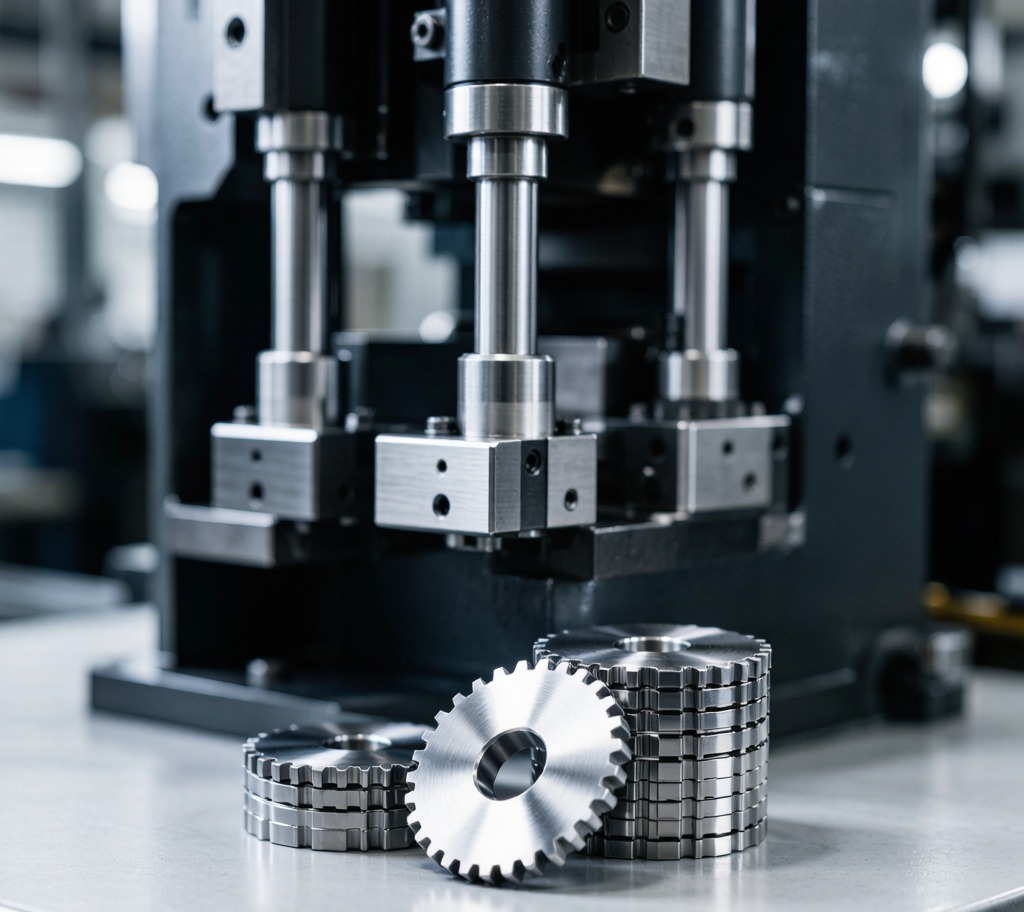
Fineblanking uses a triple-action press. Before the punch moves, a V-ring gripper clamps the strip around the part outline and a counter-punch supports the slug from below. The material is put into compression, so it flows rather than tears. Die clearance drops to about 0.5% of thickness versus 5-10% in conventional tooling. The whole cut face is burnished, straight, and perpendicular to the sheet.
This puts fineblanking in a category of its own. It is not a variant of the CNC punching we run for prototypes and low volumes, and it is not the same as the multi-station tooling described in our guide to progressive die stamping, although fineblanking tools are often built progressively so that piercing, coining, countersinking, and semi-piercing all happen in one press stroke.
Tolerances, Edge Quality and Flatness You Can Specify
Realistic expectations matter when you write a print. On a well-designed fineblanked part we typically hold:
- Dimensional tolerance: ±0.02 to ±0.05 mm on blanked outlines and pierced holes, depending on thickness
- Clean-cut (burnish) band: 90-100% of material thickness for suitable steels
- Flatness: 0.02-0.10 mm across a typical 50-100 mm part, far better than conventional blanking
- Perpendicularity of the cut face: within roughly 0.5 degrees
- Surface roughness on the sheared edge: Ra 0.4-1.6 µm, frequently good enough to serve as a running or sealing surface
- Hole-to-edge distance: as low as 50-70% of thickness, versus a full thickness or more in conventional stamping
Those numbers are why fineblanking competes so strongly against machining. A part that would otherwise need turning, milling, and surface grinding can often come off the press finished. When a portion of the feature set is still too tight — a bore that must be H7, for instance — we machine only that feature and leave the rest as-blanked.
Materials, Thickness and Design Rules
Fineblanking rewards ductile, fine-grained material. Low and medium carbon steels (C10 to C60), case-hardening grades, stainless 304 and 316, brass, copper, and softer aluminium alloys all run well. Material is usually specified in a spheroidised annealed condition so that carbides do not interrupt the clean shear. High-strength low-alloy steel and hardened stock are poor candidates — the burnish band collapses and tool life crashes.
Practical thickness range runs from about 0.5 mm to 15 mm, with 1-8 mm being the sweet spot. Design guidelines worth building into your CAD model:
- Add generous corner radii — sharp inside corners are the number one cause of premature tool wear
- Keep minimum web width at roughly 60-70% of stock thickness
- Allow a small die roll on one face and call out which face must be roll-free
- Design in coined bosses, countersinks, and half-shear pilots — they are nearly free in the same stroke
- Specify part orientation relative to rolling direction if bending will follow
Because the strip is fully constrained, we can also integrate secondary forming. Shallow draws, offsets, and flanges can be combined, though deep features are still better addressed by metal deep drawing. Where the profile needs a follow-on bend, we hand the part to CNC bending within the same sheet metal processing cell.
Tooling, Volume and the Real Cost Equation
Fineblank tooling is expensive. A compound tool for a simple washer-type part might start in the low five figures; a multi-station progressive fineblank tool with coining and semi-piercing stations can run several times that. The tool steels are premium, the guidance is far more rigid than a conventional die, and the build tolerances are measured in microns.
What makes the economics work is the piece price and the eliminated operations. Once the tool is running, cycle rates of 30-80 strokes per minute are normal, tool life between regrinds is high, and the part comes out effectively finished. The break-even against machining is usually somewhere around 20,000-50,000 annual pieces, and it drops sharply if your alternative routing includes three or more machining operations.
Cost drivers to discuss at RFQ stage:
- Outline complexity — perimeter length and number of pierced features drive press tonnage
- Thickness and material grade — tonnage scales with both
- Number of in-die operations — each coining or semi-pierce station adds tool cost but removes a downstream process
- Annual volume and release pattern — steady releases let us amortise regrinds efficiently
- Secondary processes — deburring, heat treatment, and zinc plating or other finishes
If your volumes sit below break-even, we will say so and quote the part as a machined or conventionally stamped component instead. Our engineering team applies the same honest assessment described in our precision metal stamping guide.
Where Fineblanked Parts Are Used
Automotive remains the largest market: seat recliner plates, door latch components, brake system parts, transmission clutch plates, and airbag components all depend on the clean edge acting as a functional surface. Beyond automotive, we see fineblanking in hand tools, power tool gearing, appliance mechanisms, hydraulic valve plates, and electrical switchgear contacts.
A recurring pattern is replacing a machined or sintered component. Fineblanked parts are made from wrought rolled stock, so they are inherently stronger and more consistent than powder metal equivalents, which often allows engineers to downsize the part. Where an internal spline or keyway is also required, the blank is transferred to broaching for the internal form.
Frequently Asked Questions
What is the minimum order quantity for fineblanking?
Because of tooling investment, fineblanking suits annual volumes from roughly 20,000 pieces upward. Below that, machining or conventional stamping is usually cheaper overall. We will run the comparison for you before you commit to a tool.
How long does fineblank tooling take to build?
Typical lead time is 8-14 weeks for a compound tool and 12-20 weeks for a complex progressive fineblank tool, followed by sampling and PPAP if required. Simple geometry and early DFM feedback shorten this considerably.
Can fineblanking hold H7 bores?
Not usually. Pierced holes come out around IT9-IT10. If you need H7, we pierce undersize and finish with reaming or grinding, or design the feature to be non-critical.
Does fineblanking work on stainless steel?
Yes. Austenitic grades such as 304 and 316 fineblank well, though work hardening reduces tool life relative to carbon steel, and tonnage requirements are higher. Expect a modest piece-price premium.
How thick can a fineblanked part be?
Up to about 15 mm in mild steel on large presses. Above 8 mm the clean-cut percentage begins to drop, so we validate edge quality with sample parts before committing to production tooling.
Do fineblanked parts still need deburring?
Often only lightly. A small burr remains on the die-roll side of pierced holes. Vibratory or brush deburring is normally enough, and we can include it in the quoted routing.
Getting a Fineblanking Quote That Reflects Reality
Send us a 2D print with tolerances and a STEP file, plus your material grade, annual volume, and release schedule. Tell us which faces are functional and where die roll is unacceptable — that single piece of information often changes the tool concept. Our engineers will return a DFM review that flags any features likely to hurt edge quality or tool life, an honest process recommendation, tooling cost, piece price, and a realistic build timeline. If fineblanking is not the right answer for your part, we will tell you which of our processes is.
Ready to Start Your Project?
Get a build-ready quote on your custom metal parts within 24 hours. Share your drawing and our engineers will respond with process, lead time, and pricing.

