
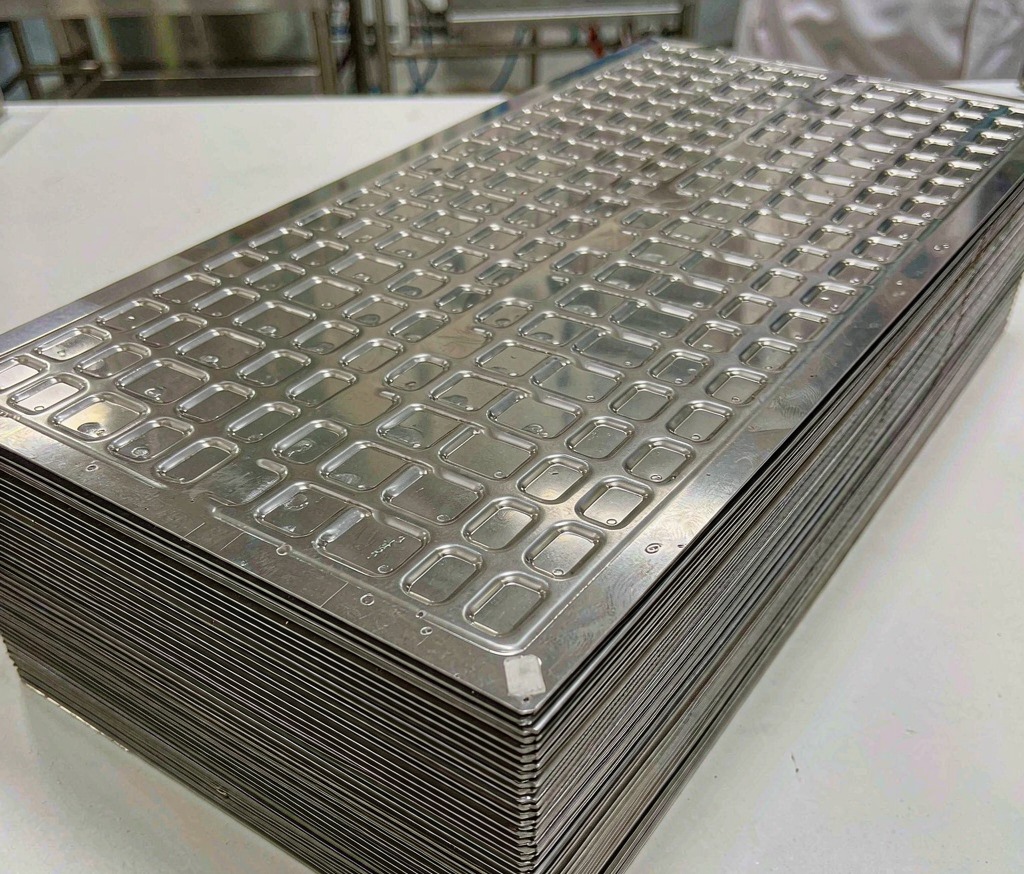
Fuel cell metal bipolar plates are the repeatable, stackable sheets that separate individual cells in a hydrogen fuel cell, carrying reactant gases across engraved flow fields while conducting current and managing coolant. At volume, stamped thin-gauge stainless or titanium plates beat graphite on weight, thickness, and cost, but they demand extremely tight control of forming, cutting, and coating. Getting a plate right means treating it as a precision stamped component first and an electrochemical part second, which is where fiber laser cutting and fine blanking or progressive stamping earn their place.
What Bipolar Plates Do
In a proton-exchange-membrane fuel cell, each bipolar plate sits between two membrane electrodes and performs three jobs at once: it distributes hydrogen and air through channels, it conducts electrons between cells, and it often routes coolant. The flow-field pattern, serpentine, interdigitated, or parallel, sets how evenly reactants reach the catalyst. Because hundreds of plates stack into a power module, a tiny variation in flatness or coating defects compounds across the stack, so plates are made to tight, repetitive tolerances rather than as one-off parts.
Metal vs. Graphite Plates
Graphite plates are corrosion-proof and easy to machine in prototype quantities, but they are thick, brittle, and expensive to mass-produce. Metal plates are thin, strong, and cheap to stamp at scale, which is why production automotive and stationary stacks favor them. The penalty is that the bare metal must be coated: stainless steel and titanium are not inert enough in the cell environment, so a conductive, corrosion-resistant coating is mandatory. This coating step is as important as the forming step for stack life.
Stamping and Forming the Flow Field
The flow channels are formed by stamping or embossing the thin sheet in a progressive die, which also blanks the outline and forms features like seals and manifolds. Because the plate is only fractions of a millimeter thick, the die must control springback and avoid necking the channel walls. CNC punching and fine blanking are alternatives for lower volumes or coarser features. Flatness after forming is critical, so the process plan includes flattening and stress relief where needed, much like other precision customized metal parts.
Laser Cutting and Piercing
Where the flow field is too fine or the volume too low for full hard tooling, sheet metal laser cutting engraves the channels and pierces the manifold ports with no tooling cost. Fiber lasers cut the thin stainless cleanly with a small heat-affected zone, which matters because any oxide or recast layer on the active surface must later be cleaned or coated. Laser also lets designers iterate flow-field geometry quickly during development before committing to a stamping die.
Coatings for Conductivity and Corrosion
The coating is the make-or-break step. It must stay conductive under compression, resist the acidic, wet cell environment, and not leach ions that poison the catalyst. Common approaches are thin noble-metal or nitride-based CVD/PVD layers, conductive polymer, or composite plates. The coating must cover edges and channel roots uniformly; a pinhole becomes a corrosion site. Because coating is a surface discipline, it dovetails with broader finish work such as OEM production finishing lines that already handle passivation and plating.
Design for Stack Volume
Design plates with symmetrical flow fields, generous bend radii, and features that a progressive die can hit repeatably. Keep the active area free of welds or folds, specify flatness in microns per plate length, and define the coating thickness and contact-resistance budget up front. Manifold seals should be designed into the plate edges so the stack assembles without extra gaskets where possible. Tighter CNC bending and forming control reduces post-form flattening, which protects the coating applied later.
Typical Applications
Automotive fuel-cell stacks, material-handling and backup-power units, and aerospace auxiliary power all rely on stamped metal plates. As hydrogen economies scale, plate cost per kilowatt falls with stamping volume, making the manufacturing approach, not the electrochemistry, the commercial bottleneck. Our automotive metal parts and contract manufacturing guides cover the volume production context these plates live in. Stationary power for data centers and telecom also adopts metal-plate stacks where footprint and weight matter, pushing plate makers toward thinner gauges and higher channel density. That trend rewards suppliers who hold flatness and coating uniformity at tighter specs without raising scrap, since a single rejected plate can stall a stack build.
Frequently Asked Questions
Why use metal instead of graphite bipolar plates?
Metal plates are thinner, lighter, and far cheaper to stamp at volume, which matters because a stack contains hundreds of them.
Why do metal plates need coating?
Bare stainless or titanium would corrode and leach ions in the cell, so a conductive, corrosion-resistant coating is required for life.
How are the flow channels made?
By stamping or embossing in a progressive die for volume, or by fiber laser cutting for low volume and fast iteration.
What tolerances matter most?
Flatness and coating uniformity dominate, because small errors compound across a tightly compressed stack.
Which metals are used?
Thin stainless steel is most common, with titanium where weight or corrosion is critical; both need a functional coating.
Can the design be prototyped without a die?
Yes. Laser-cut plates let engineers test flow-field variants quickly before investing in hard tooling.
Bipolar plates are a precision stamped part at heart. Our custom metal parts guide frames the broader production discipline these plates depend on.
Ready to Start Your Project?
Get a build-ready quote on your custom metal parts within 24 hours. Share your drawing and our engineers will respond with process, lead time, and pricing.

