
When you have thousands of small parts and every one needs a clean edge or a bright finish, hand work is too slow and too inconsistent. Mass finishing services tumble parts together with abrasive media in a vibrating or rotating bowl, removing burrs, scale, and tool marks while improving surface quality across the whole batch at once. It is the economical way to make stamped, machined, and cast parts feel finished.
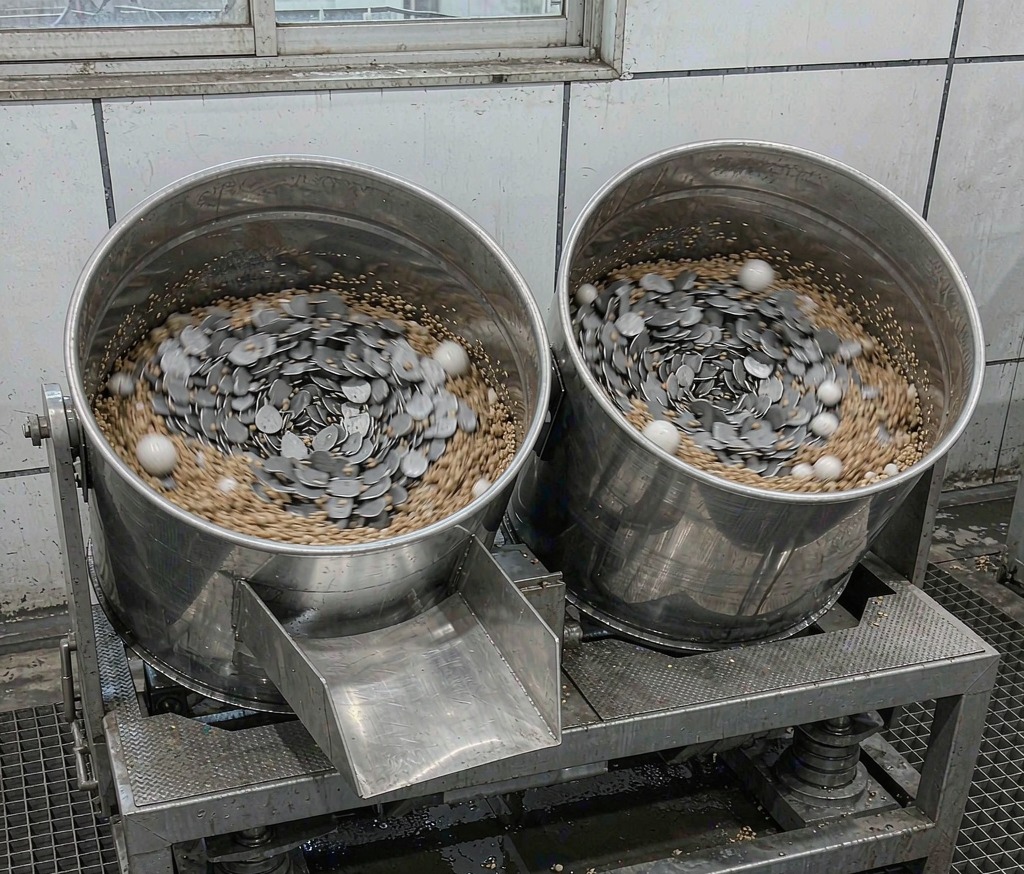
What Mass Finishing Does
The machine drives a mixture of parts and media so the media constantly rubs every exposed surface. Depending on the media and compound, that rubbing can deburr, radius edges, descale, polish, or burnish. It pairs naturally with deburring services for parts that also need a precise edge break, and it is the high-volume cousin of single-part polishing services.
The appeal is consistency at scale. A single vibratory bowl can process hundreds of kilograms per cycle, and because every part in the load sees the same media and time, the finish distribution is far tighter than manual buffing. For high-mix shops that is the difference between a repeatable process and an operator-dependent one.
Vibratory vs Barrel vs Centrifugal
Vibratory bowls are the most common: a vibrating tub keeps parts and media in motion, handling fragile and mixed loads gently while still cutting fast. Barrel tumblers rotate slowly for a very mild, low-cost finish on robust parts. Centrifugal (high-energy) machines spin at speed to deliver a mirror polish or aggressive deburr in a fraction of the time, at the cost of more machine hours. We pick the method by part fragility, target finish, and batch size.
Media and Compounds
Media comes in ceramic, plastic, steel, and natural shapes (triangles, cones, cylinders) sized to reach your features without lodging. Compounds control chemistry: cleaners, deburring agents, and burnishing soaps. Getting media and compound right is what separates a clean, consistent result from one that loads up or stains. We also blend in sandblasting or shot peening for parts that need a specific texture or fatigue improvement before the final tumble.
Achievable Surface Results
Mass finishing spans a wide range: from a soft edge break that satisfies deburr specs, through uniform matte and satin looks, up to near-mirror brightness on suitable alloys. For even finer geometry control we can follow with superfinishing or lapping services on precision faces. The key is that the whole batch lands in the same window, which is hard to achieve by hand.
Which Parts Benefit
Stamped brackets, machined fasteners, die-cast housings, medical instruments, and jewelry all run well in mass finishing. It is especially valuable when burrs would snag assembly or cut operators, or when a visible part needs to look uniform across a large order. Because parts ride together, we separate by material and hardness to avoid cross-contamination or media impingement on soft surfaces.
Quality and Consistency
We validate each recipe on a sample, set the time and media charge, then lock the process so repeat batches match. Finished parts are rinsed, dried, and inspected for residual media and surface uniformity, with surface grinding or cylindrical grinding reserved for datums that must stay precise. The outcome is a predictable finish at a per-part cost that hand work cannot touch. This consistency is why mass finishing is the default for high-volume consumer and automotive hardware, where every part in a carton must look identical to the next.
From Sample to Production Batch
We always prove a new part on a small sample before committing to a full run. That sample shows the achievable finish, flags any media lodging in holes, and lets you approve the look before we process thousands. Once the recipe is set, time, media charge, and compound are locked so every future batch matches the approved sample within a tight window.
For ongoing programs we can hold a standing process parameter set keyed to your part number, which removes guesswork on reorder and shortens lead time. Pairing mass finishing with upstream deburring or downstream polishing lets us hit an exact spec without over-processing, keeping cost per part low while protecting surface quality.
Lead time is driven by batch size and the number of process steps. A single deburr is often a next-day turn; a multi-stage prepolish plus burnish takes longer but still beats hand work by orders of magnitude. For repeating parts we keep media charged and ready, so you can release work against a standing recipe and get consistent results without re-quoting each time.
Frequently Asked Questions
Will mass finishing damage delicate parts?
Not if the recipe is right. We select gentle media and short cycles for fragile parts, and we separate soft from hard parts so nothing gets impinged.
Can you reach internal threads or blind holes?
Standard tumbling struggles with blind features; we use shaped media and sometimes pre-deburr critical holes mechanically. We will advise if a feature needs a different process.
What surface finish can you achieve?
From a simple edge break to a uniform satin or bright polish, depending on media and time. Mirror finishes are possible on compatible alloys with high-energy equipment.
Is mass finishing good for low volumes?
It shines at higher volumes, but we also run small prototype batches to prove the recipe before committing to production.
Ready to Start Your Project?
Get a build-ready quote on your custom metal parts within 24 hours. Share your drawing and our engineers will respond with process, lead time, and pricing.

