
If you are producing sheet-metal parts at volume, the die is the single biggest lever on unit cost, part consistency, and tool life. Custom metal stamping dies — progressive, transfer, compound, and deep-drawing tooling — turn flat coil or blank stock into finished components in a fraction of a second per hit. This guide explains the die types, how design choices affect cost, and what to send us for a fast, accurate tooling quote.
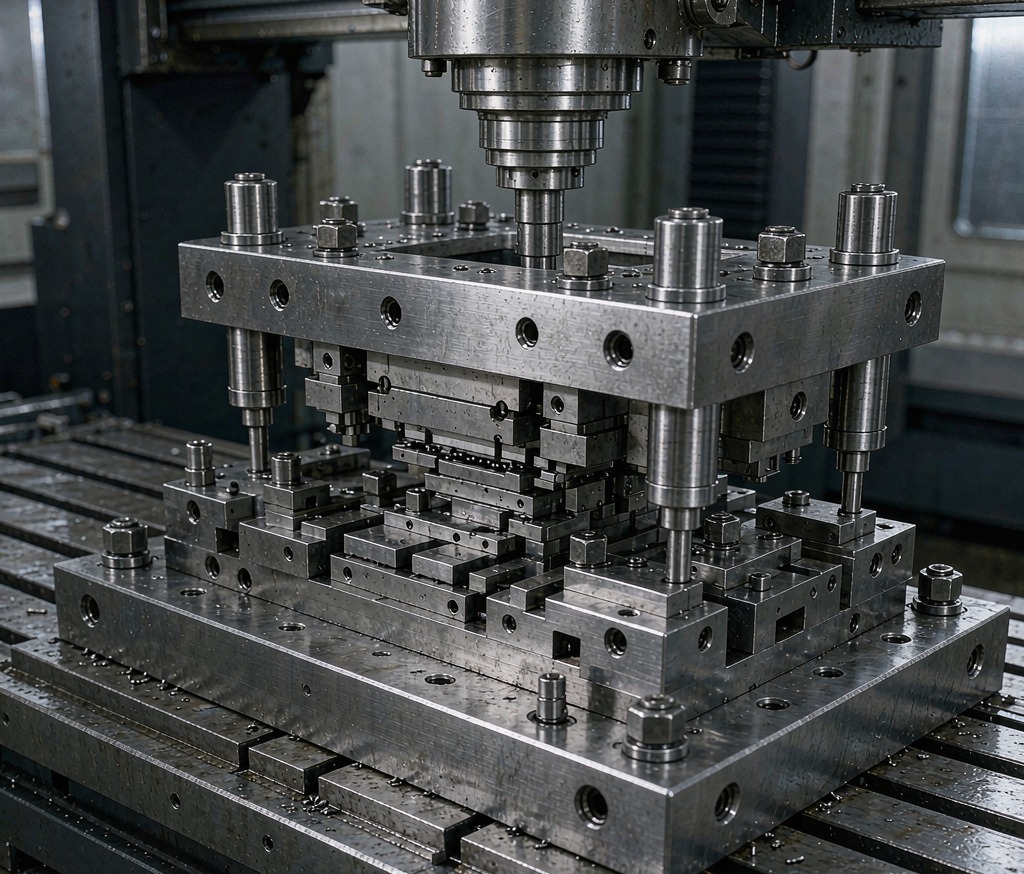
Types of Metal Stamping Dies
The die family you choose depends on part complexity and volume. Progressive dies carry the strip through sequential stations, adding features at each hit — the workhorse for high-volume production. Transfer dies move the part between stations for larger components. Compound dies perform multiple cuts or a cut-and-form in one stroke, while drawing dies form cups, cans, and enclosures. Our CNC punching and CNC bending services complement die work for short runs and prototypes.
Behind every die is a strip layout — the map of how the part nestles in the coil and what happens at each station. A good layout maximizes material yield and minimizes scrap, which on a million-piece run can dwarf the tooling cost. We model that layout before cutting steel so the economics are clear up front.
Progressive vs Transfer vs Compound
Progressive tooling spreads operations across stations, so one die can pierce, notch, form, and cut-off a finished part — ideal when you need thousands of identical pieces. Transfer dies suit parts too large for a progressive strip. Compound dies are simplest and cheapest for a single combined operation. If you are unsure which fits, our metal stamping services team models your volume against tooling cost to recommend the most economical path, and our progressive die stamping capability handles the highest-throughput jobs.
The decision also depends on part size and material thickness. Very large or thick parts are awkward in a progressive strip and better suited to transfer or single-hit tooling. We factor blank size, press tonnage, and feed length into the recommendation so the die you buy runs reliably on available equipment.
Die Design and DFM
Good dies start with design for manufacturability. We review strip layout, material utilization, pilot holes, and spring-back before steel is cut, because a small change in tab width or bend radius can double tool life. For drawn parts, our deep drawing services and precision metal stamping expertise prevent wrinkles and thinning. Tight collaboration up front is what separates a die that runs for a million hits from one that needs constant rework.
Tool steel selection is the other half of die life. We match the steel grade and heat treatment to your abrasion and shock load, and build in easy-to-replace wear plates at the stations that see the most action. The result is a die you can service rather than scrap.
Materials and Tool Grade
Die steels are selected by abrasion and shock load: air-hardening A2/D2 for wear, high-speed and shock-resistant grades for heavy sections. Component material — mild steel, stainless, aluminum, or copper alloy — sets clearances and die life. We also align the downstream finishing, such as CNC punching services, so the whole process chain is dialed in before first article inspection.
Industries Served
Custom stamping dies feed automotive, electronics, appliances, connectors, brackets, and enclosure markets where per-part cost dominates. Our precision metal stamping line is built for repeatable, high-cavity output, and we support low-to-mid volume with fast tooling turnaround. Adjacent finishing such as powder coating and galvanizing let the same part ship finished.
Tooling Lead Time and First Articles
After the die is cut we run a first-article sample and measure it against your drawing before committing to production, giving you a chance to confirm fit and function on the actual tool. Lead time for a new progressive die is typically a few weeks including proofing, while simple compound tooling can be faster, and we keep wear parts in stock so reorders are quick and your schedule stays predictable.
How to Order Custom Tooling
Send your part drawing, annual volume, material, and tolerances. We return a die concept, lead time, and tooling cost, then cut and prove the tool in-house. Early alignment with our metal stamping services guide keeps your program on schedule. For parts that also need cut features, our fiber laser cutting and plasma cutting cells provide a fast prototype path before the die is built.
Frequently Asked Questions
Which die type is cheapest for prototypes?
A compound or simple single-operation die is cheapest for low volumes; progressive tooling only pays off once volume spreads the higher upfront cost.
How long do stamping dies last?
With proper steel grade and maintenance, production dies run hundreds of thousands to millions of hits; we specify tool steel to your expected volume.
Can you build deep-drawing tooling?
Yes. We design and prove drawing dies for cups, cans, and enclosures, controlling wall thinning and wrinkling through process modeling.
Do you make the stamped parts too?
We both build the tooling and run production, so you get a single accountable supplier from die to delivered parts.
What file do I need to request a die?
A 2D drawing with tolerances plus target volume and material is enough for a concept quote; a 3D model lets us run strip-layout simulation.
Ready to Start Your Project?
Get a build-ready quote on your custom metal parts within 24 hours. Share your drawing and our engineers will respond with process, lead time, and pricing.

