
When your production line demands thousands of identical, repeatable joints every shift, few processes beat resistance welding. By passing a controlled electrical current through the part itself and squeezing it between copper electrodes, resistance welding creates a clean, solid-state bond in a fraction of a second—no filler wire, no shielding gas, no open flame. At Huaxiao we run resistance welding as part of a full metal-assembly service, so your brackets, busbars, frames and stamped parts move from flat stock to finished, weld-ready assemblies without changing suppliers.

How Resistance Welding Works
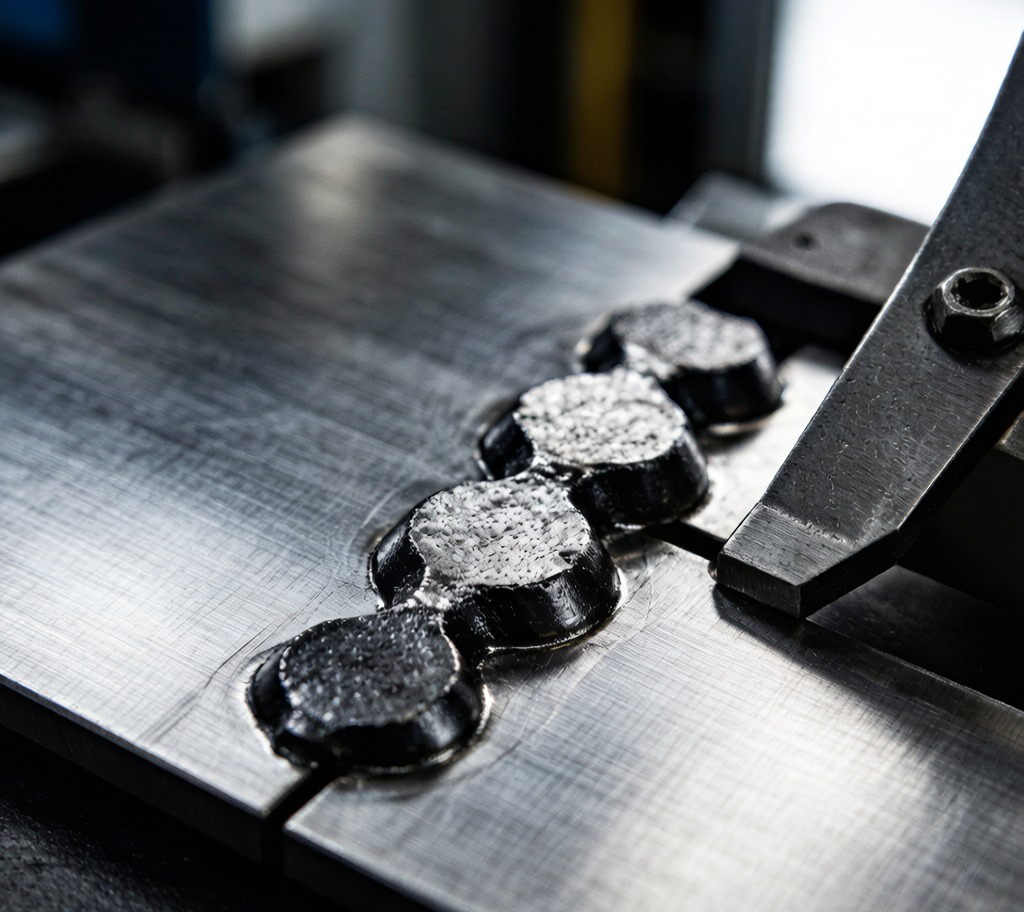
The principle is simple but the control is precise. Two or more workpieces are clamped between electrodes and a short, high-amplitude current is driven through the interface. Resistance at the contact surface generates localized heat, softening the metal just enough to forge the parts together under electrode force. Because the heat is confined to the joint, surrounding material stays cool and distortion is minimal. Our spot welding cells and robotic welding lines let us scale from short prototype runs to fully automated, high-rate production without sacrificing consistency.
Process Variants: Spot, Seam, Projection and Butt
Resistance welding is really a family of processes, and picking the right one depends on the geometry and the joint you need:
- Spot welding fuses overlapping sheets at discrete points—the workhorse for automotive bodies and appliance panels.
- Seam welding rolls a continuous, leak-tight seam, ideal for tanks and enclosures.
- Projection welding concentrates current on embossed bosses or nuts, perfect for studs and fasteners.
- Butt (flash) welding joins the ends of bars, wires and sections into one continuous piece.
All of these can feed directly into our welded assemblies workflow, and where a mechanical backup is preferred we can combine welds with riveting or TIG welding in the same cell to give you a truly complete part.
Best Materials and Joint Designs
Low-resistance, conductive metals weld most easily: low-carbon steels, stainless grades, galvanized sheet and many copper and nickel alloys. Dissimilar thicknesses are fine as long as the weld schedule is tuned—something our process engineers handle during part review. Thicker sections and high-strength alloys often pair better with our MIG welding capability, and we will tell you honestly when another process is the better call. Good joint design—flush overlaps, accessible electrodes, consistent surface condition—is what turns a tricky weld into a reliable one on every cycle.
Why It Wins for High-Volume Assembly
The headline benefit is consistency. Once a weld schedule is set, every joint is essentially identical, and cycle times are measured in tenths of a second. There is no consumable wire to manage, no gas to purge, and very little post-weld cleaning. For buyers in high-rate sectors this translates directly into lower unit cost and fewer rejects. As we cover in our guide to automotive metal parts, resistance welding is the backbone of body-in-white and battery-tray production for good reason—it is fast, clean and endlessly repeatable.
Typical Industries and Applications
You will find resistance welding in automotive structures, battery modules and busbars, appliance bodies, HVAC cabinets, electrical enclosures, wire goods and agricultural equipment. Anywhere a thin-wall sheet or section needs a fast, strong, repeatable joint, it is a candidate. We routinely run it alongside spot welding services for programs that need both manual and automated cells feeding the same line.
Beyond the headline sectors, resistance welding is also the quiet workhorse in white goods, where washer tubs and fridge compressors are joined at volume, and in electrical distribution, where welded assemblies demand low resistance and repeatable nugget size. The process scales cleanly from a single manual gun for prototypes to a multi-gun automated cell, so a growing program can move from samples to mass production without re-quoting the joining method.
Cost is another reason it dominates. With no wire, gas or filler to buy and minimal post-weld cleanup, the per-joint cost drops as volume rises. Quality is also easy to instrument: weld time, current and electrode force are logged, and squeeze-cycle monitors confirm the electrodes actually closed. For regulated industries we provide first-article reports and process capability studies so your audit trail is complete from the first part.
Design Tips to Get Weld-Ready Parts
- Keep electrode access in mind—both sides of the joint must be reachable by the electrodes.
- Specify surface finish and coatings; heavy oils or loose scale hurt consistency and shorten electrode life.
- Use projection features for nuts, studs and brackets to localize heat exactly where you need it.
- Tell us your target peel and shear strength so we set the schedule to match your drawing.
Our robotic welding services and welded assemblies guide go deeper into designing parts that weld cleanly the first time and stay consistent across the whole order.
Frequently Asked Questions
What metals can be resistance welded?
Low-carbon and stainless steels, galvanized sheet, and most copper, brass and nickel alloys weld well. Highly conductive pure copper and aluminum need careful scheduling but are routinely joined with the right electrodes and force.
Spot or seam welding—which should I choose?
Use spot welding for discrete points on overlapping sheets and seam welding when you need a continuous, leak-tight joint such as a fuel or coolant tank.
Can resistance welding join dissimilar metals?
Often yes—steel-to-stainless and many steel-to-copper joints work well because the bond forms at the interface rather than by melting a filler metal between the parts.
How strong is a resistance weld?
A correctly scheduled weld can approach the parent metal strength in shear and peel; we validate with destructive and non-destructive testing against your specification to prove it.
What tolerance can I expect?
Electrode wear and sheet variation are the main variables; with tuned schedules and in-process monitoring we hold consistent nugget size and placement across large production runs.
Do you offer automated production?
Yes. Our robotic cells handle high-rate programs with fixture and schedule control, and we can integrate projection welding and nut feeding in the same automated line.
Ready to Start Your Project?
Get a build-ready quote on your custom metal parts within 24 hours. Share your drawing and our engineers will respond with process, lead time, and pricing.

