
Seam welding services produce a continuous, leak-tight joint by rolling two sheet-metal workpieces between a pair of rotating electrode wheels while a pulsed current flows through the interface. Unlike a row of overlapping spot welds, a true seam weld is an unbroken fusion line, which is why it is the standard choice for fuel tanks, pressure vessels, bellows, and sealed enclosures that must hold liquid or gas. If your part needs a reliable seal rather than just a structural attachment, a spot welding pattern will usually leak at the cusps between nuggets, while seam welding will not.
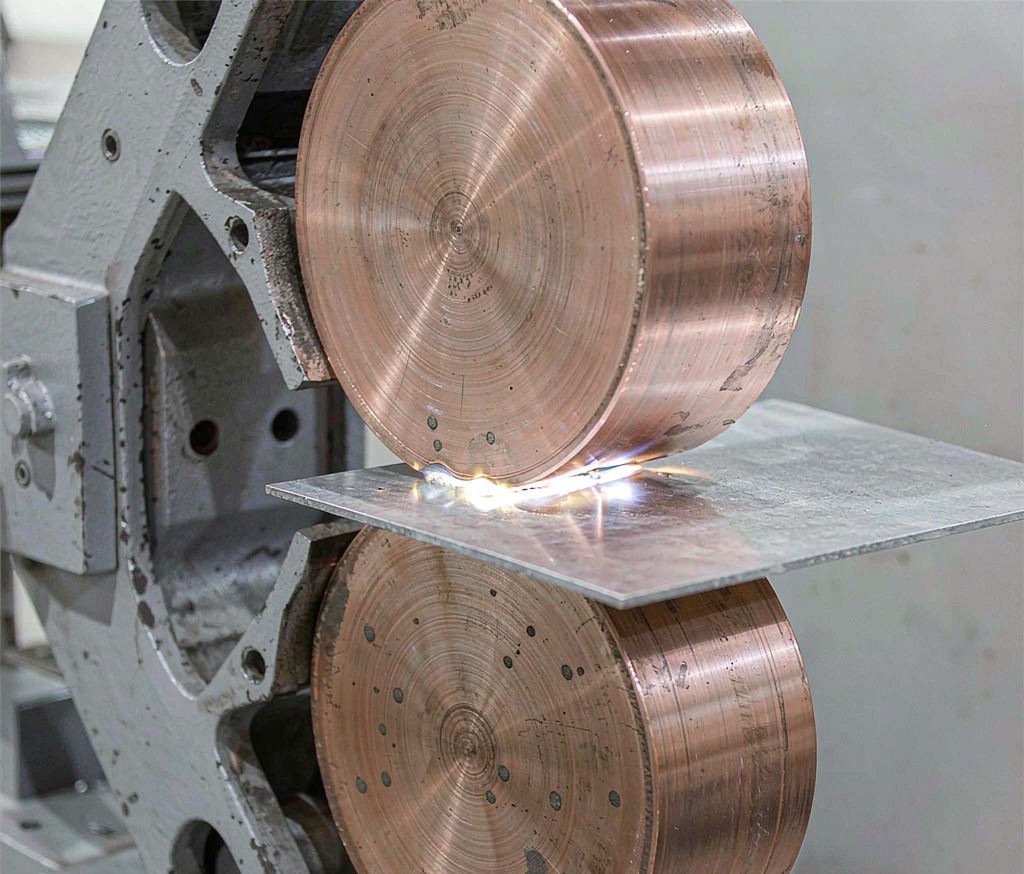
What Is Seam Welding
Seam welding is a resistance welding process. The workpieces are squeezed between two copper-alloy wheels (electrodes) that both conduct current and travel along the joint. As the wheels rotate, current is switched on and off in a controlled sequence, fusing the metal along a continuous path. The result is a weld with no starting or stopping point, so there is nowhere for pressure or fluid to escape. It is best applied to thin-to-medium sheet, typically from roughly 0.2 mm up to about 3 mm per sheet, depending on the alloy and machine capacity.
How the Process Works
A seam welding cell clamps the parts between the wheel electrodes, sets a forging force, and drives the wheels at a恒定的 surface speed while a weld controller fires current pulses. Two common modes are used: in “continuous” seam welding the current is on almost continuously, while in “stitch” or “intermittent” mode the current is pulsed so each overlap forms a tight weld nugget that merges with the next. Stitch mode runs cooler and is preferred for heat-sensitive parts; continuous mode is faster and gives the smoothest seal. Robotic welding fixtures can hold the part and feed it past the wheels with repeatable speed and force, which is what keeps weld width and penetration consistent across a long seam.
Seam vs. Spot Welding
The practical difference is leakage. A spot weld is a discrete nugget; a line of them has small unwelded cusps between nuggets. For a sealed radiator or a fuel tank that is unacceptable. Seam welding also distributes stress more evenly along the joint, which helps fatigue life on parts that flex. The trade-off is setup cost and speed: seam welding needs wheel electrodes sized to the joint radius and a controller tuned for pulse timing, so it suits production runs more than one-off repairs. Where only a structural joint is needed, MIG welding or TIG welding may be simpler and cheaper.
Materials and Thickness Limits
Low-carbon steels seam weld most easily because they have a stable, forgiving fusion range. Stainless steels weld well too and are common in food, medical, and corrosive-service enclosures. Coated steels (galvanized, aluminized) can be seam welded, but the coating must be managed so it does not gase out and weaken the seam. Aluminum and its alloys are weldable by seam welding but need higher current density, clean surfaces, and often a different electrode material because aluminum sticks to copper. Very thick plate is better served by arc processes; seam welding stays in the sheet-metal domain where its speed and seal quality win.
Design Rules for Leak-Tight Seams
Good seam-weld design starts with joint access. The wheel electrodes must reach both sides of the seam, so internal corners and blind recesses are usually out. Keep the joint on a gentle radius or a flat; tight convex curves force the wheel to skid. Edge distance matters: leave enough flange so the wheel does not roll off the edge and so heat does not blow out. Matching thickness on both sheets gives the most uniform penetration; if thicknesses differ a lot, the thinner sheet tends to overheat. Specify the required test, leak or pressure, up front so the shop sets force, speed, and pulse count to hit it. Our welded assemblies team can review the print and flag joint features that will not seal cleanly before tooling is cut.
Typical Applications
The classic seam-welded part is the steel fuel or hydraulic tank, but the process shows up wherever a seal matters: heat-exchanger shells, transformer housings, microwave and RF enclosures, fire-extinguisher bodies, and metal bellows for instrumentation. In appliances you will find seam-welded drums and tubs. Because the weld is narrow and neat, seam welding is also chosen when appearance along a visible edge matters. For complex welded structures that combine seams with other joints, partnering the seam weld with broader metal assembly work keeps the whole build under one quality system.
Quality and Testing
Seam weld quality is verified by peel or cross-section tests on coupons, plus non-destructive checks on the part itself. A simple shop test is to pressurize or submerge the part and watch for bubbles; production parts often get a helium or pressure-decay leak test with a defined acceptance rate. Destructive peel tests confirm nugget width and fusion, while microsections reveal lack of fusion or porosity. Because seam welding is repetitive, statistical process control on wheel dressing, force, and current keeps a long run stable.
Frequently Asked Questions
Is seam welding actually leak-tight?
Yes, when set up correctly. A continuous or tightly stitched seam leaves no cusps for fluid to pass, which is why it is specified for fuel tanks and pressure vessels.
What thickness can be seam welded?
Roughly 0.2 mm to 3 mm per sheet is typical, with low-carbon steel the easiest. Thicker plate usually shifts to arc welding.
Can aluminum be seam welded?
It can, but it needs higher current density, clean surfaces, and often different electrode material because aluminum tends to stick to copper wheels.
Seam welding vs. a line of spot welds?
A spot-weld line leaks at the cusps between nuggets; a seam weld is continuous and seals. Seam welding also spreads stress more evenly.
How is a seam weld tested?
Pressure or helium leak tests on the part, plus peel and microsection tests on coupons, confirm fusion and a tight seal.
How fast is seam welding?
It is a high-speed process on sheet metal, meters of seam per minute, which is why it suits production tanks and enclosures rather than one-off repairs.
Seam welding sits alongside other resistance and arc joining methods in a complete fabrication toolkit. Reviewing the part with a joining specialist early, see our notes on resistance welding services and robotic welding, helps pick the right process before tooling is committed.
Ready to Start Your Project?
Get a build-ready quote on your custom metal parts within 24 hours. Share your drawing and our engineers will respond with process, lead time, and pricing.

