
From electrical cabinets to sensor housings, custom sheet metal enclosures protect electronics and mechanisms across every industry. Laser cutting, bending, welding, and coating turn flat sheet into rigid, precise boxes — faster and cheaper than molded or machined alternatives for low-to-mid volume. This guide covers materials, the fabrication process, finishing, and how to get an accurate enclosure quote.
What Is a Sheet Metal Enclosure
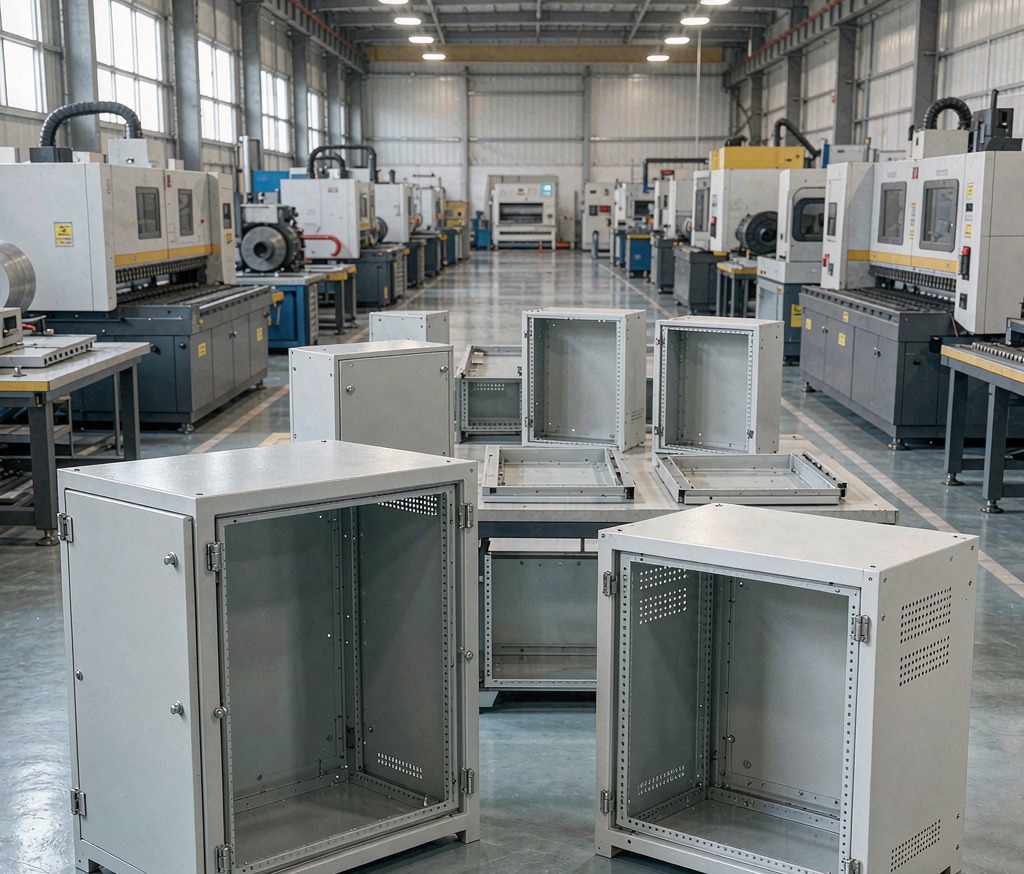
An enclosure is a fabricated shell — a box, cabinet, or housing — that shields contents from dust, moisture, impact, and EMI. Built from cut-and-formed sheet, it balances strength, weight, and cost. Our sheet metal fabrication program produces enclosures from a few units to production runs with consistent quality.
Compared with injection molding, sheet metal needs no six-figure tool; compared with machining a billet, it uses a fraction of the material. That makes it the pragmatic default for prototypes and moderate production where you cannot justify a mold.
Materials: Steel, Stainless, Aluminum
Carbon steel is strongest and cheapest, great for indoor cabinets. Stainless steel resists corrosion for harsh or food environments. Aluminum is lightest, ideal for portable or wall-mounted units. Each is cut on our fiber laser cutting systems and formed on CNC bending presses, with bends calculated for spring-back and flat-pattern accuracy.
Material also drives finishing choice: steel and aluminum take powder coat beautifully, while stainless is often left brushed or passivated for a clean industrial look. We align material and finish so the enclosure performs and presents the way your brand expects.
Fabrication Process
We start by laser cutting the blank, then CNC bending the flanges and seams. Corners are joined by welded assemblies or riveting, and features like PEM inserts and cutouts are added. Tight flat-pattern control keeps panels aligning across a run — critical when doors and rails must fit.
Digital flat-pattern design is the secret to repeatability. We model the bend allowances and relief cuts before cutting so the first enclosure and the thousandth match. That is also why a design change can be turned around quickly without re-tooling.
Finishing and IP Ratings
Most enclosures are powder coated for a durable, attractive skin, or galvanized for outdoor corrosion resistance. Gaskets, filters, and sealed seams deliver the IP rating your environment demands. Our powder coating services and welded assemblies teams coordinate so the finish and structure are proven together.
Applications
Enclosures house industrial controls, telecom gear, medical electronics, and outdoor kiosks. Our fiber laser cutting and CNC bending services support complex cutouts for displays, connectors, and vents, while powder coating services deliver the look and protection your brand needs. For parts that must also be joined to larger structures, our riveting option keeps assembly simple.
Designing for Manufacturability
A few design choices make an enclosure dramatically cheaper to build. Consistent bend radii, generous corner reliefs, and standard fastener sizes let the flat pattern cut and form cleanly without custom tooling. Mounting features are best designed as formed tabs or PEM inserts rather than separate welded brackets. And calling out only the cutouts you truly need — rather than a decorative array — keeps laser time down.
We review your concept and suggest these adjustments before quoting, so the enclosure you approve is already optimized for the process. This is also where lead time is won or lost: a clean flat pattern cuts and bends the first time, while a fussy one needs rework and re-proving. Because we control cutting, bending, welding, and coating together, we can tell you early whether a feature will be expensive and offer a cheaper alternative that looks identical to the end user.
Finally, think about service access. Doors, removable panels, and gasket channels designed in from the start cost almost nothing extra, yet save hours in the field. Good enclosure design is mostly about anticipating how the unit will be built, installed, and maintained — and we bring that perspective to every quote.
If you are unsure where to start, send even a hand sketch. We will translate it into a manufacturable flat pattern and highlight the few choices that move cost the most, so you stay in control of the budget from the first conversation. Good enclosures are rarely the result of luck; they come from a supplier who understands both the sheet metal and the product it protects.
Requesting an Enclosure Quote
Send your drawing or concept, material, quantity, IP rating, and finish. We return a flat-pattern-based quote with lead time. Our sheet metal fabrication guide helps you specify features that are easy to manufacture and gentle on cost.
Frequently Asked Questions
Which material should my enclosure use?
Carbon steel for indoor cost-sensitive cabinets, stainless for corrosive or sanitary duty, aluminum when weight matters.
What IP rating can you achieve?
With gaskets, seals, and proper seams we build enclosures to common IP ratings for dust and water protection.
Is powder coating or galvanizing better?
Powder coat gives the best look and indoor durability; galvanizing is preferred for harsh outdoor corrosion resistance.
Can you add cutouts and inserts?
Yes. We laser cut precise openings for displays and connectors and install PEM-style inserts during fabrication.
How fast can an enclosure be produced?
After the flat pattern is approved, laser cut, bend, weld, and coat typically complete in days rather than weeks for molded tooling.
Ready to Start Your Project?
Get a build-ready quote on your custom metal parts within 24 hours. Share your drawing and our engineers will respond with process, lead time, and pricing.

