
Squeeze casting services combine the shape-making freedom of casting with the density and mechanical properties normally associated with forging. Molten metal is poured into a preheated die and then compressed by a hydraulic ram while it solidifies, so the metal feeds itself and eliminates the shrinkage porosity that plagues conventional die castings. The result is a near-fully-dense structural part with fine, uniform grains, ideal for load-bearing aluminum and magnesium components. When a part must be both complex and strong, die casting alone often leaves porosity; squeeze casting closes that gap.
What Is Squeeze Casting
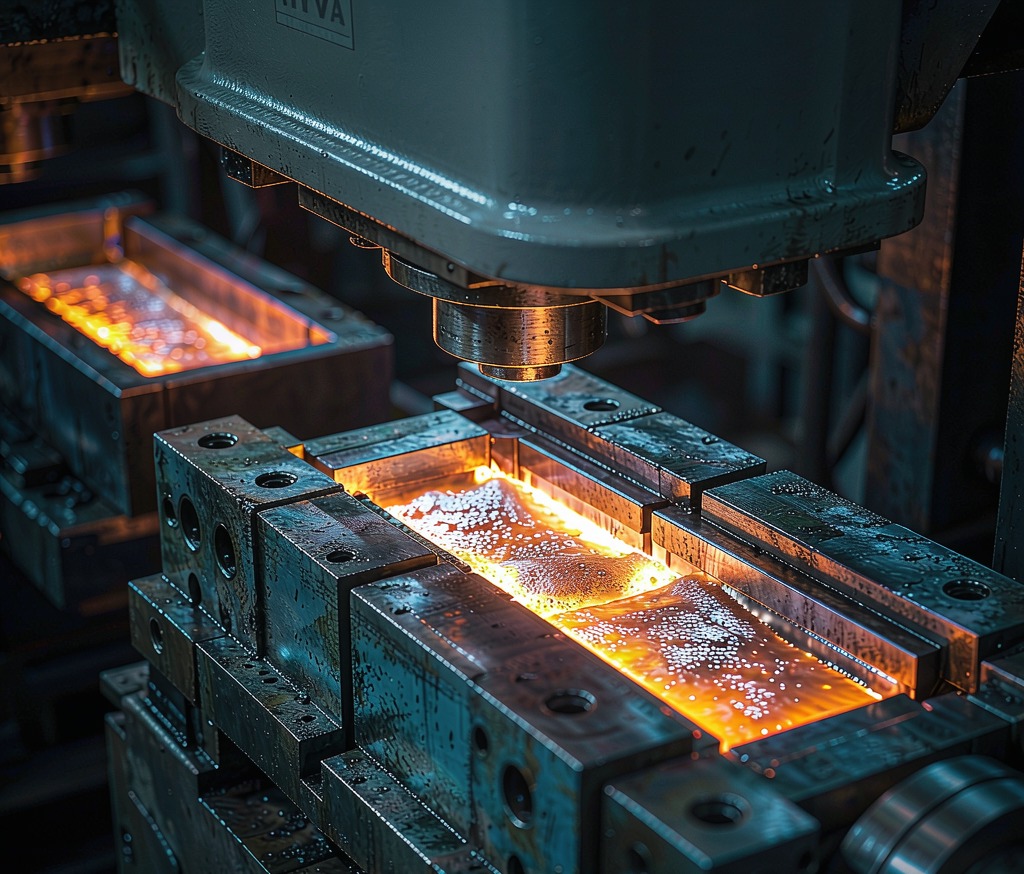
Squeeze casting, sometimes called liquid-metal forging, is a hybrid process. Unlike high-pressure die casting, where molten metal is shot into a cold die at speed, squeeze casting places a measured pour of molten metal into a heated die and applies static or slowly ramped pressure as it solidifies. The pressure keeps the metal in contact with the die wall and forces feed metal into any shrinkage, producing a pore-free casting with a forged-like microstructure. Because the die is heated and pressure is applied during solidification, the process avoids the gas entrapment that causes die-cast porosity.
How It Differs From Die and Gravity Casting
Gravity and permanent-mold casting rely on the metal’s own weight to fill the cavity, which is simple but can leave shrinkage and coarse grains. High-pressure die casting is fast and thin-walled but entrains air and gives a porous skin that cannot be heat treated. Squeeze casting trades some cycle speed for density: parts are weldable, heat-treatable, and pressure-tight, with tensile and fatigue properties approaching forgings at a fraction of forging tooling cost. Our aluminum die casting guide explains the conventional route and where its porosity limits apply.
The Process Step by Step
A squeeze casting cell melts the alloy, transfers a precise shot of molten metal to the heated lower die, closes the upper die, and applies pressure, often 70 to 100 MPa or more, through solidification. The pressure is held until the part is fully frozen, then the die opens and the dense casting is ejected. Because fill is by pour rather than high-velocity injection, there is little turbulence and almost no air entrapment. After ejection, the part may be heat treated, since it is porosity-free and can tolerate solution treatment without blistering.
Aluminum, Magnesium, and Copper Alloys
Aluminum alloys are the dominant squeeze-cast material, especially heat-treatable grades used for structural and suspension parts. Magnesium squeeze casting is used where weight savings are critical, such as in aerospace and premium automotive hardware. Certain copper alloys are also squeeze cast for dense, conductive components. For comparison, gravity casting and investment casting remain strong choices for lower volumes or more intricate detail, while squeeze casting wins on density and properties at moderate volume.
Design Rules for Dense Parts
Design squeeze cast parts with uniform wall sections so solidification is even under pressure, and avoid isolated thick sections that would need extra feeding. Generous fillets and smooth transitions reduce stress concentrations and help the pressurized metal fill completely. Draft angles are still useful for ejection, and parting lines should be placed where flash is easy to remove. Because the part is dense, features like threads and seats can be machined after casting, so plan casting and machining as one operation to hold final tolerances.
Mechanical Properties vs. Forging
A well-run squeeze casting reaches 90 to 100 percent of the properties of a forging in the same alloy, with far lower tooling cost and the ability to make shapes forging cannot. Elongation, fatigue strength, and impact resistance are all markedly better than in porous die castings. For buyers deciding between processes, our forging vs. casting comparison lays out the trade-offs in cost, strength, and geometry.
Typical Applications
Squeeze casting is common in automotive control arms, knuckles, and subframe brackets where strength-to-weight matters, and in motorcycle and bicycle components. It appears in metal casting programs for compressor and pump bodies that must be pressure-tight, and in sporting and aerospace hardware needing dense, light parts. Where a conventional sand casting would be too coarse or a forging too costly, squeeze casting is the pragmatic middle.
Frequently Asked Questions
Is squeeze casting porosity-free?
It is essentially fully dense. Pressure applied during solidification feeds shrinkage, eliminating the porosity that limits conventional die castings.
Can squeeze cast parts be heat treated?
Yes. Because they are dense and gas-free, they can be solution treated and aged without blistering, unlike porous high-pressure die castings.
Squeeze casting vs. forging?
Properties are close to forging, but tooling is far cheaper and more complex shapes are possible, making it attractive at moderate volumes.
Which alloys work best?
Heat-treatable aluminum alloys lead, with magnesium for weight-critical parts and some copper alloys for dense conductive components.
Is it good for pressure-tight parts?
Yes. The lack of shrinkage porosity makes squeeze cast housings and bodies suitable for pressurized fluids and gases.
When should I not use squeeze casting?
For very high volumes of thin-walled cosmetic parts, high-pressure die casting is faster; for very low volumes with fine detail, investment casting may be cheaper.
Squeeze casting is one of several routes to a strong aluminum component. Our precision casting and die casting vs. injection molding guides help frame when a dense cast route beats molding or welding.
Ready to Start Your Project?
Get a build-ready quote on your custom metal parts within 24 hours. Share your drawing and our engineers will respond with process, lead time, and pricing.

