
Vacuum heat treatment removes the atmosphere from the equation. With no oxygen and no carbon-bearing gas in the chamber, parts come out bright, dimensionally stable, and free of the oxide scale, decarburised skin, and intergranular attack that atmosphere furnaces leave behind. For finish-machined tool steel, stainless, titanium, and superalloy components, that usually means the part goes straight to final grinding instead of through a cleaning and stock-removal detour.
This guide explains what vacuum heat treatment services deliver, which processes run in a vacuum furnace, how high-pressure gas quenching controls distortion, how loads should be fixtured and cleaned, and what documentation to require so the metallurgy is provable rather than assumed.
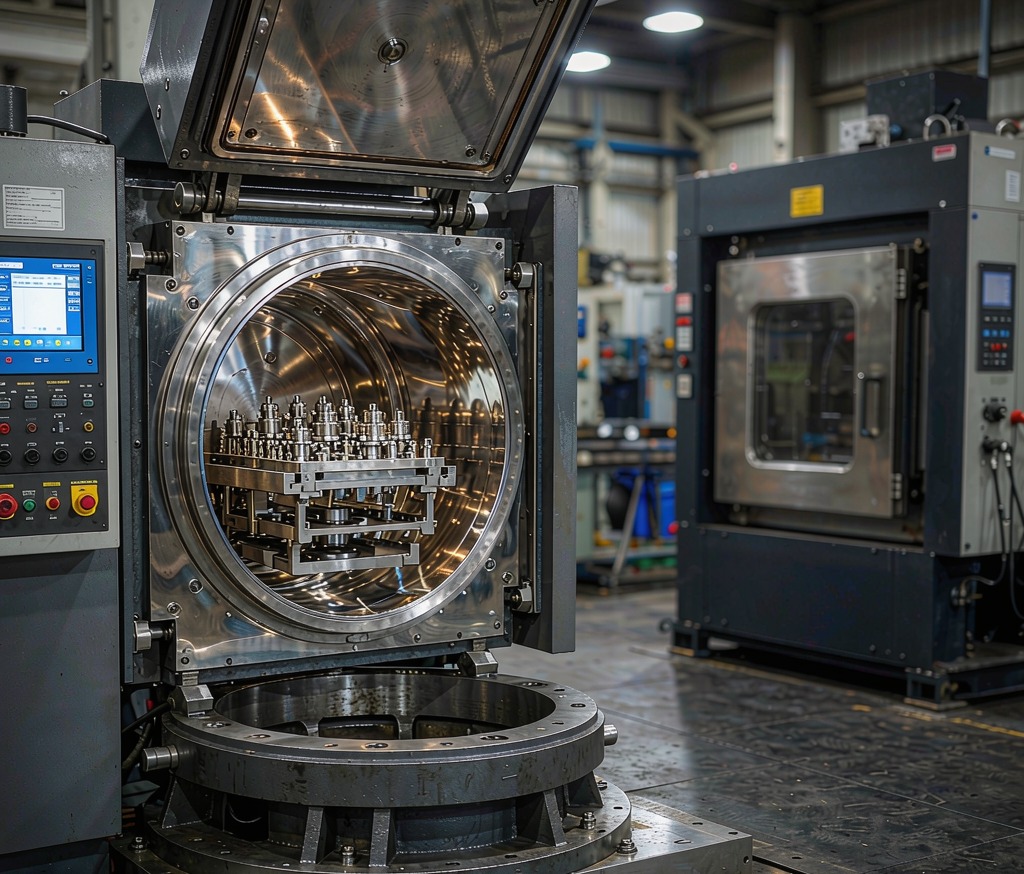
What Vacuum Heat Treatment Actually Changes
Three things change when you pump the chamber down to 10⁻³ mbar or below. First, there is no oxidation, so surfaces stay bright and no scale has to be blasted off. Second, there is no decarburisation, so the carbon content at the surface — and therefore the hardness — matches the core specification. Third, degassing occurs, which improves cleanliness on titanium and nickel alloys where hydrogen pickup is a genuine failure mode.
The practical benefit is dimensional. Because parts are heated radiantly and quenched in gas rather than plunged into oil, thermal gradients are gentler and distortion is much lower. Finish-machined components can often be treated to size with only a light grind afterwards, which is why the process is standard on precision tooling and aerospace hardware. Compared with the general options in our heat treatment services overview, vacuum is the choice whenever surface condition or distortion drives the decision.
Processes Run in a Vacuum Furnace
Hardening of tool steels and martensitic stainless is the highest-volume use: austenitise, gas quench, then temper, often with a cryogenic step between. Solution annealing of austenitic stainless and nickel alloys restores ductility and dissolves carbides. Age hardening of precipitation-hardening grades such as 17-4 PH develops strength in a controlled cycle. Bright annealing softens material without scaling.
Vacuum furnaces also run stress relieving, tempering, sintering, degassing, and brazing. Stress relief before finish machining is one of the highest-value uses because it removes the residual stress that makes parts move on the machine — the reasoning is set out in our stress relieving guide. Precipitation cycles for PH stainless and nickel alloys follow the logic described in age hardening services.
Materials That Benefit Most
Tool steels — D2, A2, H13, M2, and powder grades — gain hardness uniformity and dimensional stability. Martensitic stainless such as 420 and 440C keeps its corrosion resistance because no chromium-depleted scale forms. 17-4 PH and 15-5 PH are solution treated and aged. Titanium alloys must be vacuum processed because they react aggressively with oxygen and nitrogen at temperature. Inconel, Hastelloy, and cobalt-chrome superalloys are solution treated and aged in vacuum as standard practice.
Plain carbon steels can be vacuum treated, but the economics rarely justify it unless the part is finish-machined or has a cosmetic requirement. For those, surface-only hardening by induction hardening or nitriding is usually a better fit — you get a hard case with a tough core and no full-section heating.
High-Pressure Gas Quenching and Distortion Control
Instead of oil, modern vacuum furnaces quench with nitrogen, argon, or helium at pressures from 2 to 20 bar. Cooling rate is tuned by gas type, pressure, and fan speed, so the same furnace can deliver a slow quench for a distortion-sensitive part or a fast one for a grade that needs it. Helium cools fastest and is recovered and recycled because of cost.
Distortion control comes from three levers: uniform heating, a quench no faster than the grade requires, and load design that lets gas flow evenly around every part. Sections that must stay straight are supported or hung rather than laid flat. Long slender parts are quenched vertically. These choices routinely halve the distortion seen in oil quenching, which directly cuts post-treatment cylindrical grinding time.
Fixturing, Cleanliness, and Load Design
Cleanliness is not optional. Machining oils, coolant residue, and fingerprints vaporise in vacuum, contaminate the chamber, stain parts, and can carburise surfaces locally. Parts are degreased — usually ultrasonically — and handled with gloves before loading. Any masking compound or marker must be vacuum compatible.
Fixtures are molybdenum, TZM, graphite, or high-temperature stainless depending on temperature. They must support the part without creating a heat sink or blocking gas flow, and they must not sag under load at temperature. Load density is a real engineering decision: packing parts tightly improves furnace economics but slows and unevens the quench, so we design loads around the tightest distortion or hardness requirement in the batch, not the average.
Where Vacuum Beats Atmosphere and Salt Bath
Choose vacuum when the part is finish-machined or near-net, when a bright surface is required, when the alloy is reactive, when distortion tolerance is tight, or when documentation must be complete and traceable. Choose atmosphere or salt bath when the part is a rough forging with generous machining allowance, the alloy is plain carbon, and cost per kilogram dominates.
The comparison is rarely just furnace cost. Vacuum-treated parts skip descaling, need less stock removal, and scrap less, so the loaded cost is often lower even when the per-kilo price is higher. Stainless parts also keep their passive film intact, and only need passivation if machining occurred afterwards, while cosmetic parts avoid an extra polishing cycle.
Metallurgical Verification and Documentation
Every load should produce a furnace chart showing time, temperature at multiple thermocouples, vacuum level, and quench pressure. Hardness is tested on the parts or on witness coupons of the same heat lot. Case depth, where relevant, is verified by microhardness traverse on a sectioned coupon. Microstructure is checked metallographically when the specification requires retained austenite limits or grain-size control.
For aerospace, medical, and defence work, we supply the furnace chart, pyrometry calibration status, hardness and microstructure results, and a certificate stating the specification met — AMS 2759, AMS 2801, or your internal standard. Parts that continue to finish machining afterwards are held to the post-treatment dimensions established during CNC machining planning.
Cost, Batch Economics, and Lead Time
Vacuum heat treatment is priced by furnace cycle rather than by piece, so batch consolidation is the single biggest lever on unit cost. A part that shares an alloy and cycle with other work rides an existing load cheaply; a unique cycle for six pieces carries the whole furnace charge. Helium quenching, cryogenic steps, and multi-stage aging all add cycle time and cost.
Typical schedules: 3–6 days for standard hardening and tempering once parts are received, 5–8 days where solution treatment plus aging or a cryogenic stage is involved, and 24–48 hours for expedited single loads. Send the material grade and condition, the target hardness or specification, critical dimensions that must not move, and quantity, and we will state the cycle, the fixturing approach, and the documentation you will receive. Additional CNC grinding planning is included when parts are treated as part of a full machining package.
Frequently Asked Questions
Why is vacuum heat treatment more expensive than atmosphere furnace work?
Furnace capital, vacuum pumping, and inert gas cost more per cycle. However, parts need no descaling, less stock removal, and scrap less, so the total delivered cost is often lower for finish-machined components.
How much distortion should I expect?
Gas quenching typically produces well under half the distortion of oil quenching. Actual movement depends on geometry and section change; we advise fixturing and orientation to keep critical features within your allowance.
Can you treat titanium and reactive alloys?
Yes. Titanium, zirconium, and nickel superalloys must be vacuum processed to avoid oxygen and nitrogen pickup, and our furnaces are configured for those cycles.
Do you provide furnace charts and certification?
Every load produces a time-temperature-vacuum chart. We supply hardness results, microstructure where specified, pyrometry calibration status, and a certificate to AMS 2759 or your internal standard.
Should parts be finish machined before or after treatment?
Leave a light grinding allowance on critical features. Vacuum treatment moves parts far less than oil quenching, but a few hundredths of a millimetre of allowance still protects tight tolerances.
What is the minimum batch size?
There is no piece minimum, but pricing is per furnace cycle. Small quantities are most economical when they share an alloy and cycle with other scheduled work.
Ready to Start Your Project?
Get a build-ready quote on your custom metal parts within 24 hours. Share your drawing and our engineers will respond with process, lead time, and pricing.

