
Vacuum brazing joins metals inside a sealed furnace evacuated to a high vacuum, so the filler alloy flows into the joint without flux, without oxidation, and without the distortion that fusion welding brings. For buyers sourcing heat exchangers, cooling plates, sensor bodies, vacuum chambers and ceramic-to-metal assemblies, it is often the only process that delivers a leak-tight, hermetic joint on a thin-walled part that must stay dimensionally perfect.
This guide explains how vacuum brazing works, which alloys and base materials suit it, what tolerances and leak rates you can expect, how pricing is built up, and how to prepare a drawing package that gets a firm quote back quickly. If you already know the geometry you need, our engineering team can review your joint design and recommend the right filler alloy and furnace cycle.
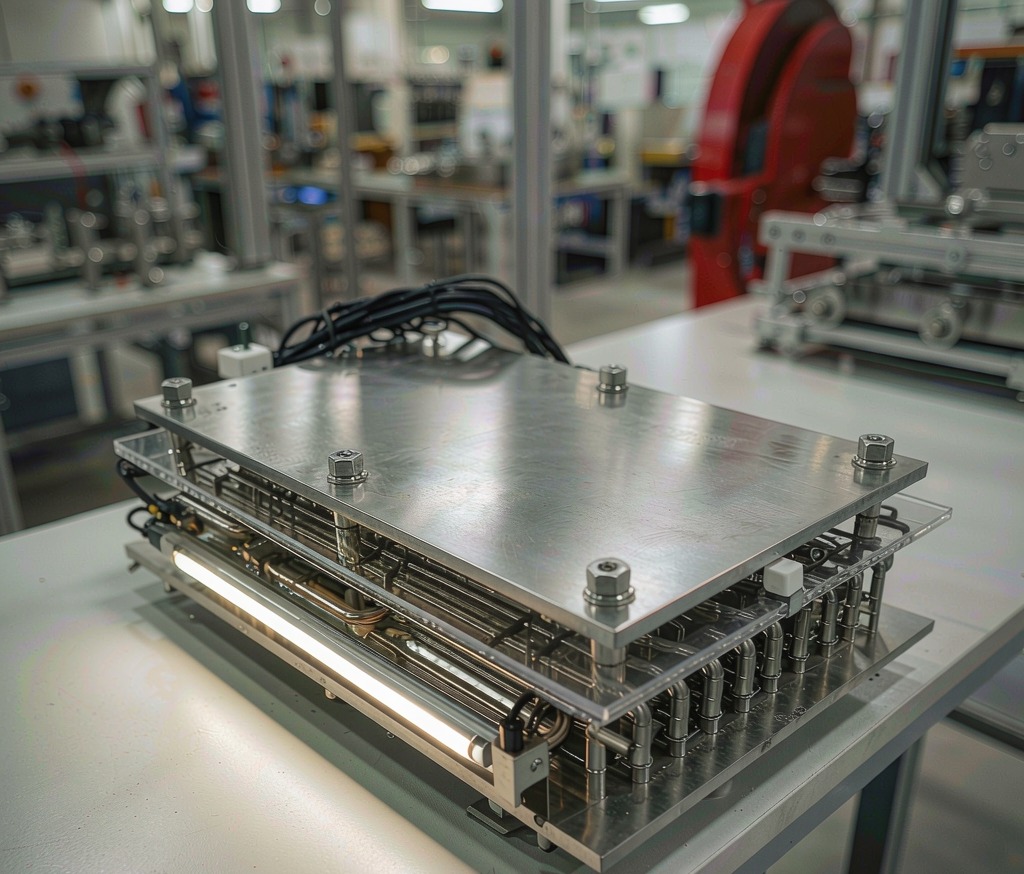
How Vacuum Brazing Works
The assembly is cleaned, fixtured, loaded with filler alloy in paste, foil or preform form, and placed into a cold-wall vacuum furnace. The chamber is pumped down to roughly 10-4 to 10-6 Torr, then heated uniformly by radiant graphite or molybdenum elements. Because there is virtually no oxygen present, oxides do not re-form on the faying surfaces and no chemical flux is needed. The filler melts, wets the joint, and is drawn through the gap by capillary action.
Uniform radiant heating is the reason vacuum brazing beats torch or induction brazing on complex assemblies. The whole part reaches temperature together, so residual stress stays low and thin fins do not slump. Many shops combine the braze cycle with a solution treatment or age so the part leaves the furnace already heat treated, which removes a separate heat treatment operation from the routing.
Joint clearance is the single most important design variable. Most nickel and copper filler systems want 0.025 to 0.075 mm of clearance at brazing temperature, and because base metals expand at different rates you have to design the gap hot, not cold. We machine mating details on CNC turning and CNC milling centres to hold that clearance repeatably across a production lot.
Filler Alloys and Base Material Combinations
Nickel-based fillers such as BNi-2, BNi-5 and BNi-7 are the workhorses for stainless steel, Inconel and Hastelloy assemblies that see 400 to 900 °C in service. Copper (OFHC) works beautifully on stainless when a ductile, high-conductivity joint is wanted. Silver-copper-palladium alloys serve vacuum electronics and medical work, and aluminium-silicon fillers braze 3003 and 6061 heat exchangers around 590 to 610 °C.
Dissimilar joints are the real strength of the process. Copper to stainless, molybdenum to Kovar, titanium to stainless and alumina ceramic to metal are all routine once the metallisation and filler are chosen correctly. Comparing the joint families side by side against conventional torch and furnace work in our metal brazing services guide is a useful starting point before you commit a design.
Where the application needs a solid-state bond with no filler at all, diffusion bonding is the neighbouring process, and for localised joints on thicker sections laser welding may cost less per part. We will tell you honestly which of the three fits your drawing.
Applications That Depend on Vacuum-Brazed Joints
Liquid cold plates and micro-channel heat exchangers for power electronics and battery packs are the highest-volume application, because a flux-free internal cavity means no residue to contaminate coolant. Vacuum chambers, feedthroughs, bellows assemblies and gas-delivery manifolds for the semiconductor equipment sector rely on the hermeticity that vacuum brazing gives.
Aerospace uses it for fuel nozzles, honeycomb seals and turbine components. Medical device makers braze surgical tool tips, endoscope housings and imaging assemblies where a clean, biocompatible joint with no flux entrapment is mandatory. Instrumentation makers use it for pressure sensor stacks and load cells.
Nearly all of these assemblies arrive as a kit of machined details plus tubing and sheet. We build the complete kit in-house, including tube laser cutting for the fluid circuit and welded assembly work for the frames that carry the brazed core.
Quality, Leak Testing and Inspection
A hermetic claim means nothing without a documented test. We helium leak test to 1 x 10⁻⁹ std cc/sec on vacuum-service parts, pressure test cold plates hydrostatically to 1.5 times working pressure, and hold burst test data on file for the qualification lot. Radiography or ultrasonic C-scan verifies filler coverage inside closed cavities where visual inspection is impossible.
Dimensional control after brazing is checked on a CMM against the drawing datums, not against the pre-braze part, because the furnace cycle is where growth or shrink shows up. Typical post-braze flatness on a 300 mm cold plate lands within 0.15 mm, and we can lap or surface grind afterwards if the sealing face needs better.
Stainless assemblies usually finish with passivation to restore the chromium oxide layer, and high-purity gas parts get an electropolish. Full material certificates, braze operator qualification records, furnace charts and a first article report ship with the parts.
Cost Drivers and How to Quote Cheaper
Furnace time dominates the price. A vacuum braze cycle runs six to fourteen hours including pump-down, ramp, soak and controlled cool, so the real lever is how many assemblies you can nest into one load. Designing your part so eight or sixteen fit a single fixture instead of two can cut the per-piece furnace cost by an order of magnitude.
Fixturing is the second driver. Graphite or ceramic fixtures are consumable and are amortised over the programme, so a stable, repeat annual volume earns much better pricing than a one-off. Filler alloy choice matters when precious metals are involved; swapping a palladium alloy for BNi-2 where service temperature allows can halve the material line.
Machining tolerance on the faying surfaces is worth spending money on, because a well-controlled gap gives first-pass yield and avoids re-braze cycles. Send us the assembly model early and our DFM support team will mark up gap, fillet and vent recommendations before tooling is cut.
Lead Time and How to Request a Quote
Prototype brazed assemblies typically ship in 15 to 20 working days including machining of details, fixture build and one furnace cycle. Production lots after fixture qualification run 20 to 30 days depending on volume and finishing. Expedited single-cycle work is possible when the fixture already exists.
To quote accurately we need a 3D model of the assembly, a 2D drawing showing joint locations and required leak rate, base material and temper for each detail, service temperature and pressure, quantity per release and annual volume, plus any specification you must meet such as AWS C3.6 or a customer-specific braze spec.
If the design is still open, send the thermal or pressure requirement instead of a finished drawing. We regularly convert a performance target into a manufacturable brazed assembly, and our material consulting service will confirm the base metal and filler pairing before you freeze the print.
Frequently Asked Questions
Is vacuum brazing stronger than welding?
A well-designed brazed joint typically develops the strength of the weaker base metal in shear, and it distributes load over a large area instead of concentrating it in a fusion zone. Welding wins on very thick sections and single localised joints; vacuum brazing wins on thin walls, many joints at once, and dissimilar materials.
What clearance should I design into the joint?
Plan on 0.025 to 0.075 mm at brazing temperature for nickel and copper fillers. Because the two base metals expand differently, calculate the gap at temperature rather than at room temperature, then hold the room-temperature machined dimension that produces it.
Can you braze aluminium in a vacuum furnace?
Yes. Aluminium vacuum brazing with Al-Si filler around 590 to 610 °C is standard for 3003 and 6061 heat exchangers and cold plates. It requires a dedicated furnace and magnesium getter control, and the process window is narrower than nickel brazing on stainless.
Do brazed parts need heat treatment afterwards?
Often not, because the braze cycle can double as the solution or age treatment. For precipitation-hardening stainless such as 17-4 PH we design the furnace profile so the braze and the aging step happen in one load, which saves cost and avoids a second distortion risk.
What leak rate can you certify?
We routinely certify 1 x 10⁻⁹ std cc/sec helium on vacuum and gas-service assemblies, with the test report shipped against the lot. Tighter rates are achievable on small hermetic packages; tell us the target in the RFQ so the joint design supports it.
What is the minimum order quantity?
There is no hard minimum. Single prototypes are welcome, though per-piece cost is dominated by furnace and fixture time at low volumes. Batching several designs into one furnace load is a common way to keep prototype cost reasonable.
Ready to Start Your Project?
Get a build-ready quote on your custom metal parts within 24 hours. Share your drawing and our engineers will respond with process, lead time, and pricing.

