
When you need a full-strength joint between two metals—especially dissimilar ones—without melting either part, friction welding is the process to know. It generates heat by rubbing the two components together under axial force until the interface is plastic, then forges them into a single solid piece as the motion stops. No filler, no flux, no shielding gas, and a bond that can be as strong as the parent metal. Huaxiao offers friction welding as part of a joining program that can also use spot welding and TIG welding where a different joint is required.

How Friction Welding Forms a Solid-State Bond
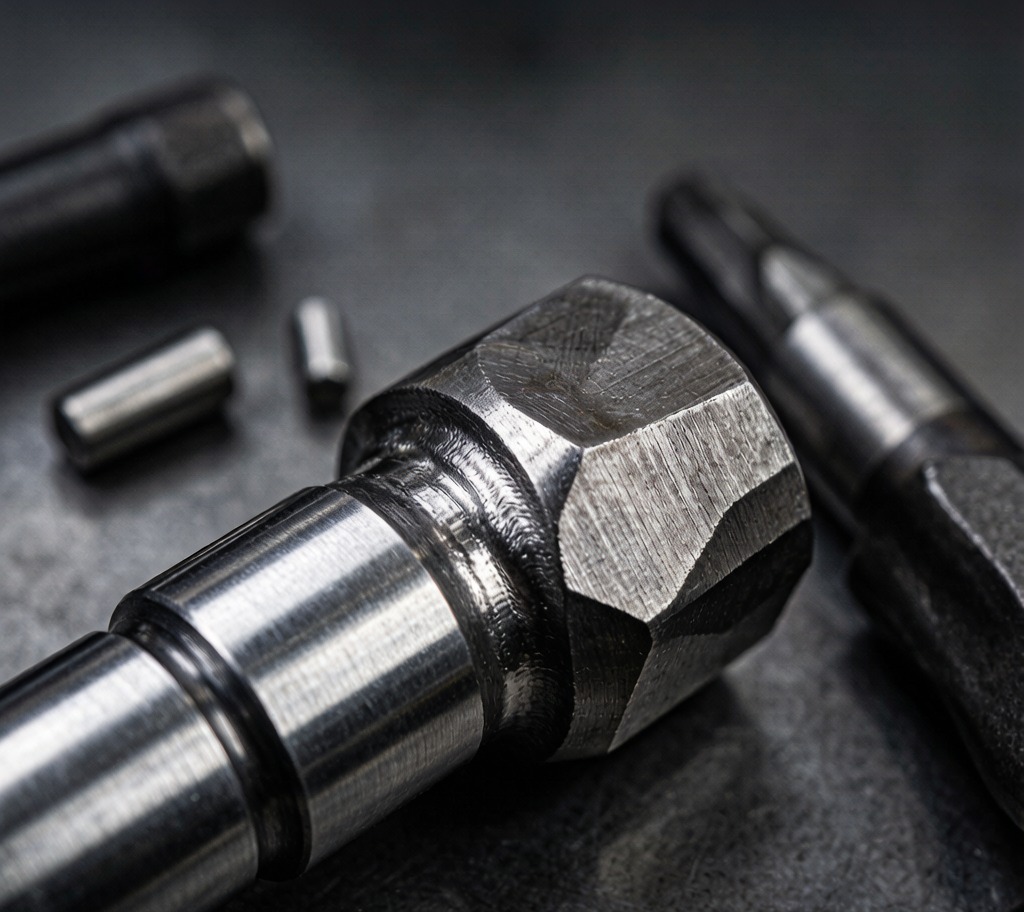
In inertia and rotary friction welding, one part spins while the other is held stationary and pushed axially into it. Friction heats the interface; at the right moment the drive stops and the forge force squeezes out the softened, oxidized material as a flash, leaving clean metal bonded to clean metal. Linear (reciprocating) friction welding does the same with a back-and-forth motion for non-round parts. Our robotic welding cells complement this for thinner or more complex assemblies.
Inertia, Rotary and Linear Variants
Inertia welding stores energy in a flywheel for a repeatable, consistent burn; rotary welding uses a motor with controlled rpm and force; linear welding serves rectangular or non-rotationally-symmetric joints. All produce a solid-state bond with a characteristic forged flash that is trimmed after welding. Where a mechanical backup is wanted, we can add riveting or MIG welding in the same cell.
Joining Dissimilar and Hard-to-Weld Metals
Because there is no melt pool, friction welding joins combinations that arc welding struggles with: aluminum to steel, titanium to steel, copper to aluminum, and tool steel to mild steel for cost-efficient cutting tools. The bond is metallurgical and free of brittle cast microstructure. As our friction stir welding services guide notes, both are solid-state but serve different geometries—stir for plates and extrusions, friction welding for round and butt joints.
Strength and Consistency Advantages
A correctly made friction weld matches or exceeds the weaker parent in tensile and fatigue. There is no filler to vary, no porosity from solidification, and the process is highly repeatable once parameterized. That is why it is a staple in automotive metal parts—valve stems, axle tubes and driveline components are classic examples.
Typical Applications and Industries
Beyond automotive, you will find friction welding in drill pipes and tool joints for oil and gas, hydraulic piston rods, bimetallic saw bodies, and orthopedic implants. Anywhere a strong, clean butt joint between a costly alloy and a cheap base saves material, it pays for itself. Many of these programs run through our welded assemblies guide workflow.
The material-saving angle is what wins many programs. Joining a short section of expensive alloy to a long, cheap base—rather than making the whole part from the costly metal—can cut material cost dramatically while keeping the performance exactly where it is needed. This bimetallic logic is why friction welding appears in oilfield tool joints, bimetal saw bodies and orthopedic implants, where only the working tip needs the premium alloy. The solid-state bond also avoids the brittle intermetallics that plague arc welding of dissimilar metals.
Reliability is the other draw. With no filler to vary and no solidification porosity, the joint is governed by process parameters—speed, force, burn-off—that are easy to monitor and reproduce. We log those on every part and verify with tensile, bend and macro-etch testing to your spec, so the weld is a controlled, documented feature rather than a hoped-for one. For safety-critical driveline and structural parts that consistency is what earns friction welding its place.
Design and Joint Preparation Tips
- Keep the joint face square and clean; the forge flash removes defects but not heavy contamination.
- Design for flash removal—leave stock on the diameter so the upset can be trimmed flat.
- Match cross-sections so heat generates evenly across the interface.
- Specify the required joint efficiency and we will select inertia vs rotary accordingly.
Our welded assemblies line can take friction-welded sub-components and finish them into a complete, inspected part.
It is worth noting what friction welding does not replace. Thin-sheet structures, complex multi-axis joints and parts where one side is inaccessible are better served by arc or resistance methods, and we will steer you to the right one rather than force a process. The strength of the approach is in solid, axisymmetric, high-strength joints—used where it fits, it is hard to beat, and where it does not, it simply is not the tool we reach for.
Frequently Asked Questions
Is a friction weld as strong as the base metal?
It can equal or exceed the weaker parent in tensile and fatigue when the schedule is correct, because the bond is forged, not cast.
Can it join aluminum to steel?
Yes—this is a headline use case. Solid-state bonding avoids the brittle intermetallics that plague arc welding of those combinations.
What shapes can be welded?
Rotational parts (shafts, tubes, discs) suit inertia or rotary welding; linear friction handles rectangular and non-round joints.
Is there any filler or gas?
No filler, flux or shielding gas. The joint is made entirely by frictional heat and forge force.
How do you control quality?
We monitor spindle speed, force and burn-off, and verify with tensile, bend and macro-etch tests to your specification.
What about the flash?
The upset flash is trimmed after welding to leave a clean, flush joint at the finished diameter you specify.
Ready to Start Your Project?
Get a build-ready quote on your custom metal parts within 24 hours. Share your drawing and our engineers will respond with process, lead time, and pricing.

