
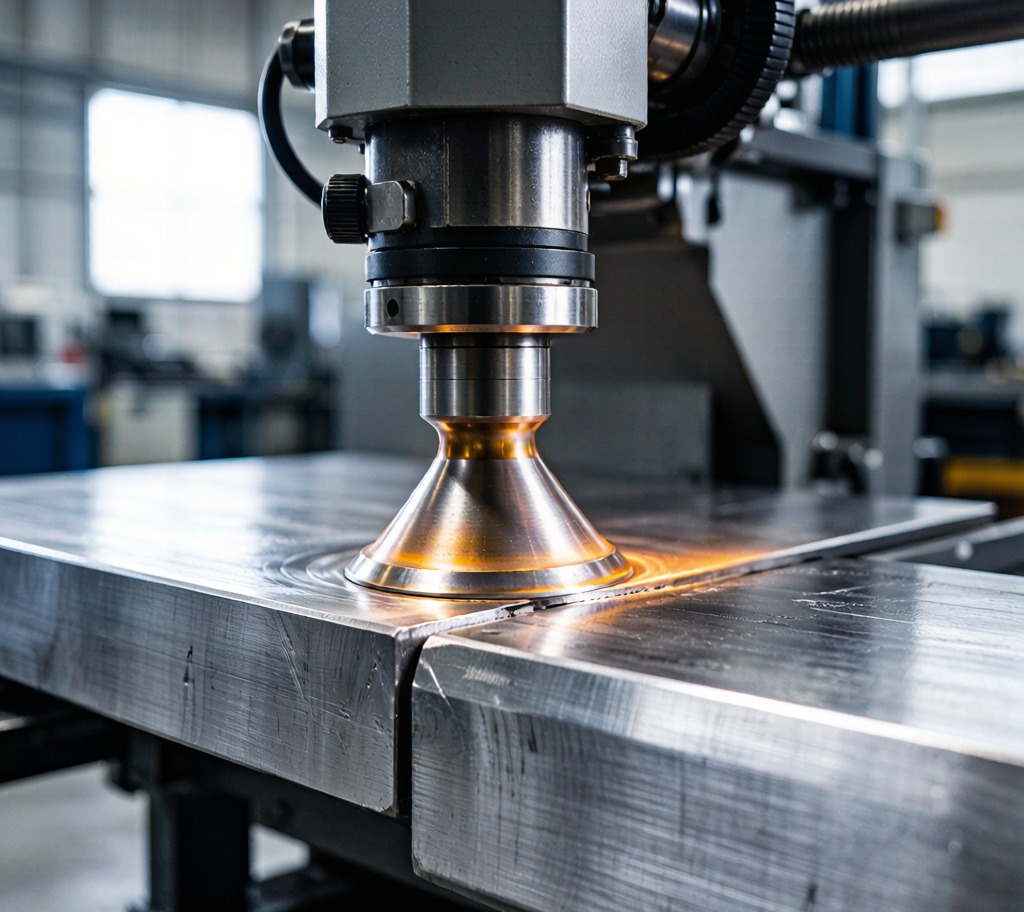
Friction stir welding services join aluminium without melting it. A rotating tool with a profiled pin and a broad shoulder plunges into the seam between two clamped plates and traverses along it. Friction generates enough heat to soften the metal to a plastic, dough-like state — roughly 80 percent of melting point — and the tool’s rotation stirs material from both sides into a single, forged, fine-grained joint. Nothing liquefies. That single fact eliminates porosity, solidification cracking, alloying element loss, and most of the distortion that makes fusion welding of aluminium so difficult. For EV battery trays, liquid cold plates, and structural panels, FSW is now the default rather than the exotic option.

Why Solid-State Joining Beats Fusion on Aluminium
Molten aluminium dissolves large amounts of hydrogen and rejects almost all of it on solidification, which is why fusion welds in aluminium are prone to porosity. The oxide layer melts at 2,050 °C while the metal beneath melts at 660 °C, so the weld pool is permanently fighting a tenacious skin. Heat-treatable 6000 and 7000 series alloys lose temper in the heat-affected zone, and 6082-T6 can drop from 310 MPa to below 180 MPa across a TIG weld.
Friction stir welding sidesteps all of this. Peak temperature stays in the 400 to 500 °C range, hydrogen never enters solution, and the oxide film is mechanically broken up and dispersed by the stirring action. Joint efficiency is typically 70 to 90 percent of parent strength in heat-treatable alloys and can reach 100 percent in non-heat-treatable 5000 series — substantially better than any arc process. Fatigue performance is better still, because there is no weld toe stress raiser and no cast microstructure.
Distortion drops by roughly 70 to 80 percent compared with MIG. Heat input is a fraction of an arc process, and the plate is rigidly clamped throughout. On a 1,500 mm battery tray, that can be the difference between a part that drops into the assembly fixture and one that needs three hours of straightening. If you are weighing the arc alternatives first, our aluminum welding guide and the comparison in MIG vs TIG welding set out where each still makes sense.
Joint Designs, Thickness and Process Limits
Butt joints are the natural configuration and the most widely used. Lap joints are possible with a modified pin profile, though hooking defects at the joint interface need careful parameter control. T-joints, corner joints, and multi-pass welds on thick section are all in production somewhere, but butt and lap cover the overwhelming majority of commercial work.
Single-pass thickness ranges from about 0.5 mm foil up to 65 mm in aluminium with a suitable machine and tool. The commercial sweet spot is 2 to 25 mm. Welding from both sides doubles the achievable thickness. Travel speeds run 200 to 2,000 mm per minute depending on thickness and alloy.
Two process constraints matter at design stage. First, the weld requires a backing anvil beneath the joint to react the substantial downward forge force, typically 5 to 30 kN. That means the joint must be accessible from below, or the design must incorporate an integral backing flange — a reason many FSW parts start life as aluminum extrusion profiles with backing webs built into the section.
Second, the tool leaves an exit hole where it retracts at the end of the weld. This is normally placed on a run-off tab that is later trimmed, or filled with a retractable-pin tool. It should never be left in a structural region.
Alloys and Dissimilar Metal Joints
Every aluminium series can be friction stir welded, including alloys classed as unweldable by fusion processes. The 2000 series (2024, 2219) and 7000 series (7075, 7050), which crack readily in arc welding, join reliably by FSW — a capability that opened aerospace fuselage and rocket tank applications. The 5000 series (5052, 5083, 5754) gives near-parent-strength joints. The 6000 series (6061, 6082, 6063) is the volume workhorse for extruded structures and heat sinks.
Copper, magnesium, zinc, titanium, and even steel can be friction stir welded with tools made from polycrystalline cubic boron nitride or tungsten-rhenium, though tool cost rises sharply. More commercially interesting is dissimilar joining: aluminium to copper for battery busbars and terminals, and aluminium to steel for automotive body structures. Because no melting occurs, the brittle intermetallic layer that ruins fusion welds between these metals is kept to a few microns. Our work on copper busbar manufacturing covers the electrical side of those joints.
Where a joint must be leak-tight and thermally efficient rather than structural, brazing is often the better economic answer, and our brazing services guide compares the two for heat exchanger work.
Applications, Fixturing and Cost
The dominant application today is EV battery enclosures. A tray is typically assembled from extruded aluminium profiles friction stir welded along their length to form a wide, flat, hermetic floor with integral cooling channels. FSW gives the low distortion needed for sealing surfaces and the leak-tightness needed for IP67 rating, without the porosity risk of MIG. The same logic drives liquid cold plates, where a machined channel plate is capped and sealed by a continuous stir weld — closely related to the constructions described in our aluminum heatsink manufacturing article.
Beyond automotive, FSW is used on aerospace panels and rocket propellant tanks, marine deck panels and hulls, railway carriage bodies, and large architectural panels. For hybrid assemblies where stir welding handles the long seams and arc welding handles the brackets and bosses, our robotic welding services and welded assemblies cells complete the part.
Cost structure differs from arc welding. There is no filler wire, no shielding gas, and no consumable electrode — a tool lasts hundreds of metres of weld in aluminium. Against that, the machine must be extremely rigid, and fixturing must clamp the workpiece firmly enough to resist both the traverse force and the downward forge load. Fixture cost is the main setup expense, so FSW rewards production volume and repeatability. Machining of the finished assembly, whether trimming run-off tabs or finishing sealing faces, is handled on our CNC milling centres, while smaller brackets and bosses are attached with TIG welding or MIG welding as appropriate.
Frequently Asked Questions
How strong is a friction stir weld? Typically 70 to 90 percent of parent metal tensile strength in heat-treatable alloys such as 6061-T6, and effectively 100 percent in 5083 and other non-heat-treatable grades. Fatigue strength usually exceeds fusion welds by a wide margin.
Is FSW leak-tight? Yes. The absence of porosity makes it exceptionally reliable for pressure and vacuum service, which is why it is used on rocket propellant tanks and sealed battery enclosures. We helium leak test where the specification requires it.
What is the minimum production volume? Fixturing cost means FSW usually needs a few hundred parts per year to beat arc welding, though large panels and leak-critical assemblies can justify it much sooner. We quote both routes so the comparison is explicit.
Can you weld curved or three-dimensional seams? Straight and gently curved seams are straightforward. Complex 3D paths need a robotic or five-axis FSW head with force control, which we assess case by case.
Does the weld need post-processing? The surface carries a characteristic onion-ring pattern and slight flash at the shoulder edge. Flash is trimmed, and the weld can be milled flush if the surface is cosmetic or a sealing face. No grinding of porosity or spatter is needed.
What do you need to quote? A 3D model of the assembly, alloy and temper, plate or extrusion thickness, seam lengths, leak or strength requirements, and annual volume. We will return a joint design proposal, fixture concept, and pricing within 24 hours.
Ready to Start Your Project?
Get a build-ready quote on your custom metal parts within 24 hours. Share your drawing and our engineers will respond with process, lead time, and pricing.

