
Electron beam welding sends a focused beam of electrons through a vacuum to melt and fuse metal with a depth-to-width ratio no arc process can match. The result is a deep, narrow weld with a tiny heat-affected zone, which is why it is the choice for turbine parts, sensors, and reactive alloys that cannot tolerate distortion or contamination. This article explains when electron beam welding beats laser or TIG, where it falls short, and how to prepare a part for the vacuum chamber. We contrast it with TIG and robotic welding you may already use.
How the Beam Works
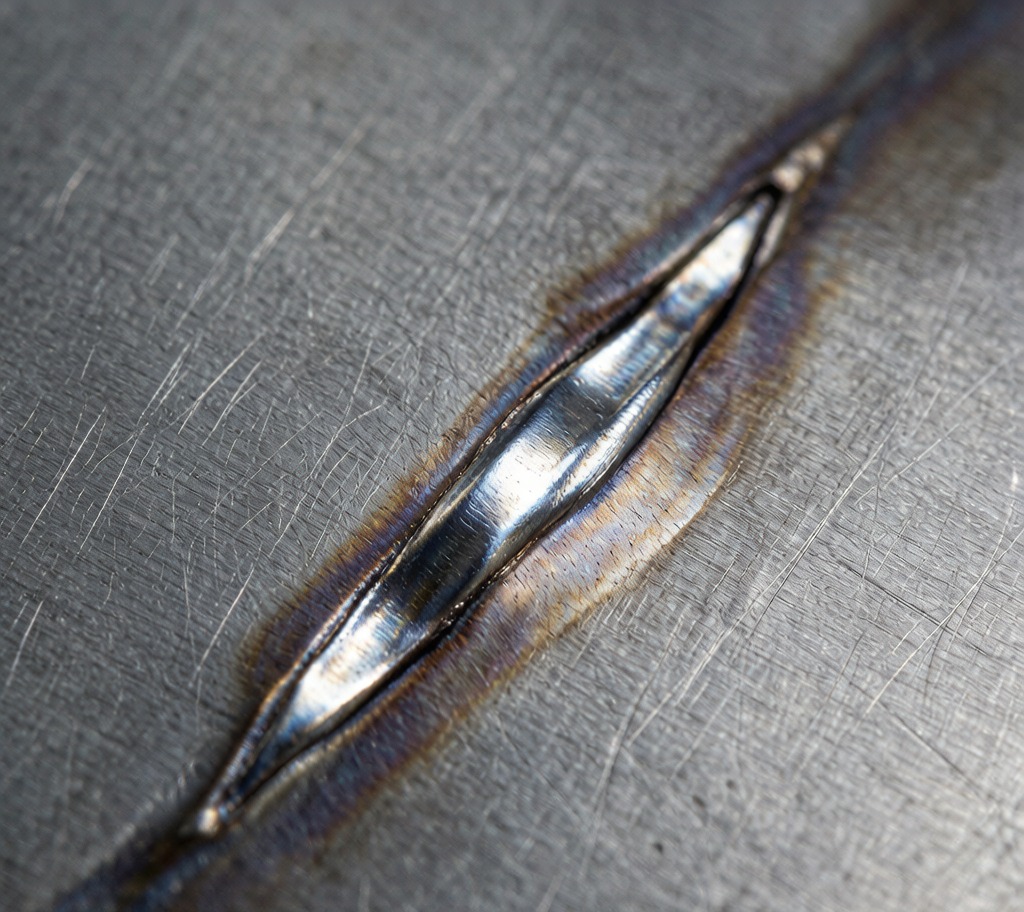
Inside a vacuum chamber, an electron gun accelerates and focuses a beam to a spot smaller than a hair. The kinetic energy turns to heat on contact, melting a narrow keyhole that travels through the joint. Because the chamber is evacuated, there is no atmospheric contamination of the molten pool.
The beam can be steered electromagnetically, so complex seam paths are programmed rather than fixtured. This pairs well with our laser welding line for parts that move between processes.
Deep Penetration, Low Distortion
A single pass can weld tens of millimeters of steel or titanium while the surrounding material stays cool, so thin features near the joint do not move. That low distortion removes straightening and re-machining steps that arc welding would force.
For assemblies that must hold a finished dimension, we often finish-machine first, then wire EDM or weld last so geometry is preserved.
Reactive and Refractory Alloys
Titanium, zirconium, and high-nickel alloys oxidize instantly in air; the vacuum makes clean joints possible without filler gas games. This is why EB welding appears in aero engine and medical implant work where a contaminated weld is a failure.
After welding reactive alloys, a heat treatment or stress relief may be specified to stabilize the part; we quote that as a follow step.
When Not to Use It
The vacuum chamber sizes the part, so very large or awkward shapes are better on laser or MIG lines. Throughput is also lower because pump-down takes time, so EB welding suits high-value, lower-volume work more than high-rate stamping.
If you only need a shallow seal weld, our friction stir welding or laser options are faster and cheaper.
Joint Design and Fit-Up
EB welding demands tight fit-up, typically a square butt with near-zero gap, because the narrow beam will not bridge a void. Step or lap joints are possible but the beam path must be programmed to the interface.
We review the joint drawing and may suggest a slight land or a tack sequence using robotic welding before the EB pass to hold alignment in the chamber.
Inspection and Quality
Welds are checked by dye penetrant, radiography, or ultrasonic depending on the spec; the narrow zone makes defects easy to read on a radiograph. First-article parts get full NDE before a run is released.
As with any structural joint, our welded assemblies guide applies for symbol reading and distortion control across the larger build.
Quality Control and Inspection
Every electron beam welding services order begins with a first-article inspection. We measure the critical dimensions on a CMM or dedicated gauge and compare them to your drawing before any volume runs start. Only after you approve the report do we release production, so the first batch is already at spec rather than a learning curve.
For functional features we add targeted checks, from thread gauging on fasteners to flatness, squareness, and runout on frames and shafts, and we keep a traveller with the lot so a later question can be traced to the exact machine setup. That discipline is what keeps reject rates low across repeat orders.
We also confirm the finish and any marking against the approved sample, because a good dimension on a badly finished part still fails on the line. Surface, color, and legend are inspected alongside the numbers so what ships matches what you signed off.
Lead Time and How to Request a Quote
Quoting electron beam welding services is fast when you send a drawing, a sample, or even a marked sketch with the key dimensions called out. We return a price with DFM feedback, a recommended material, and a realistic lead time, usually within one business day, so you can plan the build without waiting on a vendor.
Prototype quantities run in days; production batches scale with material and finish, and we can hold your drawing on file for fixed-schedule replenishment so you keep stock without tying up cash in inventory you do not need yet. Tell us annual volume and we set the cadence.
If you are unsure of the best process, ask. A short call before release often saves a costly rework, and we would rather steer you to the cheaper capable route than quote the one you assumed. The goal is a part that assembles first time at the right cost.
Common Specification Mistakes to Avoid
The most expensive mistake on electron beam welding services is over-tightening tolerances the assembly never needed. Every step past process capability adds cost per feature, so call out only the dimensions that locate or seal another part and leave the rest to standard commercial limits. Tight where it counts, loose where it does not.
The second mistake is forgetting the datum and the environment. State which surface everything is measured from, and name the service condition, indoor, outdoor, washdown, or vacuum, so the material and finish are chosen once and not reworked after a field failure.
The third is treating finish as an afterthought. Plating, anodize, or coating change dimensions and must be in the tolerance stack from the start. Tell us the final coated size you need and we will machine to suit, instead of discovering the coat pushed you out of spec at the end.
Frequently Asked Questions
When is EB welding worth the cost?
For deep, low-distortion, contamination-free welds in titanium, nickel, or thin-near-thick sections.
What size part fits?
Limited by chamber size; large or high-rate parts suit laser or MIG instead.
Is filler metal used?
Usually not; the beam fuses the parent metal, which keeps the weld chemistry clean.
How is quality checked?
Dye penetrant, radiographic, or ultrasonic NDE per spec, with first-article inspection.
Can you weld after machining?
Yes, finish-machine then weld last to preserve critical dimensions.
Ready to Start Your Custom Part?
Send us your drawing or sample and get a competitive quote with DFM feedback, lead time, and material recommendation within one business day.

