
Choosing between metal stamping vs die casting decides your tooling cost, unit price, and what shapes are even possible. Stamping shapes sheet metal with dies; die casting forces molten metal into a mold. Both make volumes of identical parts, but they suit very different geometries. This guide helps engineers pick the right one. Our metal stamping services and die casting services cover both capabilities.
How Each Process Works
Stamping uses a press and hardened die to cut, bend, or form sheet stock in milliseconds per hit. It excels at flat or lightly formed parts: brackets, shields, clips, and enclosures. CNC punching and CNC bending are flexible sheet-metal variants. Die casting injects liquid metal under pressure into a steel mold, producing complex 3D shapes with internal features in one shot. Die casting is the choice for solid, net-shape components. The physics of each process sets hard limits on what you can make and at what cost.
Tooling and Unit Cost
Stamping dies are relatively cheap and fast to make; die-casting molds are expensive but very long-lived. At low to mid volume, stamping usually wins on tooling. At high volume, die casting’s per-part cost drops sharply because the mold yields millions of shots. Progressive dies let stamping scale too, as our precision metal stamping page explains. The break-even between the two is mostly a function of annual quantity and part complexity, not of the metal itself, so the volume forecast drives the decision more than intuition.
Materials and Part Shapes
Stamping works in steel, stainless, and aluminum sheet, plus some copper alloys; parts are thin-walled by nature. Die casting is dominated by zinc, aluminum, and magnesium alloys and can produce thick sections, bosses, and internal cavities that stamping cannot. Sand casting is the alternative for very large or low-volume solid parts. If your part needs a hollow boss or an undercut cavity, die casting or casting beats stamping every time and avoids the weld-and-insert workarounds stamping would force on you.
Tolerances and Surface Finish
Stamped parts hold tight flatness and hole-position tolerances and take paint or plate well. Laser cutting can pre-cut blanks with burr-free edges. Die-cast parts hold good dimensional repeatability and need minimal finish machining, though pores can appear in thick sections. Powder coating finishes both processes uniformly. Plan the downstream finish before you commit to a process, because it changes the as-cast or as-stamped tolerance you can reliably hold across a run.
When to Choose Which
Pick stamping for thin, flat, or formed sheet-metal parts at low to high volume where cost per hit matters. Pick die casting for complex, solid, or hollow 3D parts where molding internal features beats machining them away. If the part is a bracket or shield, stamp it; if it is a housing with bosses and ribs, die cast it. The cross-over is usually geometry first, then volume. When in doubt, send the drawing and let process engineering pick the cheaper route that still meets the spec without sacrificing function.
Secondary Operations and Assembly
Neither process ships alone for most parts. Stamped blanks are deburred, bent, and often welded or assembled; die-cast parts are trimmed, blasted, and machined on datums. CNC bending forms stamped brackets, while powder coating protects the finished part. Planning these secondary steps up front avoids a tolerance stack-up between operations. Send the full part scope, not just the primary form, and process engineering will sequence the work to hold the critical features you care about most.
Stamped vs Cast: Part Examples
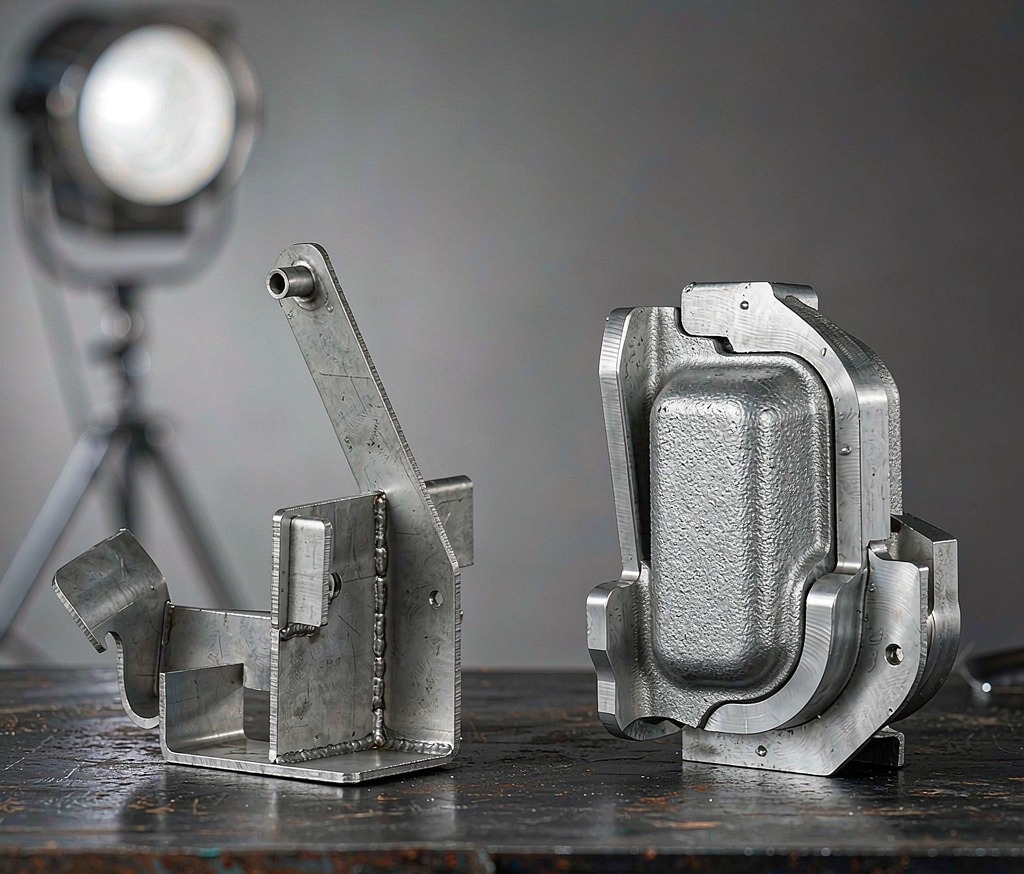
A laptop shield, a washer, a spring clip, and a mounting bracket are natural stampings: thin, flat, and produced in the millions at low cost per hit. A gearbox housing, a pump body, a motor end-bell, and a bracket with hollow bosses are natural die castings: solid or hollow 3D shapes with features molded in, not machined out. CNC punching extends stamping into perforated and tabbed sheet, while die casting extends into complex aluminum and zinc assemblies. Matching the part to its natural process is the single biggest lever on unit cost, so send the drawing early and let geometry decide the route instead of habit.
Design Tips to Lower Cost
For stamping, keep bend radii reasonable, avoid tiny holes near edges, and design for progressive-die flow to cut tooling. For die casting, use uniform wall thickness, add draft to every face, and place bosses where the mold can fill them. CNC bending of stamped blanks should be planned with the die so features do not collide. Our precision metal stamping page lists the design rules we quote against. A drawing tuned to the process can cut tooling cost and lead time substantially without changing the function the customer sees on the finished assembly.
Frequently Asked Questions
Is stamping cheaper than die casting?
Stamping usually has lower tooling cost and wins at low-to-mid volume; die casting wins on per-part cost at very high volume thanks to long mold life.
Can die casting make thin walls?
Yes, but stamped sheet metal reaches thinner, flatter walls more economically. Die casting suits thicker, more complex solid shapes.
Which materials can be stamped?
Steel, stainless steel, aluminum, and some copper alloys in sheet form are standard stamping materials.
Metal stamping vs die casting is a geometry-first decision backed by volume. Send us your drawing and we will recommend the process that minimizes cost and lead time.
Ready to Start Your Project?
Get a build-ready quote on your custom metal parts within 24 hours. Share your drawing and our engineers will respond with process, lead time, and pricing.

