
5G, IoT, and telecom infrastructure depend on antenna hardware that is electrically precise and mechanically rugged. The metal parts behind an RF antenna, including brackets, radome mounts, waveguides, and heat-spreaders, must hold tight geometry so signal performance is not compromised by mechanical drift. This guide covers manufacturing RF and 5G antenna metal components to specification and at scale.
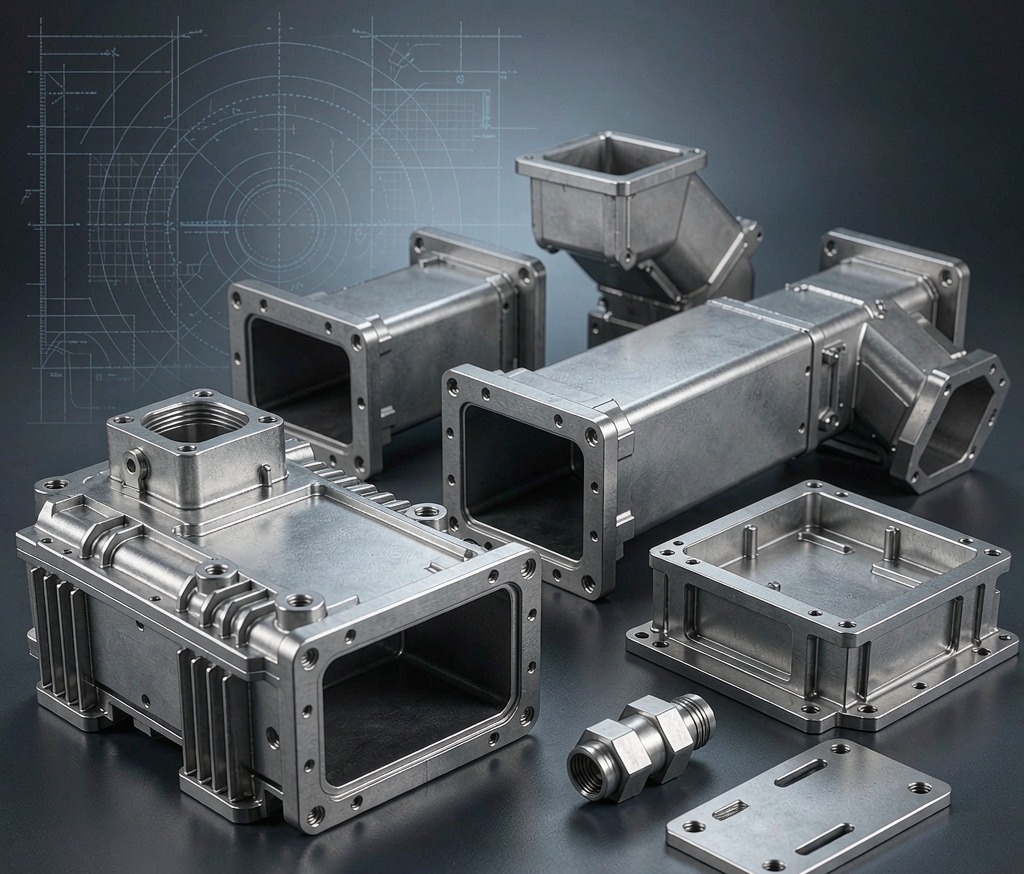
The Role of Metal in RF Antennas
Metal provides the structural backbone, grounding path, and thermal route for antenna assemblies. Dimensional accuracy affects beam alignment and return loss, so sloppy machining shows up directly as lost throughput. Our CNC milling and CNC turning deliver the flatness and concentricity RF designs demand, holding features that plastic or composite tooling simply cannot match consistently.
Mounting Brackets & Enclosures
Antenna mounts must survive wind load, temperature swing, and UV exposure for a decade or more. Aluminum brackets with anodizing or powder coating resist corrosion outdoors without adding weight to the structure. Enclosures for radio units are detailed in our custom metal enclosures guide, which addresses venting and thermal management for active electronics.
Waveguide & RF Structures
Waveguides and cavity parts need smooth internal surfaces and exact dimensions, because roughness and variance scatter energy and shift the operating frequency. Machined aluminum is standard, and tight tolerances keep losses low. Shielding considerations are covered in our EMI/RF shielding parts article, which explains how seams and coatings preserve signal integrity in dense deployments.
Telecom Infrastructure Parts
From base-station frames to small-cell housings, telecom hardware spans cast, extruded, and machined metal. Our telecom metal parts guide outlines the common components and their processes, including aluminum extrusion for heat-sinks and rails that keep equipment within its thermal envelope during peak traffic.
Materials & Finishes
Aluminum leads for weight and conductivity; steel is used where stiffness dominates and mass is acceptable. Conductive finishes and proper grounding paths preserve signal integrity, while non-conductive coatings protect surfaces that are not part of the RF path. For high-volume bodies, die casting offers repeatable geometry and lower unit cost once the tool is proven and sampled.
Deployment & Installation Hardware
Antennas are only as reliable as the brackets holding them through years of wind and ice load. Machined mounting plates with precise hole patterns simplify field installation and reduce the risk of misalignment that degrades the beam. Consider ordering brackets and enclosures together so the interfaces are validated as a pair rather than assumed compatible from separate drawings.
Lifecycle & Maintenance
Outdoor RF hardware is expected to run for a decade with minimal service. Specify finishes rated for the local environment, including coastal salt spray or industrial pollution, and confirm the supplier can reproduce the exact anodize or coating on reorders years later. Documented process control is what keeps a replacement part identical to the one installed at launch.
Working With Your Supplier Early
RF performance is won or lost in the details of geometry and finish, so bring the manufacturer in while the design is still flexible. They can advise on which features must be machined versus cast, and on the anodize or coating that preserves both corrosion resistance and electrical contact. Early alignment avoids the expensive late discovery that a seemingly minor dimension drives return loss beyond the spec your network plan assumed.
Documentation & Traceability
Telecom builds span years and many sites, so keep material and finish records with each batch of hardware. A supplier who provides consistent, batch-level documentation lets you reorder identical parts long after the original engineer has moved on. This discipline keeps a decade-long deployment coherent, with every replacement bracket matching the one installed at launch without reverse-engineering from a faded label.
Getting Started on Your Antenna Hardware
Start by sharing the RF drawing, the environmental rating, and your expected rollout volume so the manufacturer can propose the right process mix. A brief technical review catches the dimensions that drive signal loss before tooling is cut, saving both schedule and budget. With a partner who treats flatness and finish as performance parameters, your antenna hardware will hold its specification from the first site through the last, decade after decade.
Qualifying an RF Parts Supplier
Require material traceability, first-article inspection, and the ability to hold the specific flatness and bore tolerances your RF model needs. Ask about plating and anodizing control, which affect both corrosion resistance and electrical contact at joints. A supplier who understands why a tenth of a millimeter matters will protect your link budget better than one optimizing only for cycle time.
Scaling From Pilot to Rollout
5G builds move from lab pilots to thousands of sites quickly. Confirm the shop can replicate the first-article result across the volume you need, with documented process control and batch-level inspection. Plan for finish capacity early, because anodizing and coating queues, not machining, often become the critical path on a tight deployment schedule.
Frequently Asked Questions
Why is aluminum common in antenna hardware?
It is light, conductive, corrosion-resistant when anodized, and easy to machine to the RF-critical tolerances that preserve signal performance.
How tight must waveguide dimensions be?
Typically within a few hundredths of a millimeter; even small deviations shift frequency response and increase insertion loss noticeably.
Can these parts be outdoor-rated?
Yes. Anodized or powder-coated aluminum with sealed enclosures meets most outdoor telecom specifications for a long service life.
Is casting suitable for RF structures?
For non-critical surfaces, yes; signal-affecting surfaces are usually machined after casting to guarantee the required finish and dimension.
Ready to Start Your Project?
Get a build-ready quote on your custom metal parts within 24 hours. Share your drawing and our engineers will respond with process, lead time, and pricing.

