
You can hold every individual dimension on a drawing to tight tolerance and still end up with an assembly that will not fit. The culprit is almost always tolerance stack-up: the way small variations on each feature add together across a chain of parts. Understanding stack-up is what lets engineers design assemblies that assemble the first time instead of after three frustrating reworks. This article explains the methods and how to apply them to custom metal parts.

What Tolerance Stack-Up Actually Is
Every manufactured feature carries some variation, even on a good CNC milling center. When two or more toleranced features sit in a dimension chain, their variations combine. Stack-up analysis predicts the worst-case and most-likely gaps, clearances, or interferences in an assembly. Ignore it and you discover the problem only when parts do not go together on the bench. With CNC turning, stack-up often shows up as a shoulder-to-shoulder length that drifts out of fit.
Worst-Case vs RSS Methods
Two common methods are used. Worst-case (WC) adds every tolerance at its maximum in the same direction, guaranteeing fit but forcing tighter per-feature limits. Root-sum-square (RSS) assumes variations are independent and statistically distributed, producing a smaller predicted spread and looser, cheaper tolerances. RSS is realistic for high-volume runs; WC is conservative and safer for low-volume or safety-critical parts. Our CNC machining tolerances guide explains the numbers behind both.
Where Stack-Up Breaks Assemblies
Stack-up bites hardest in three places: sliding fits where accumulated clearance causes rattling or binding, bolt patterns where hole-position errors push fasteners out of their slots, and sealed housings where lid and base variations leak. A 5-axis CNC machining part may be perfect alone yet fail to mate because a chain of six features each drifted by a few microns.
Datum Control and GD&T
Good stack-up control starts with clear datums. GD&T datum references and geometric tolerances (position, profile, runout) constrain variation relative to a consistent reference frame instead of loosely to other features. This removes ambiguity a chain of plus/minus dimensions creates. Our GD&T for machined parts article breaks down the symbols and how to apply them. Even a modest stack-up review at the quoting stage pays for itself the first time a costly redesign is avoided, because tolerance problems caught on paper cost nothing to fix.
A Simple Stack-Up Example
Imagine a cover that must sit within a 0.30 mm gap above a base, and three features each carry a ±0.05 mm tolerance in the chain. Under worst-case analysis the total variation is 6 × 0.05 = 0.30 mm, exactly at the limit, so any combined drift jams the cover. Under RSS the predicted spread is roughly sqrt(6) × 0.05 ≈ 0.12 mm, leaving comfortable margin. The lesson is not that RSS is always right, but that the analysis tells you which tolerances actually threaten the fit. You can then loosen the five non-critical features to ±0.10 mm and keep the one truly critical feature at ±0.02 mm. That single decision cuts cost and inspection load without touching the fit, and a short review of your dimension chain delivers this clarity before metal is cut.
Stack-Up in Sheet Metal and Castings
Stack-up is not only a machining problem. In sheet metal, bend angle variation and material thickness spread accumulate across a multipart enclosure, so a cover may not seat even when each flat pattern is in tolerance. In castings, shrinkage and draft add their own variation, and a cast feature held to a machine-only tolerance is expensive to guarantee. The same WC versus RSS logic applies, but the dominant variables change. The practical move is to design assemblies so critical fits depend on as few chained features as possible, and to locate datums on stable, machined surfaces rather than on as-cast or bent faces. A supplier comfortable with GD&T across processes will flag these risks during a DFM review instead of after parts are made.
How to Specify Tolerances That Survive
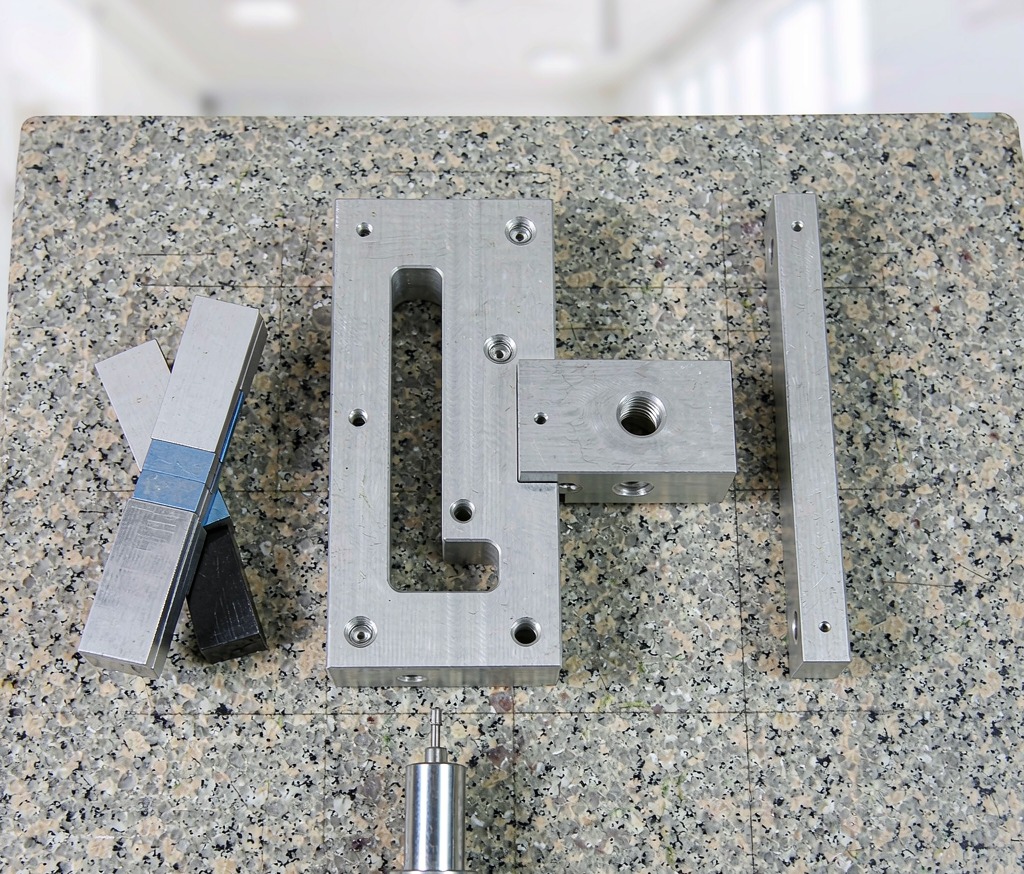
Reserve your tightest tolerances for features that truly affect function, and let everything else ride a general tolerance such as ISO 2768. Every unnecessary ±0.01 mm adds inspection, slows cutting, and raises cost. On surface grinding and CNC boring, tight tolerances on bores are worth it; on non-critical edges they are waste. Tolerances should protect fit, not decorate a drawing.
Frequently Asked Questions
What is tolerance stack-up analysis?
It is the calculation of how individual feature tolerances combine across an assembly dimension chain to predict the total possible variation in a gap, clearance, or interference.
When should I use worst-case instead of RSS?
Use worst-case for low-volume runs, safety-critical parts, or when features are not statistically independent. Use RSS for high-volume production where variation is well behaved.
Does GD&T help with stack-up?
Yes. Datum-referenced geometric tolerances constrain variation to a consistent reference frame, reducing the ambiguity and accumulated error of chained plus/minus dimensions.
How tight should my tolerances be?
Only as tight as function demands. Apply tight limits to mating, sealing, and bearing features, and use general tolerances elsewhere to control cost.
Let Us Review Your Drawing
A short DFM and stack-up review before production saves far more than it costs. Our engineers check your dimension chains, flag risk, and propose tolerances that assemble reliably. See our precision machining services for how we hold critical features and document them.
Ready to Start Your Project?
Get a build-ready quote on your custom metal parts within 24 hours. Share your drawing and our engineers will respond with process, lead time, and pricing.

