
A flawless anodize or plating job lives or dies at the step most people overlook: cleaning. Every machining mark leaves cutting fluid, every handling leaves skin oil, and every casting carries release agent. If those contaminants are still on the surface when the finish goes on, the coating peels, spots, or fails salt spray. Metal parts cleaning and degreasing is the unglamorous foundation of every good surface treatment. For buyers specifying finishing, understanding the cleaning step explains why two quotes at the same price can yield very different field performance.
It is also the step where cost is easiest to cut and quality is easiest to lose. A supplier who skips or rushes cleaning may still ship a part that looks fine on arrival, only for the coating to fail weeks later in the customer’s hands. Specifying the cleaning step protects you from that delayed, expensive surprise.
Why Cleaning Precedes Finishing
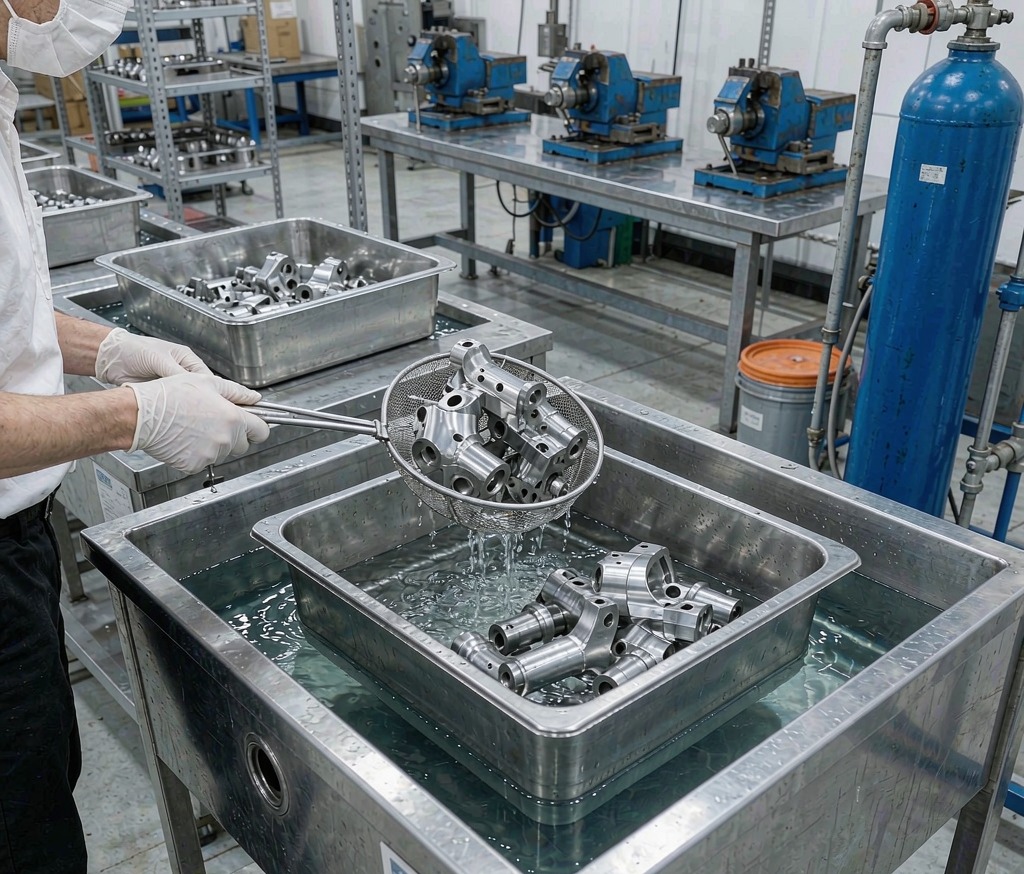
Coatings bond to a clean, active surface. Oil, grease, and particulate block that bond and trap corrosion underneath. A part that goes into anodizing with cutting fluid still on it will show dye streaks and weak oxide; a part sent to black oxide with shop soil will spot out. Cleaning is not optional prep, it is part of the spec. Our deburring and sandblasting steps often run right before cleaning so the surface is both smooth and bare.
Common Cleaning Methods
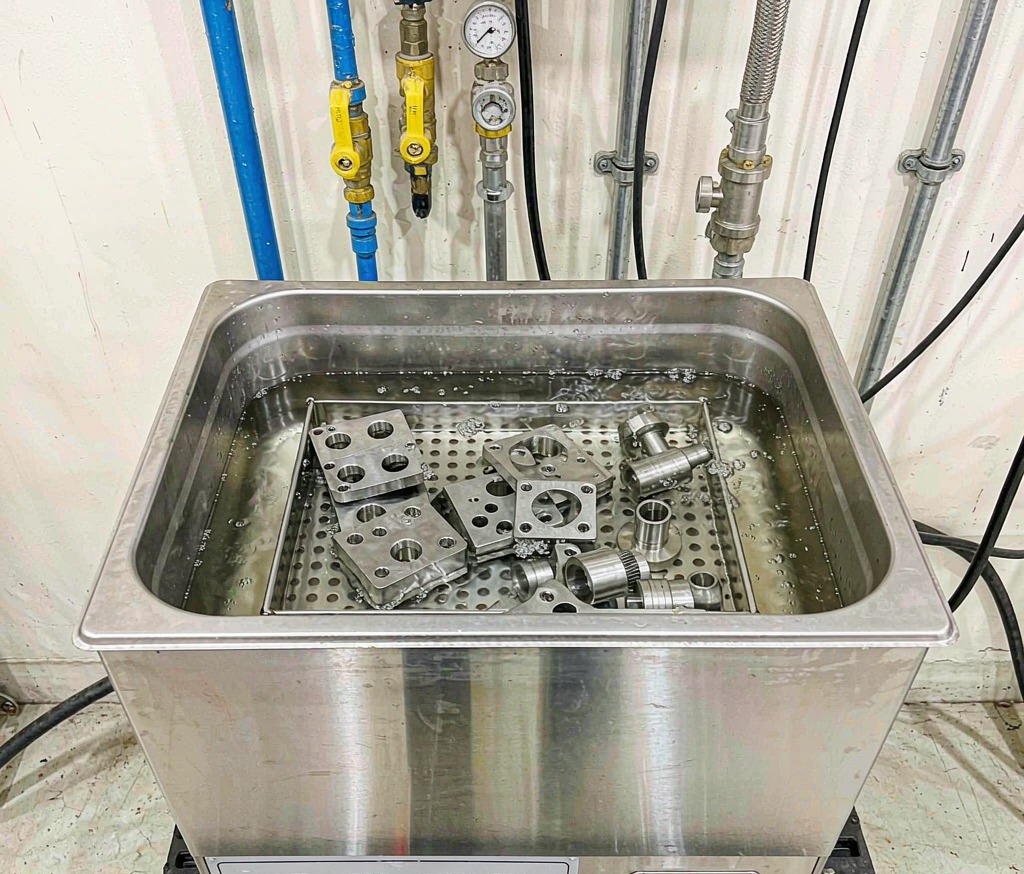
Alkaline degreasers dissolve oils, ultrasonic tanks agitate solvent or aqueous cleaners into blind holes and threads, and vapor degreasing handles precision parts. For stainless, a citric or nitric passivation doubles as a cleaner that also restores the passive film. Mechanical methods such as polishing and blasting remove both contaminant and surface, but the chemistry step still follows to clear residues. The method is matched to the soil and the base metal.
Ultrasonics deserve special mention for parts with threads, blind holes, and internal channels, exactly where contaminants hide and where a simple soak cannot reach. If your part has complex internal geometry, ask specifically whether ultrasonic cleaning is in the sequence.
Matching the Process to the Contaminant
Heavy machining oil calls for alkaline or solvent degreasing. Fine particulate after grinding needs rinsing and possibly ultrasonic action. Welded or cast parts carry scale and release agent that need stronger alkaline or acid steps. The wrong cleaner can stain or etch the substrate, so the sequence, pre-clean, wash, rinse, dry, is engineered per alloy. A clean, dry, fingerprint-free part is the only correct input to a finish.
Quality Checks Before Coating
Good shops verify cleanliness with a water-break test, a wipe, or a fluorescence check for residual oil, and they control the rinse water quality so spotting does not appear at the last second. Drying matters too: trapped water under a coating becomes a corrosion site. When cleaning is treated as a measured process rather than a rinse, the downstream anodize or plate adheres the first time.
Specifying Cleaning in the PO
The simplest protection is to write the cleaning requirement into the purchase order alongside the finish: which soils to remove, which method, and which acceptance check. A supplier who sees cleaning as a line item, not a courtesy, is far more likely to deliver a coating that survives salt spray.
Cleaning and Corrosion Resistance
Cleaning does more than help the coating stick, it also sets the floor for corrosion resistance. Residual chloride or sulfate from a poor rinse can sit under an anodize and seed filiform corrosion months later. That is why rinse-water quality and a final deionized stage matter, especially on architectural or marine aluminum. A supplier who controls the whole chain, clean, rinse, dry, finish, removes the handoffs where contamination sneaks back in, and the result is a finish that passes salt spray the first time.
Cleaning in Your Finishing Chain
Buyers should specify cleaning as part of the finishing purchase, not assume it. Our deburring services and sandblasting services notes cover the surface prep that pairs with cleaning, while our passivation services explain the stainless-specific clean-and-passivate sequence. For a mirror or sanitary surface, see our electropolishing services, which begins with the same contaminant-free requirement.
Frequently Asked Questions
Can I skip cleaning if the part looks clean?
No. Invisible cutting fluid and finger oils are exactly what cause finish failures. A visual check is not enough; the cleaning step must be specified and verified.
Does cleaning differ by alloy?
Yes. Aluminum, steel, and stainless each need compatible chemistries; the wrong cleaner can etch or stain. The sequence is set per material.
How is cleanliness verified?
Common checks are a water-break test, a white-glove wipe, or fluorescent oil detection, followed by controlled drying before the coating step.
Specify the Clean, Not Just the Coat
The finish is only as good as the surface beneath it. Write cleaning into the spec, and your anodize, plate, or paint finally holds the way the data sheet promises. The difference shows up months later, on the parts that are still intact.
When in doubt, ask the finisher to document the full sequence on the traveler, not just the coating name. A one-line record of clean, rinse, and dry lets you trace a future finish problem back to its cause instead of guessing, and it keeps the supplier accountable for the step that matters most.
Ready to Start Your Project?
Get a build-ready quote on your custom metal parts within 24 hours. Share your drawing and our engineers will respond with process, lead time, and pricing.

