
For parts that must survive shock loads, fatigue, and continuous stress, forged metal outperforms cast or machined stock because the grain flow follows the part’s shape. Among forging methods, drop forging remains the workhorse for strong, repeatable components. This guide explains what drop forging services deliver, how they compare to other forging routes, and where the process earns its keep on real production programs.
Drop Forging in One Minute
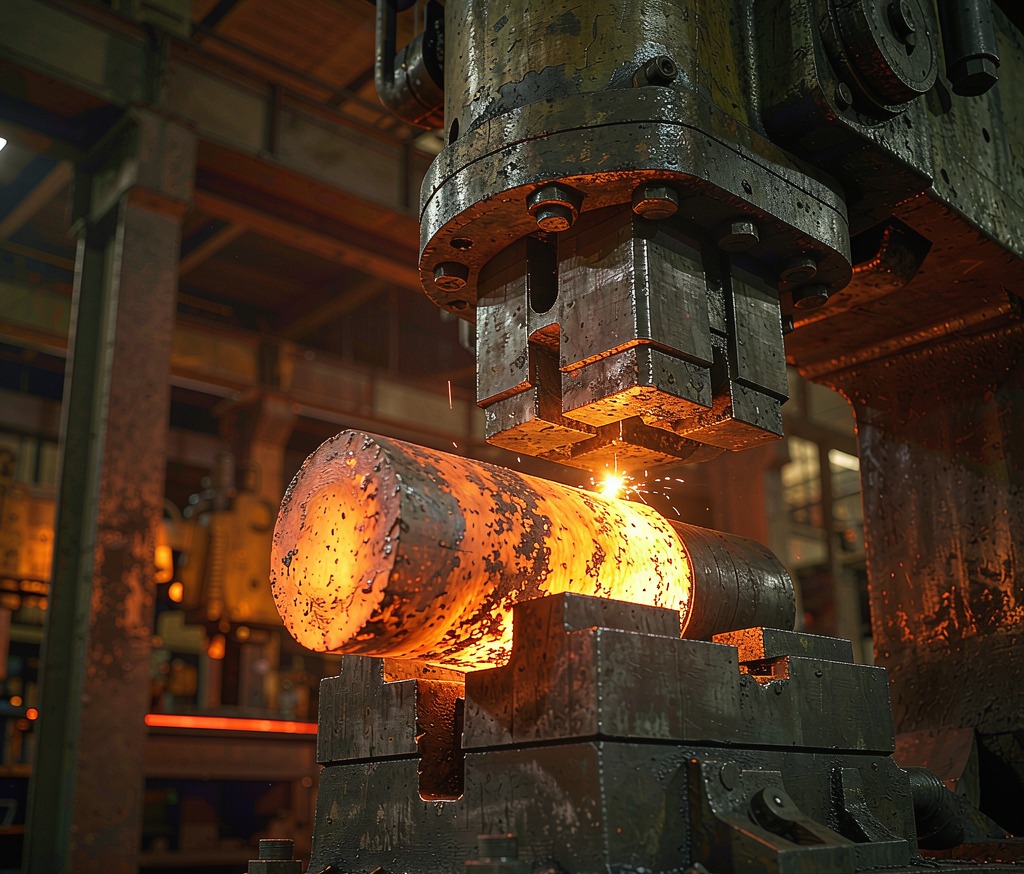
Drop forging shapes heated metal between dies by repeated hammer blows, consolidating the material and aligning its grain along the part contour. The result is higher strength-to-weight, better fatigue life, and fewer internal defects than sand casting. Our hot forging line runs both manual and automated hammers for runs of any size, and we control forging temperature tightly to keep the grain refined rather than coarse.
Drop Forging vs Closed-Die & Open-Die
Drop forging is a subset of impression-die (closed-die) forging, distinguished by the energy source—gravity or power hammers rather than presses. Closed-die forging gives tighter tolerances and less flash; open-die forging suits large, simple shapes. For high-volume precision parts, press forging often wins on consistency, but drop forging stays popular for its tooling economy and the fine surface it leaves on the finished component.
Our closed-die forging and open-die forging capabilities cover the full spectrum when drop forging is not the optimum route for your geometry or volume.
Best Applications for Drop Forged Parts
Think anything load-bearing: crankshafts, connecting rods, gears, flanges, hand tools, and oilfield hardware. Upset forging handles headed bolts and valves, while ring rolling produces seamless rings for bearings and flanges. The common thread is that failure is expensive, so the grain structure must be right. Forged parts simply do not fail the way castings do when a shock load arrives unexpectedly in the field.
Design Rules That Save Money
Forging needs draft angles, generous fillets, and balanced sections so the die fills without cold shuts. Designing for symmetry and avoiding thin-to-thick transitions cuts scrap and tool wear. After forging, parts usually go to heat treatment and then CNC turning or forging-plus-machining to hit final tolerances, because forging leaves a scaled surface that machining cleans up precisely.
Forging vs Casting: The Core Decision
Our forging vs casting guide lays out the trade-offs: forging wins on strength and fatigue; casting wins on complexity and unit cost for low volumes. Many programs start cast for prototyping, then move to metal forging services at production volume once the geometry is frozen and quantities justify the tooling investment.
Salvage, Rework & Life Extension
A lesser-known use of forging is restoring worn or undersized components by building them back up and reforging or machining to size. Combined with hard chrome or nitriding, forged-and-reconditioned shafts can outlast the original. This circular approach matters for expensive capital equipment where replacement lead times are long and downtime is measured in lost revenue.
Alloys, Tolerances & What Forging Can’t Do
Drop forging handles a wide range of ferrous and non-ferrous alloys, from low-carbon steel for simple brackets to stainless and titanium for corrosive or weight-sensitive service. Tolerances off the die are typically in the range of a few tenths of a millimeter, with final precision achieved by machining the forged envelope. What forging cannot do well is produce thin-walled, highly detailed internal cavities—that remains casting’s territory. The smartest programs therefore combine closed-die forging for the load path with machining and, where needed, ring rolling for seamless annular parts, getting strength where it counts and detail where it is needed.
Cost Model: Tooling vs Piece Price
Forging economics are dominated by die cost spread over the run. Below a few hundred pieces, the tooling can outweigh the per-part saving versus machining; above that, forging usually wins on material yield and labor. The crossover point depends on part complexity and the alloy, and we model it with you before committing so you invest in tooling only when the volume justifies it. For bridge volumes we can often use semi-hard tooling or adapt an existing die family to cut upfront cost. Our metal forging services team will tell you honestly when machining or casting is the cheaper route for your quantity rather than pushing forging by default.
Sustainability & Material Yield
Forging is also the greener option for many parts. Because the grain follows the shape, you need less material to achieve the same strength, and the near-net shape leaves less to machine away as swarf. That lower buy-to-fly ratio matters for both cost and carbon footprint, especially in automotive and off-road programs with sustainability targets. We recycle 100% of forge flash and turnings back into the supply chain, and we can document material yield for your environmental reporting. Where a part is later forged and machined, the machining is planned to remove only what is needed, preserving the grain benefit at the loaded sections.
Frequently Asked Questions
When should I choose drop forging?
When you need strength, fatigue resistance, and economy at moderate-to-high volumes, and the shape suits die impression.
What metals can be drop forged?
Carbon and alloy steels, stainless, titanium, and aluminum. Each needs its own forging temperature and die material.
How does it compare to machining from bar?
Forged parts have continuous grain and no weak cut faces, so they outlast machined bar stock under cyclic load.
What are typical lead times?
Tooling a few weeks; production parts follow quickly. Hot forging and upset forging run on shared lines for speed.
Can you machine the forgings too?
Yes—our forged steel parts program includes finish machining and inspection under one roof.
Ready to Start Your Project?
Get a build-ready quote on your custom metal parts within 24 hours. Share your drawing and our engineers will respond with process, lead time, and pricing.

