
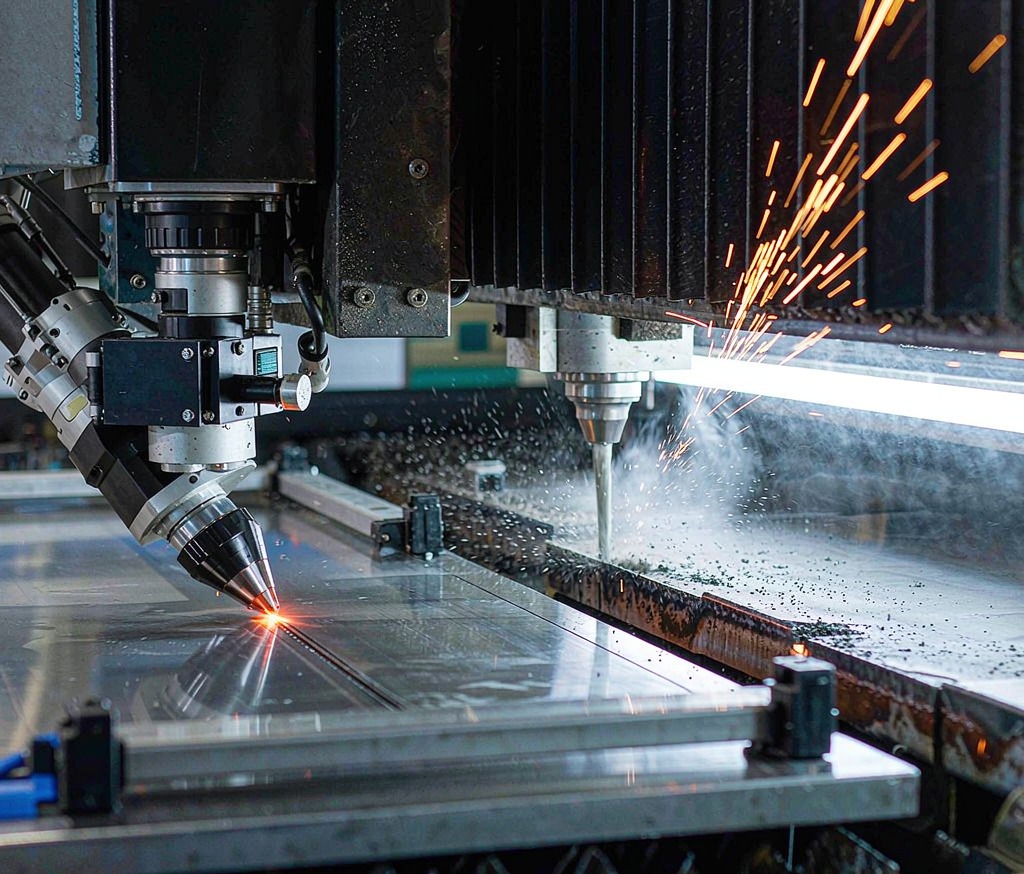
Cutting a flat plate to shape usually comes down to laser cutting vs waterjet. Both are non-contact, both handle sheet and plate, but they remove material in completely different ways — one with focused light, the other with pressurized abrasive slurry. The right pick depends on material, thickness, and how much edge quality matters, and confusing the two leads to either burned edges or an overspent cutting budget.
How Each Process Works
Fiber laser cutting melts and blows away metal with a concentrated beam; waterjet cutting erodes it with a high-pressure stream of water and garnet abrasive. No tooling touches the part in either case, which is why both are ideal for rapid prototyping and low setup cost compared with stamped or punched blanks.
Because neither uses a physical die, you can change a profile by editing a file. That makes both processes perfect for low-volume or one-off plates where CNC punching would not be justified by quantity.
Edge Quality and Finish
Laser leaves a clean, slightly oxidized kerf that is excellent for most fabrication and welds well after light prep. Waterjet leaves a satin, burr-free edge with no heat tint — ideal when the cut face is a visible or bonded surface. For thin sheet, both are superb; for thick plate, waterjet edges stay square while laser can taper and dross may form on the bottom edge.
Material Thickness Limits
Laser is fastest and cleanest on thin-to-medium sheet (up to ~20 mm steel, less for reflective metals). Waterjet cuts from foil to over 200 mm in almost any material, including CO2 laser-resistant reflective alloys and stone or composites that lasers cannot touch. If your part is thick or exotic, waterjet is often the only cold option.
Heat Affected Zone
Laser introduces a small heat-affected zone that can harden edges or stress thin parts, sometimes requiring stress relief before bending. Waterjet is cold — zero thermal distortion, which matters for tight-tolerance sheet metal laser cut blanks that will be formed afterward, because a flat blank stays flat through the cut.
Cost and Speed
Laser is cheaper and faster on thin sheet at volume. Waterjet costs more per minute but wins on thick, exotic, or heat-sensitive materials where laser would need multiple passes. Our plasma cutting line handles even heavier plate where raw cut speed beats edge finish, rounding out the three thermal and hydraulic options.
Choosing the Right Cutter
For thin, reflective-light, high-volume sheet, laser is the workhorse. For thick plate, heat-sensitive alloys, or a cold burr-free edge, waterjet is the better tool. Our laser vs plasma guide helps when plasma enters the conversation, and the laser cutting services page details our fiber capacity.
Tolerances You Can Actually Hold
Both methods are often quoted at ±0.1 mm, but the real story is edge squareness and repeatability. Laser narrows slightly on thick plate and can leave a taper of a degree or two; waterjet stays near-vertical through the full thickness. For parts that will be welded or stacked, that squareness decides whether you need a secondary op.
If your drawing calls for a finished hole pattern, neither process taps threads — you would send the blank to CNC machining services for the holes. Planning that combined route up front keeps the per-part cost predictable instead of discovering it after the first batch.
Nesting and Material Utilization
On thin sheet, nesting efficiency often decides the true cost more than the cut speed. Laser’s narrow kerf lets you pack parts tighter, raising yield per sheet, while waterjet’s wider kerf and abrasive stream need more spacing. For a run of thousands of small brackets, that yield difference can outweigh the per-minute rate.
If the alloy is pricey, ask for a nested layout quote from both methods. A slightly slower waterjet on a better-packed sheet can still beat a fast laser on a poorly nested one, and the cold edge may remove a separate deburring operation from the routing.
When to Use Both
Some shops run laser and waterjet side by side, routing thin reflective sheet to laser and thick or heat-sensitive plate to waterjet from the same nest files. If your product mix spans both, ask for a vendor that owns both so the process choice is technical rather than forced by a single machine. That flexibility often lowers total cost more than squeezing one method.
Edge Prep Before Welding
If the cut part will be welded, edge condition drives rework. Laser edges usually need only a light wipe; waterjet edges are clean but may carry a faint abrasive residue that should be rinsed before welding to avoid porosity. Neither needs the heavy grind a plasma cut demands, which is why both beat thermal cutting when the joint is critical and the inspector is strict.
FAQ
Does waterjet distort thin parts?
No — it is a cold process with no heat-affected zone, so thin sheets stay flat and stress-free.
Which is faster on 3 mm steel?
Laser, by a wide margin, especially across many identical blanks where pierce time dominates waterjet.
Can waterjet cut aluminum?
Yes, and without the reflectivity problems that challenge laser cutting services on some setups, since there is no beam to reflect.
Ready to Start Your Project?
Get a build-ready quote on your custom metal parts within 24 hours. Share your drawing and our engineers will respond with process, lead time, and pricing.

