
When off-the-shelf enclosures will not fit your electronics, sensor, or control package, custom metal boxes give you the exact footprint, mounting, and ingress protection you need. We build boxes and enclosures from steel, stainless, and aluminum using laser cutting, press braking, and welding, then finish them to survive the environment they live in. The result is a housing that looks engineered and protects what is inside.
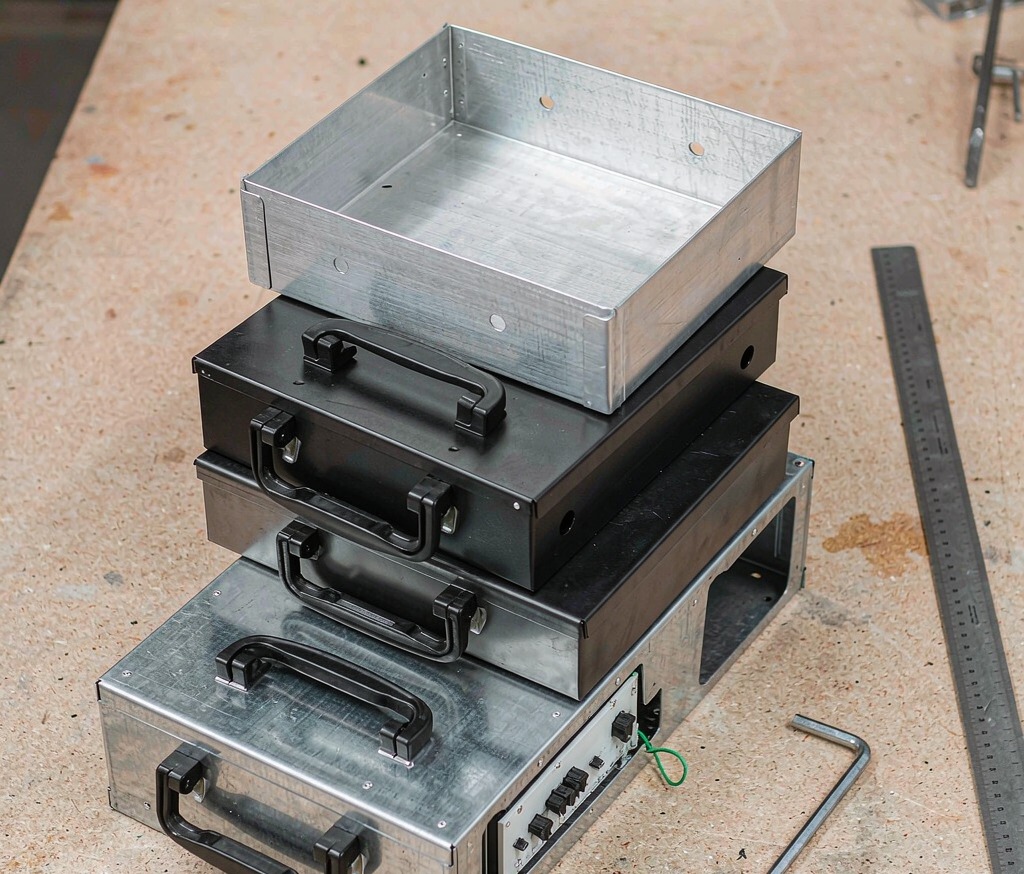
Types of Custom Metal Boxes
The family ranges from simple junction boxes and instrument cases to rack-mount chassis and IP-rated outdoor enclosures. Some need only a folded shell with a lid; others need internal brackets, EMI gaskets, and cable glands. If you need a deeper or more complex shell, our custom metal enclosures program covers NEMA and IP-rated designs, while custom metal housings handle sealed sensor and actuator bodies.
Boxes also vary by how they open and mount. A wall-mounted terminal box wants a hinged or screw lid and conduit entries; a bench instrument wants a removable top and feet; a field device wants a gasketed sealed lid and tamper screws. Defining the access and mounting early keeps the fabrication simple and the seal reliable.
Material Choices
Cold-rolled steel is economical and easy to paint, making it the default for indoor boxes. Stainless (304/316) resists corrosion in washdown and outdoor duty. Aluminum keeps weight down for portable and aerospace-adjacent gear. Material also sets the cut and bend strategy: we use sheet metal laser cutting for clean, burr-free edges and CNC bending for crisp, repeatable folds.
Fabrication: Cut, Bend, Weld
A typical box starts as a flat blank cut on the laser, then bent into a U or tray, with corners closed by welding. We choose the joining method by appearance and strength: MIG welding for speed on steel, TIG welding for a clean, cosmetic seam on stainless and aluminum. Lids, hinges, and mounting feet are added in the same cell so the box arrives as one finished assembly rather than a kit of parts.
Finishing and Sealing
Finish is where a box earns its rating. Powder coat gives a durable, attractive skin and is our default for most enclosures via powder coating; hot-dip galvanizing suits heavy outdoor and structural boxes. For water and dust protection we add gaskets, continuous welds, and sealed lids, and we can screen-print labels and logos with silk screening. The goal is a consistent seal path so the stated IP or NEMA rating is real, not just claimed.
Design Tips for Enclosures
Design for manufacture: keep bend radii consistent, avoid weld access conflicts at corners, and place hole patterns so they clear the laser’s pierce limits. Call out flatness and hole true-position, and decide early whether you need EMI shielding or just environmental sealing. Our sheet metal fabrication and custom metal fabrication teams can review your drawing for DFM before cutting, which saves rework on the first article.
Ordering and Lead Time
Send a drawing, target quantity, material, and finish. Prototypes can ship in days; production runs are scheduled against your build plan. Because we cut, form, weld, finish, and inspect in one flow, a custom metal box is usually faster and cheaper than you expect compared with a multi-vendor chain, and every unit matches the approved sample.
From Prototype to Production Run
Most box programs start with a single prototype to prove fit and sealing, then scale to a recurring production order. We keep the same drawings and tooling between stages, so the prototype you approve is exactly what the production run reproduces. For recurring builds we can hold finished-goods inventory or ship on a Kanban schedule tied to your assembly line, which smooths your receiving and frees floor space.
Documentation is part of the product: material certs, finish specs, and inspection records travel with the boxes so your quality team can trace every batch. That traceability matters most in regulated industries where an enclosure failure is not just inconvenient but audit-relevant, and it is built into how we release each order.
Lead time depends mostly on finish and volume. A simple painted steel box can turn around in days; a stainless, gasketed, IP-rated enclosure with custom cutouts takes longer because of welding and cure cycles. Tell us your needed date and we will sequence cutting, welding, finishing, and QA to hit it, and we can stage deliveries so you receive boxes in step with your own production schedule rather than all at once.
Frequently Asked Questions
What ingress rating can you achieve?
With continuous welds, gaskets, and sealed lids we regularly build to IP65/IP66 for outdoor and washdown use. The exact rating depends on the design and how the lid and glands seal.
Steel or aluminum for an outdoor box?
Aluminum is lighter and naturally corrosion-resistant; stainless is best for harsh or coastal duty; galvanized steel is the budget option for heavy fixed installations.
Can you add cutouts and threaded inserts?
Yes. We punch or laser cut connector cutouts, and we can weld or press in threaded inserts, studs, and standoffs so your internals mount cleanly.
Do you assemble the internals too?
We focus on the metal enclosure, but we can add simple hardware, gaskets, and labels. For full box-build we coordinate with your assembly team.
Ready to Start Your Project?
Get a build-ready quote on your custom metal parts within 24 hours. Share your drawing and our engineers will respond with process, lead time, and pricing.

