
When you need a metal part produced at scale, the oldest question in procurement keeps coming back: sand casting or die casting? Both turn molten metal into a solid shape, but they differ so sharply in tooling cost, volume economics, material range and surface quality that picking wrong can add real money to every unit you buy. This guide breaks the decision down the way our engineering team does it with customers — by production volume, part size, tolerance and budget — so you can brief your supplier with confidence.
What Each Process Actually Does
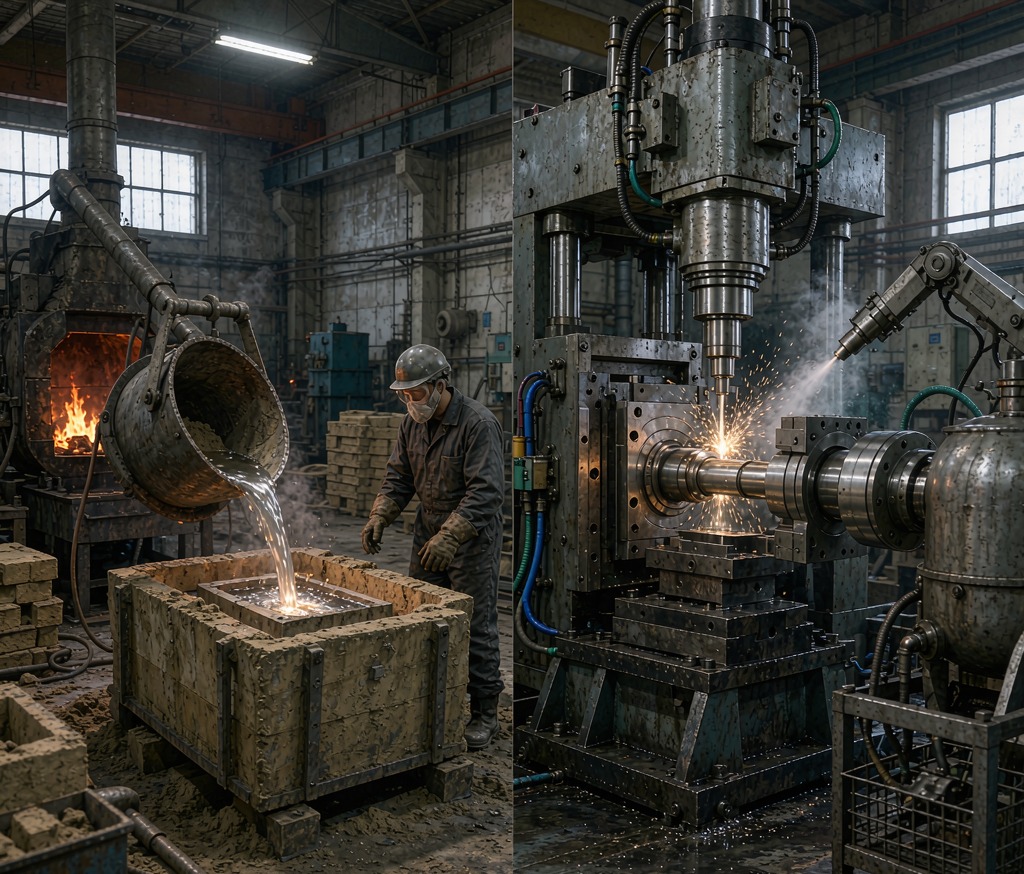
Sand casting packs a reusable pattern into bonded sand to form a mold cavity, pours molten metal, lets it solidify, then breaks the sand away. The mold is consumed every cycle, which is exactly why tooling stays cheap. Die casting instead forces molten metal under high pressure into a hardened steel die that lasts for hundreds of thousands of shots. That reusable die is the source of die casting’s speed and precision — and its high upfront cost. If you want the full picture on the casting family, our metal casting overview maps every process we run.
Tooling and Setup Cost
This is usually the first filter. A sand casting pattern and gating rig can cost a few hundred to a few thousand dollars, and it is ready in days. A die casting die is machined from tool steel, often with integrated cooling lines and ejector systems, and typically runs from five figures into six for a complex multi-cavity tool. For a prototype or a short custom run, sand casting is almost always the cheaper entry. The trade-off shows up only when volume climbs.
Production Volume and Economics
Die casting wins decisively at volume. Because cycle times are measured in seconds to minutes and finishing is minimal, the per-unit cost collapses once the tool is paid off. Most suppliers point to a break-even around 1,000 to 5,000 parts per year, depending on complexity. Below that, sand casting’s low setup keeps total cost lower. Above it, die casting’s speed and repeatability dominate. We see this trade-off constantly when helping teams choose between gravity casting and high-pressure routes for enclosures and brackets.
Material and Size Flexibility
Sand casting is the more flexible of the two. It handles iron, steel, stainless, aluminum, brass, bronze and magnesium, and it is the only practical route for very large parts — engine blocks, valve bodies, frames and counterweights measured in meters. Die casting is largely limited to low-melting non-ferrous alloys (aluminum, zinc, magnesium) because steel tooling cannot survive the heat of ferrous melts. If your part is big, ferrous or likely to change, sand casting is the safer call.
Dimensional Accuracy and Surface Finish
Die casting delivers tight tolerances (commonly IT10–IT13) and a smooth as-cast surface that often needs no machining beyond drilled holes. Sand casting is rougher and less repeatable shot to shot, so critical faces usually get CNC milling or CNC turning after casting. That extra machining is not a failure of sand casting — it is simply part of the cost model you should budget for. Our heat treatment and finishing services often pair with both routes.
Lead Time and Design Changes
Sand casting patterns can be revised quickly, so it suits development phases where the design is still moving. Die casting tooling is a capital commitment: every change means re-machining steel. If you expect more than one revision, sand casting protects you from expensive tool rework. Teams weighing casting against other forming methods also read our investment casting guide for thin-wall, high-detail work.
How to Decide for Your Part
Use this quick rule of thumb: choose sand casting for low-to-medium volume, large or ferrous parts, frequent design changes, or when tooling budget is tight. Choose die casting for high volume, non-ferrous alloys, thin walls and the smoothest possible finish at the lowest per-part cost. Many programs actually use both — sand cast the prototype, then move to die casting once the design freezes.
Frequently Asked Questions
Which is cheaper overall? Sand casting is cheaper at low volume and for prototypes; die casting is cheaper per unit once you pass the tooling break-even, typically a few thousand parts a year.
Can die casting handle steel? Generally no. Die casting is confined to lower-melting alloys like aluminum, zinc and magnesium. Steel and stainless are sand cast or investment cast.
Which gives better surface finish? Die casting, by a wide margin, often needing no secondary finishing. Sand cast parts usually need machining on functional surfaces.
Can I switch processes later? Yes. Many teams sand cast during development, then transition to die casting for production once the geometry is locked.
Ready to Start Your Project?
Get a build-ready quote on your custom metal parts within 24 hours. Share your drawing and our engineers will respond with process, lead time, and pricing.

