
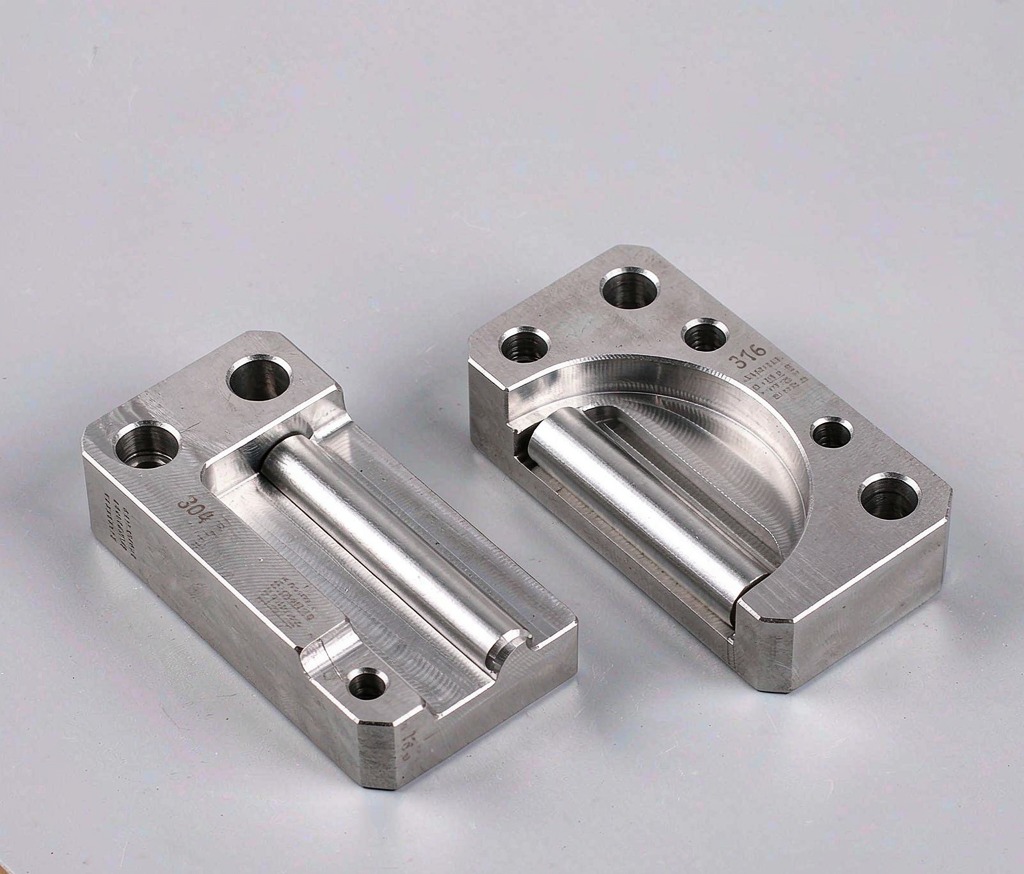
The most common stainless question we field from buyers is 304 vs 316 stainless steel. Both are 18-8 austenitics, both machine, bend, and weld similarly, and both are non-magnetic in the annealed state. The entire difference comes down to one alloying element—molybdenum—and whether your part will ever see chlorides. This guide explains when 316’s premium is money well spent and when 304 is the smarter default for CNC machined and fabricated components.
Composition: The Molybdenum Difference
304 contains about 18% chromium and 8% nickel with no deliberate molybdenum. 316 adds roughly 2–3% molybdenum, which sharply improves resistance to pitting and crevice corrosion in chloride-rich environments. Mechanically the two are close: 304 reaches about 85 ksi ultimate tensile strength, 316 about 75 ksi, with near-identical modulus and melting point. For most structural calculations the grades are interchangeable; the decision is driven by environment, not strength. Our stainless steel machining overview covers cutting strategy for both.
Corrosion Resistance in Real Environments
304 is excellent in normal atmosphere, fresh water, and food service, but coastal spray, road salt, and bleach or brine wash-downs will eventually pit it. 316 is the textbook “marine stainless”: its molybdenum content blocks chloride attack in salt air, seawater, and aggressive sanitizing cycles. If a part lives outdoors within a few kilometers of the coast, or sees frequent chlorinated cleaning, 316 pays for itself. For deeper grade-specific guidance, see our posts on 304 stainless steel machining and 316 stainless steel machining.
Mechanical Strength and Machinability
In the annealed condition 304 is marginally stronger, but the gap is irrelevant for the vast majority of parts. Both work-harden during machining, so sharp tooling, positive rake angles, and controlled feeds matter more than grade choice. Expect similar cycle times on CNC milling and CNC turning centers. The bigger variable is finish: 316’s slight stickiness can demand a touch more attention to surface quality on tight-tolerance features.
Welding and Finishing Behavior
Both grades weld cleanly with standard processes. After machining, passivation is recommended to restore the chromium-rich surface film and maximize corrosion resistance—our passivation service is routinely applied to 316 in particular. Note that welding 316 in marine service should use a 316L or 317L filler to avoid sensitization. Heat treatment of austenitics does not harden them, but stress-relief via our heat treatment process can improve dimensional stability on thin-walled parts.
Cost and Availability
316 carries a clear price premium—often 30–60% above 304 depending on form and market—because molybdenum is expensive. 304 is the default for a reason: it covers the overwhelming majority of indoor, fresh-water, and food-contact uses at the best cost. Buy 316 only where the environment demands it; buying it “just in case” is usually wasted spend. For components that also need tight flatness or fine finishes, our surface grinding and black oxide options round out the process chain.
Choosing 304 or 316 by Application
Default to 304 for commercial kitchens, indoor railings, enclosures, machine guards, dairy and standard wash-down, and any dry indoor structural part. Step up to 316 for marine hardware, coastal brackets and panels, chemical and pharmaceutical processing, food lines using chlorinated sanitizers, and anything exposed to road salt. When thickness exceeds about 1/8″ and 316 stock is unavailable, the question becomes moot—it is 304. For bracket and flange geometries our custom metal brackets and custom metal flanges references show typical designs.
Frequently Asked Questions
Which is more corrosion resistant, 304 or 316?
316, decisively, in chloride environments thanks to its molybdenum content. In ordinary atmosphere and fresh water the two perform similarly.
Is 316 worth the extra cost?
Only where chlorides are present—salt air, seawater, road salt, or aggressive sanitizers. Otherwise 304 is the cost-effective choice.
Do 304 and 316 machine the same?
Nearly. Both work-harden and need sharp tooling; 316 is slightly stickier but cycle times are comparable.
Should I passivate after machining?
Yes for corrosion-critical parts, especially 316 in marine or chemical service, to restore the passive film.
Ready to Start Your Project?
Get a build-ready quote on your custom metal parts within 24 hours. Share your drawing and our engineers will respond with process, lead time, and pricing.

