
Electric vehicles are reshaping how metal components are designed, sourced, and manufactured. Unlike internal-combustion platforms, EVs concentrate demand on lightweight structural assemblies, high-density battery hardware, and precision thermal-management parts. For procurement and engineering teams, the challenge is finding a supplier that can hold tight tolerances on aluminum and high-strength steel while scaling from prototype to high-volume production without compromising safety or cost.
Why EV Metal Parts Are Different
An electric powertrain removes the engine block, exhaust system, and fuel tank but adds a large battery enclosure, traction-motor housings, and power-electronics brackets. Every kilogram saved directly extends driving range, so designers push for thin-wall aluminum castings and extruded profiles rather than heavy stamped steel. At the same time, these parts must meet crash, thermal-runaway, and EMI-shielding requirements that simply did not exist in a conventional vehicle. Our aluminum extrusion services and die casting services are built for exactly these lightweight, high-integrity applications where geometry and weight are in constant tension.
Structural & Chassis Components
EV chassis subframes, crash rails, and battery-tray frames demand dimensional stability under load and predictable energy absorption in a collision. CNC milling finishes critical mating surfaces after casting or extrusion, while CNC turning produces the precise bushings and spacers that locate modules within the pack. Teams planning a new platform should review our custom metal chassis guide for design-for-manufacture recommendations that cut both weight and cost before tooling is committed.
Battery Enclosure & Thermal Hardware
The battery pack is the single largest metal assembly in most EVs. Enclosure walls, cooling-plate manifolds, and busbar supports require leak-tight welds and consistent wall thickness to keep cells safe and cool. We combine extrusion, powder coating for corrosion resistance, and heat treatment where strength is critical. See how this hardware fits into a full program in our EV battery metal parts overview, which details cell-to-pack structures and thermal-runaway barriers.
Motor & Power-Electronics Mounting
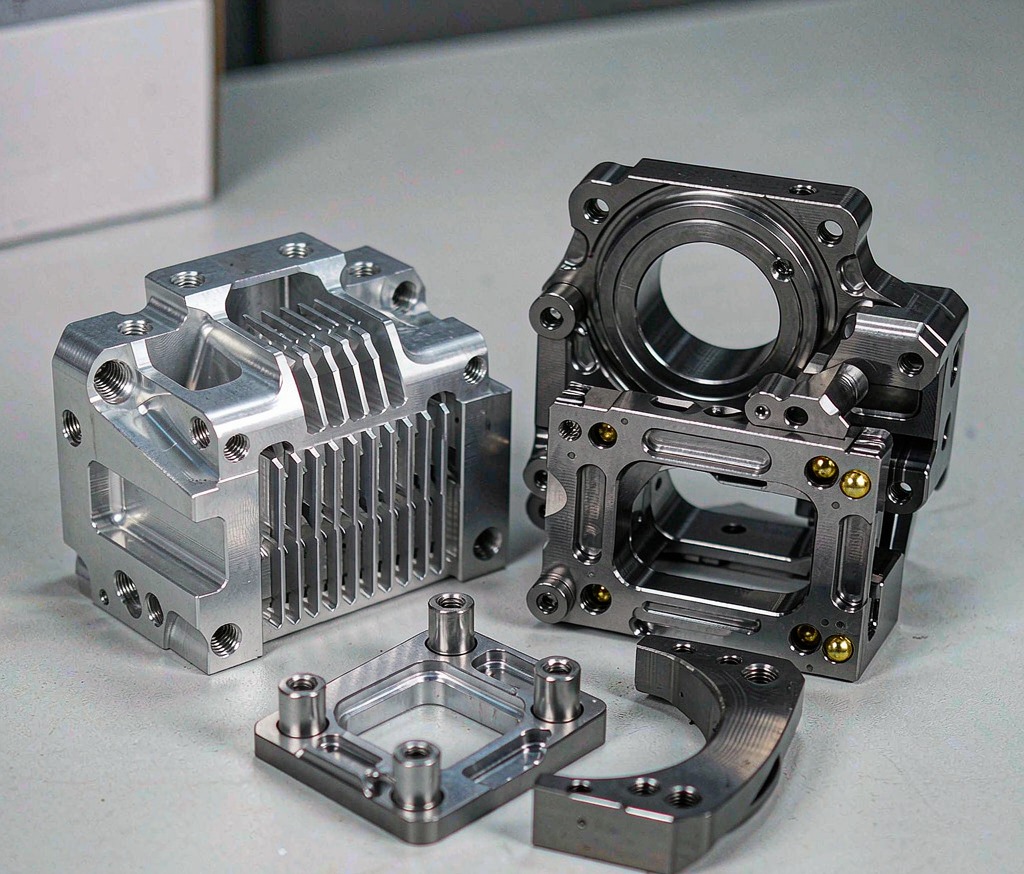
Traction-motor housings, inverter brackets, and onboard-charger enclosures need flat, true mounting faces and tight bore accuracy so that rotors spin true and heat sinks seat correctly. Multi-axis machining delivers this repeatably across thousands of units. Our related automotive metal parts article covers the broader supplier checklist for vehicle programs, from PPAP documentation to production ramp planning.
Material & Process Selection
Aluminum 6000 and 7000 series dominate structural and thermal parts because of their strength-to-weight ratio and thermal conductivity; high-strength low-alloy steel appears in safety-critical members where stiffness outweighs weight. The choice between cast, extruded, and machined-from-billet is a trade-off between tooling cost, production volume, and geometric freedom. A short DFM review early in the program prevents expensive re-tooling later and often identifies where a simpler geometry saves more than a premium alloy would.
Lightweighting Without Compromise
Lightweighting is not only about material substitution; it is about integrating functions. Combining a cooling channel and a structural rail into one extruded profile removes joints, fasteners, and potential leak paths. Our extrusion capabilities support complex hollow profiles, while secondary milling adds the precision features mass production demands. The result is a lighter assembly with fewer failure points and a lower total landed cost.
Qualifying a Production Partner
Ask for PPAP documentation, material certifications, and a documented inspection workflow that includes CMM measurement, gauging, and leak testing where relevant. Capacity to scale from fifty prototypes to fifty thousand units matters more than the lowest unit price on a quote sheet, because a partner who cannot hold the process window will cost far more in scrap and field failures. Visit the line if possible, or request process capability studies for the features you care about most.
Cost Drivers in EV Metal Programs
The biggest cost levers are not the metal itself but the number of setups, the scrap rate, and how much finishing the geometry demands. Designing parts that machine in fewer operations, or that can be extruded rather than five-axis milled, often cuts unit cost more than negotiating the alloy price. Early collaboration with a supplier who runs both processes lets you choose the route that fits the volume curve of your program rather than the tooling they happen to own.
Sustainability & Recyclability
Automakers face rising pressure to report embedded carbon, and aluminum’s recyclability is a genuine advantage when sourced and processed responsibly. Closed-loop scrap recovery in casting and extrusion reduces both cost and footprint. Specifying alloys with high recycled content where performance allows strengthens your sustainability reporting without compromising the structural or thermal properties the application requires.
Working With Your Supplier Early
The savings in an EV program come from decisions made before the first part is cut. Sharing your pack architecture, target weight, and volume forecast lets a supplier propose the right mix of extrusion, casting, and machining instead of defaulting to the most familiar process. This early conversation often surfaces a simpler geometry that meets the requirement at a lower cost, and it aligns both teams on the inspection and traceability the program will demand as volumes climb toward production.
Inspection & Documentation
As EV parts move from prototype to production, documentation becomes as important as the part itself. Material certificates, first-article reports, and CMM data should travel with every shipment so issues can be traced quickly. Build this expectation into the supplier agreement from the start; a partner accustomed to automotive discipline will provide it without friction, while one unused to it will slow your entire launch while scrambling to produce records after the fact.
Frequently Asked Questions
What materials are best for EV battery enclosures?
Aluminum extrusions and die-castings, such as AlSi10Mg-class alloys, are preferred for weight and thermal conductivity, with steel used where crash stiffness is paramount and cost permits.
Can one supplier handle prototyping and production?
Yes. A partner with both CNC machining and casting or extrusion capabilities can carry a part from first-article prototype through high-volume runs without re-sourcing and the risk that entails.
How are EV parts protected from corrosion?
Powder coating, anodizing, and targeted plating are standard; sealing and gasketing manage IP ratings for pack and electronics enclosures exposed to road spray.
What tolerances are typical for motor housings?
Bearing bores are commonly held to ±0.01 to 0.02 mm and mounting faces to ±0.05 mm, with both verified by coordinate measuring machine inspection.
Ready to Start Your Project?
Get a build-ready quote on your custom metal parts within 24 hours. Share your drawing and our engineers will respond with process, lead time, and pricing.

